
An Alternative Christmas
An excerpt from an alternative history novel about the end of slavery in 1778

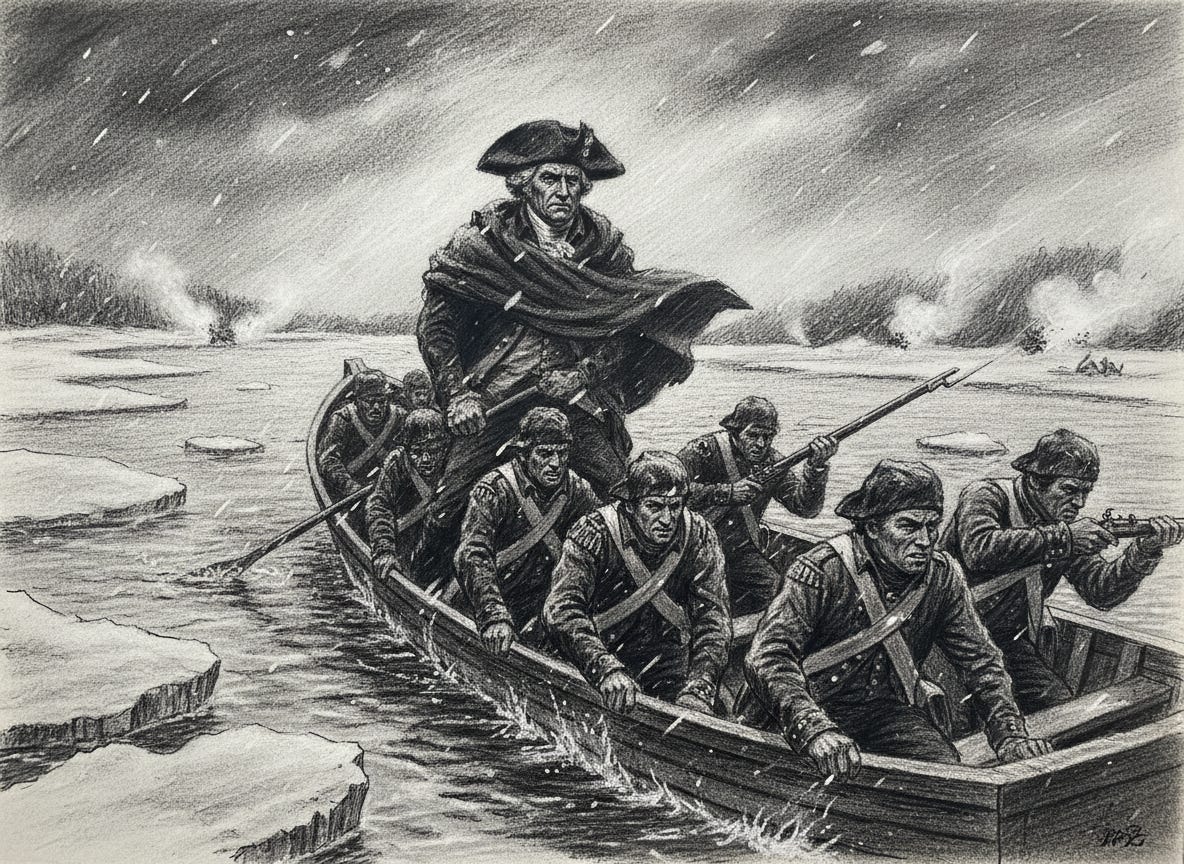
This is a sample chapter from the first part of Restive Souls, an alternative history novel about a North America that sees slavery ended in the late 1700s and experiences no further indigenous ethnic cleansing from that point as a powerful Black nation rises in the Carolina Low Country. There may be some grammatical miscues and other minor mishaps in this version not in the final version targeted for publication.
This chapter begins with the narrator, Guillaume Diderot, a free Haitian who has befriended American spy John Honeyman, describing a tense prequel to Washington’s expected approach. Diderot has, by this point in the story, become a key player in the cause for the British as a local guerrilla leader.
Honeyman has been tasked by George Washington with spycraft in support of the Christmas attack on Trenton from across the Delaware River.
Honeyman was a spy for Washington in our timeline, but in the Restive Souls timeline, his loyalties are in question after his new friendship with Diderot, who seems to have convinced him that a British victory would result in the freeing of slaves, which Honeyman would like.
Colonel Shepherd is a British colonel on site to command a local platoon.
Bolo’s Notes are made by a fictional historian, Emmet Bolo, who annotates the story with historical facts, trivia, and notes.
Trigger warning: Subversive!
This excerpt will be paywalled within a week or so.
Restive Souls
Part One, Ye Old Seeds of Flame
An Excerpt from Diderot’s Tale: 1776
On Christmas Eve, Colonel Shepherd established pickets north and south of our encampment. This maneuver, I knew, would have the unfortunate effect of ensnaring us in battle.
It may have made some sense to some for the British and their Hessian allies to attack Washington as he crossed the Delaware, but they couldn’t know the precise time this would happen, and Colonel Shepherd informed me that the Hessians were convinced that Washington would get across the river, thinking his attack on Trenton was the surprise he considered it to be.
Any number of things could ruin our plans, most of which revolved around Honeyman. It was possible that he could inform Washington that the Hessians were ready for his attack. It was also possible that, instead, the attack would not come on Christmas or Christmas Eve as we expected. Troops could not be expected to huddle in redoubts for days on end in winter.
Such considerations expose the gamble that a military adventure can sometimes face. Decisions must be made. The importance and opportunity of capturing or killing George Washington was supremely unique, but obtaining precise information regarding his next move was like catching a snowflake in a tempestuous wind.
Colonel Shepherd informed us that Cornwallis had presumed Washington’s attack would occur on Christmas night. Mr. Candy had supplied the Hessian regiments with beer containing the lower alcohol content I had requested. This was another form of insurance. Even if the Hessians were to overindulge on Christmas Eve, they would not be wretched military men the next day.
I still didn’t know if von Donop had found his way down to Trenton to take charge of the regiments, or if instead he had succumbed to Betsy Ross’s charms. His presence would make it more likely that the Hessians would refrain from holiday celebration, although it seemed Shepherd was gaining favor. Some of his conversations led me to even wonder if he had been given oversight of the Hessians.
The gamble and the decision meant that Washington, if he attacked on Christmas Eve, would in all probability be turned back, but the possibility of capturing or killing him was small.
Mostly, the British wanted to turn away the rebels, who had been in full retreat and were demoralized. A British victory in Trenton would likely give final credence to the notion that the rebellion was a lost cause.
If our gamble was correct and Washington attacked on Christmas Day, the Hessian and British troops had a more complete ambush planned than if he attacked on Christmas Eve. Weather conditions were deteriorating such that it wouldn’t be possible to establish positions for longer than 24 hours.
Thus did Christmas Eve arrive silently. It left us the same way, to a cold, wet morning filled with dancing snowflakes bandied about by mild winds. British pickets established north of our encampment reported no movement anywhere along that part of the Delaware.
From further south came similar reports. There were fewer scouts south, because Honeyman had stated that Washington would cross the Delaware near a ferry north of our settlement.
Christmas saw no celebration, only tense anticipation.
Shock Christmas special!
Shepherd’s platoon moved north of our encampment that morning. The movement surprised me. I knew it was not for our protection. Rooting for a British victory did not mislead me into thinking we were allies. My conclusion was that the British or Hessians had received new intelligence, possibly from Honeyman.
We would soon discover the truth underlying Honeyman’s loyalties, such as they were.
Many in the encampment had left, seeking shelter by participating in raids against local slave ranchers. There were four women in camp, including Oo-reeh. A few of the other women had also left to participate in raids.
The women in our camp were capable with weapons. Oo-reeh, too, knew the musket. She had said when she began to reveal details of her troubles in the forest, “It was just a warning shot. I coulda shot your head off.” Kanatsoyh was amused until she demonstrated her shooting ability against a rabbit running through some brush.
“Stew meat,” she said with a proud grin. Kanatsoyh stared at her, astonished.
The day drifted on. As it did, I knew the sentries would begin to grow weary at their various posts. I took sleep in the afternoon, convinced that Washington would attempt a nighttime crossing.
Kanatsoyh and Sacareesa were encamped. Jacob Longfish returned from a raid with a slave man in tow after dusk. The slave man, who called himself Jimbo, had a fine musket that looked like it had never been fired.
Jimbo was the tallest man I had ever seen, with a body that looked like the thinnest surviving tree trunk from a scorching forest fire, and brown hair with the small, frenzied curls of an African. Something about the man struck me instantly. A warmth in his eyes, perhaps, very nearly a light stationed above his head as if he was blessed with angelic features. He spoke very little English.
“How will he know what to do?” I asked Longfish.
Longfish pointed to his horse. “He rode here with me on that horse he stole from the ranch as if he had lived atop the horse his entire life,” said Jacob. “He shall know what to do. He is guided by Gauh-dee-keh-raw-Kwest.” I looked at him blankly. “The Good Spirit,” he added.
As predicted, Jimbo went about helping around the camp everywhere he could. We had begun building a rough fortification at the edge of the tree line that began the cluster of trees protecting our small settlement.
It was not as fully secured as a redoubt, because the cold had hardened the ground too much to build a significant trench, but we had the good fortune of a fallen tree, probably the victim of a lightning strike, and several of the men had spent the past day and a half hacking at it with axes and stacking heavy logs into a circle, which was camouflaged with brush.
Any military man on close approach would quickly discover its purpose, but it was better than nothing. One of the men had mastered the art of planting angled spikes within the wood casement. I was astonished at its ingenuity.
“You here tonight,” Jimbo said to me, as if delivering a command. He touched the Ferguson hanging from my shoulder. “Not enough.” He pointed to a quiver of arrows and a bow leaning on a nearby rock, then touched my gun again. “Not enough!” he said loudly. “No good!”
Then his tall, spindly legs bounded over to the arrows and bow. He picked them up and handed them to me on his return. He pushed them into my chest and nodded his head. When I nodded and slung the quiver over my other shoulder, feeling quite burdened, Jimbo smiled grandly, revealing gritty, darkened teeth that looked considerably older than he, who was most likely a young man in his twenties.
We stationed sentries at the exterior of the longhouse at both ends. The rest of the clan ate a rabbit stew meal.
And we waited.
I began to fear, as the number of hours grew and the forest sounds gave way to the fury of a wet winter storm, that Washington would not launch his attack. I spent the night in our small fortification, which Kanatsoyh called Oo-Weh-Neh, The Iron, with Kanatsoyh, Sacareesa, Longfish, and Jimbo.
We huddled together, keeping warm in the furious wind, which shot shards of frozen rain against our faces, forcing us to wrap our heads in hooded vests. I sensed I wouldn’t see or hear rebel troops until they were upon me.
Just as that thought entered my mind, I heard distant cannon fire. It began as one, then two shots separated by substantially long moments. Soon after, it became a volley. We couldn’t know from our vantage point whose they were, but I knew their origin was north.
I wanted to jump out of the fortification, and I must have moved as if I might, because Jimbo held my shoulder down and put a finger to his mouth as if to shush me, although I hadn’t said a word. He pointed ahead, as if he could see something that wasn’t there.
The cannon fire did not draw closer. I presumed its source to be British and Hessian defenses remaining stationary to deliver an initial blow to one of Washington’s regiments, which must have successfully crossed.
How that was possible in this ungodly weather was far beyond my ability to understand. Was God, in fact, on the side of Washington? Had He parted the raging waters for the rebel general? Crossing the river would be impossible for any but the most impressively disciplined troops, and although I had never questioned rebel bravery, I had often questioned their discipline. But the sounds of battle could mean nothing else.
All we could do was wait in the cold, angry storm.
“We should be up front,” said Kanatsoyh, “at the crossing, instead of huddling here in the cold like cowards.”
I had considered that. The crossing was likely to be at or near a ferry owned by someone named Mr. McConkey, a devout rebel who had a reputation for plucking loyalist Haudenosaunee out of a crowd and introducing them to the deep waters of the river after an unpleasant death. “We don’t have the information the British have,” I replied. “And by now, were we to visit upon the battle scene, we would be but observers of the results. It will be over soon. Come. I think it safe to build a fire.”
Even Jimbo agreed to that, so we all left the fortification and built a large fire by the river. It was glorious, as the windy sleet transformed into a fantastic fall of snow that I could see clinging to the trees around us. The combination of snow and fire quickly brightened the air, casting shadows among the trees that ringed the small open space where we had built the fire.
It was an odd affair. We roasted game meats over flames amid barrages of thunderous cannon fire echoing and flashing in the distance. That the sound seemed to come no closer gave me great hope with its evidence that Washington’s advance was stalled.
After an hour, the cannon fire subsided, introducing a stillness to the air that was accentuated by white sleeves of snow adorning tree branches, icicles dangling in the softened wind, flurries tossed in the air as if shaken within a glass toy.
The contrast of such a campground scene with the pronouncements of war in the distance only moments before could not have been starker. The tension of the camp gave way to levity and dark humor, yet I was still anxious, mostly to trek northwards to discover what the remnants of battle had yielded.
The quiet was broken, however, by the unmistakable sound of galloping horses. I sensed half a dozen, at least. Leaving the fire, we scrambled to different positions.
I made haste for the bark fortress, suddenly frightfully aware that our hastily constructed attempt at a nominal redoubt would be insufficient against a sustained blast of musket fire. Jimbo and Kanatsoyh followed me. Sacareesa and others hid within nearby stands of trees.
I pulled the Ferguson off my shoulder and tried to load it, but the loading device was jammed.
The horses neared.
Jimbo tapped my shoulder with a smile while nodding his head, then tapped my quiver full of arrows. I shook my head. It was as if he had known all along. I quickly took the bow and left my right hand, holding an arrow, at one side.
Bolo’s Notes
Jimbo was the man we now know as James Tagoe, who eventually became the renowned Seer of the Princeton Synod of the New Lights. Tagoe played a crucial role during the Taking of Princeton by armed former slaves after the Colonial Rebellion. The former slaves wanted to raze the college to the ground, but Tagoe convinced them to maintain the university. He struck a bargain with the university’s trustees after Princeton’s President, a slave owner named Jonathan Dickinson, was hanged outside Nassau Hall.
The Europeans who made up the vast portion of the student body would be allowed to complete their studies after a two-year sabbatical, during which time Afrikers would be taught at the school even if they couldn’t read or write. Tagoe argued that the reading and writing could come later, but that lectures must take place with no prerequisites. The mass resignation of faculty nearly destroyed his plan, but similar events occurred at other Eastern universities, such as William & Mary, and a substantial portion of the faculty eventually returned.
The result of this was that many universities became apprenticeship centers. More advanced academics eventually prevailed in most higher education schools, but some, such as Harvard, which is now known as the Harvard Center for Advanced Vocational Studies, today remain important venues for apprenticeship rather than academics.
Tagoe’s initial efforts at establishing Princeton as an Afro-centric university failed, but the university’s student population by the end of 1850 consisted of 70% Black and First Settlers. However, the faculty did not become majority Afriker until the 21st century.
Tagoe’s principal accomplishment was the race to educate Afrikers in the Carolina Union, and it can be argued that his emphasis on haste provided the launching pad for the immense technological progress that propelled the mid to late 19th-century Carolina Union, and later, the United States, into a world power.
The men who finally arrived on horseback seemed drunk, as one of them fired a musket blindly while still riding, no doubt because he saw the fire and assumed a Hessian camp. There were six horsemen, five of whom seemed to be taking care to protect the sixth.
They jumped off their horses and made a circle around the sixth man, who remained on his horse. The sixth man wore a heavy dark blue coat flattened by the dreadful weather. A dark blue tricorn hat covered long reddish-brown hair fastened in the back as a ponytail. A long streak of white powder, matted down and moistened by rain and sleet, acted as a crease of sorts in the middle of the man’s ponytail. More white powder colored the hair around the man’s temples. He wore long, grand black boots.
His men were shooting randomly into the forest at nothing, looking disoriented and frightened. A shot exploded out of the trees nearest me and struck one of the men, shearing off his scalp and sending him flying backwards to his instant death. Another shot, this one from Jimbo next to me, making a terrible sound that hollowed out my right ear, ruptured another man’s abdomen, which I could see becoming a wild plumage of flesh and blood as the man looked down, his hand reaching into the mess created by the musket ball before he fell to the ground. My ears felt as if they had been filled with stone, and I was barely able to hear anything because Jimbo had fired the blasted thing so near to me.
I took an arrow and aimed at the protected man’s left shoulder, delivering a perfectly executed shot that struck just beneath his shoulder blade. I rearmed as the man turned around to face me for some reason, his horse on its two rear legs as another musket blast tore into the beast’s rib cage. I released the bow, striking the man in the front of the same shoulder. He cried out in words that would make the devil blush, as the remaining three men jumped onto their horses and galloped away, leaving the wounded man to fall upon the front of his horse as it collapsed to the ground.
I ran to him, seeking to offer aid, struck by my sudden sympathy for what was surely a man suffering from something worse than physical injury.
Jimbo followed me, carrying a rope from God knows where. It was as if the young lad were a magician. I looked at the man in the tricorn hat, then I looked at Jimbo holding the rope. “George Washington, I presume,” I said, motioning to Jimbo to secure the prisoner with his magical threads.
Thanks for reading!
Notes
As mentioned, Honeyman is based on a real character, John Honeyman.
The battle of Trenton, as we learn in the novel, was a desperate gambit by Washington after his troops were routed from New York.
The revolution was on the precipice of failure in both timelines. Washington desperately needed the Trenton victory to improve morale and help recruit more troops to his decimated and demoralized command.
In our timeline, Washington won that battle and provided a badly needed morale boost. But historians know that even the smallest alteration to events can change the flow of history to the point where a courageous river crossing becomes but a footnote.


Such an interesting premise!