

Let’s start with the first part of this post’s headline. Have some of the larger Substackers discovered that adding “Breaking:” is a view magnet? I receive about five per day in my inbox. Even Kinzinger, a former Congress critter, is doing it. I guess I’ll find out after I hit “Send.”1 As a writer, I despise chasing algorithms, yet here we are.
Many non-millionaire Substack writers, both new and otherwise, seem to be expressing the same complaint: Growth has been terminated among us lesser folk. This is an algorithm problem, but it’s guesswork to figure out how.
This matters to you, the reader, because as the trend grows, the writing becomes scarcer, or, worse, it all becomes the same because those who remain are chasing a Substack algorithm that rewards conformance.
I can only describe what I’m seeing on my Substack.
On September 3, 2025, I had 1,770 free subscribers. Today, I have 1,778.
Before this flatline, I was getting 20 or 30 new subscribers per month. Since a year ago, I’ve gained a grand total of eight more.
Somehow, I grew from about 300 imported subscribers to 1,770.2 Then, it all stopped.
I haven’t changed anything. I offer the same mix of content, from well-researched stuff with lots of footnotes, to satire, to humor, to fiction. I also give my readers a way to subscribe and unsubscribe to sections they are or are not interested in.
For example, Fiction. If you unsubscribe from that, you don’t receive any emails when I post to the Fiction part of Ruminato.
Same with Politics. A lot of my fiction readers want nothing to do with that shiz. So they can unsubscribe from that without unsubscribing from my Fiction newsletters (although my fiction tends to lean left).
It’s always been this way.
Managing Ruminato subscriptions
You can choose which kind of posts you want to receive in your email in the “Manage Subscriptions” part of the website.
In the upper right corner of the website, click on your face or the generic avatar and then, in the dropdown, click “Manage Subscription.”
Scroll down to Notifications:
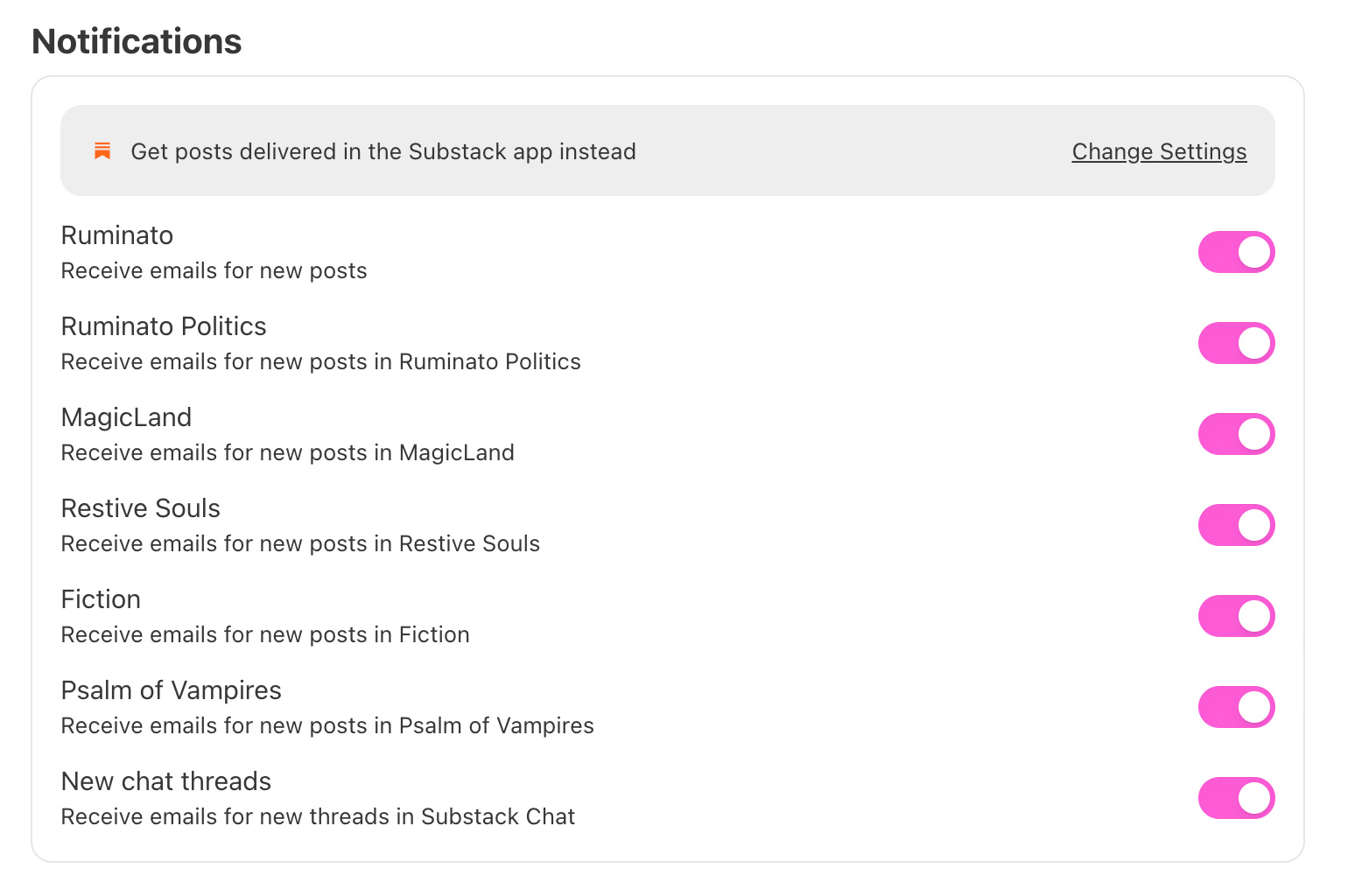
You’ll see a bunch of topics. Just turn off the ones you aren’t interested in. You won’t receive any emails labeled as one you’ve turned off.
Lately, I’ve been posting exclusively to “Fiction” and “Ruminato Politics.” So even when I post something related to one of my books, it ends up being tagged as a Fiction post.
“Ruminato” is generally a meta post or a non-political essay.
I’ve never charged anything for any content or the freedom to comment. So nothing has changed there, either.
So, I’m left guessing, and this is where I land: The Substack algorithm favors the mainstream media refugees who have flooded Substack over the last year or two. If you’re a name, you automatically get an algorithm bonus.
Even Andrew Tate, an accused serial rapist, got top billing by simply being a celebrity of ill repute, and then hacking the Substack database by importing a million bogus subscribers.
There are probably other reasons for the plateau my subscriptions have reached, too, such as Substack’s decision that it wants to be a YouTube competitor, and that its algorithm seems to favor weight, meaning that the more attention a topic gets, the more growth it receives. And guess who gets the most attention these days?
I’ve seen people I respect write, “No, the Substack algorithm is unique. It rewards content.” I respectfully disagree. It’s impossible to prove either way, because Substack’s discovery algorithm is obfuscated.
I can’t blame the refugees. They’re just doing what I would do if I were them. But my Notes feed is dominated by these refugees, either through restacks or original Notes.
Videos automatically get their own Note. If you launch a video podcast, a Note is automatically generated. The algorithm seems to be saying that we must all become video influencers if we want to grow.
If I had a teenage daughter or niece, I’d see if I could talk her into dancing on video while I rage against Trump in the background. Maybe that would help my numbers.
Of course, I could just use AI to do that, which, I suppose, is another problem, but one I’ll skip for the sake of brevity. AI is its own animal.
Lots of my fellow writers say, “Well, I’m not here to grow my numbers,” etc.
Well, I am.
I see no point in working several hours per day writing deeply researched stories if only a few people, as much as I appreciate them, are going to read them.
“But, Charles, don’t you love writing for the act of writing?”
To a point, but if I want to only write for the love of writing, I’ll alert Siri every time I finish a piece and ask her how she liked it. Why bother with the Substack infrastructure if the infrastructure is now failing me?
Fiction is a little different. Let that fall where it may. I’d love it if more people read my fiction. Those who do seem to enjoy it. But it’s a different type of work. It’s not research (click-tap the cute little raised number for an exception to this), it doesn’t involve fact-checking and re-fact-checking. And it involves something I did as a hobbyist for 50 years before I started trying any outreach.3
But even with fiction, I’m conceited enough to think other people should read it. I’ve written more than 40 short stories and three novels during the last five years or so. I’ve been told by more than a few people that some of it is good. So why not see if a few more agree?
The problem with mainstream journalist refugees
As a reader, I didn’t come to Substack to read corporate journalists. Ironically, they are one reason why I came here, but the idea was to escape them, not embrace them.
I do subscribe to a few of them, but I don’t read them very often, and when I do, it’s usually someone like Jennifer Rubin, who probably never belonged in mainstream media in the first place.
The original promise of Substack, or so I once thought, was that it was a refuge for original thought, not for refugees from corporate media.
Mainstream journalist refugees, whether they intend to or not, encourage conformity. A certain politeness that sometimes isn’t warranted creeps into the entire Substack echosphere through their posts and, especially, videos. The only thing missing in their videos is a little logo on the bottom right of the screen.
In this day and age, with a batshit crazy president who was best friends with a serial child rapist, and who may actually be one himself, the only politeness I have patience for is through my middle finger.
The problem with video
I am not on Substack for video. I am here for long-form writing, which is Substack’s origin story.
Substack wants me to do video. They ask me every day. It’s not that I refuse to do it, but I didn’t come here to watch other people’s videos, and I didn’t come here to create my own. There are plenty of videos on YouTube and TikTok. I don’t need more here.
I also read a lot faster than I can watch. If I spend a half hour watching someone’s video, that’s a half hour of lost reading time, which is the difference between learning one thing and learning dozens of things.
That’s my personal preference. I assume that lots of folks watch videos here. I have friends here who do video. I rarely watch them.
The algorithm should not punish those of us who don’t want to sit in front of a video cam. I’m not sure that it does, but I’m not sure it doesn’t, either.
The Substack algorithm seems to favor the same topics over and over again
During the last year, my inbox has filled with precisely the same headline each day, with dozens of minor iterations.
Today, it’s either about the mad clown’s name map name changes or yet another attempt at voter suppression, this time through the U.S. Postal System.
The few main topics for the day then branch out a bit to include a few clever takes, and then the process begins again the next day.
Like many of you, I keep waiting for that one magical headline: “Trump dies choking on cheeseburger hand-fed to him by Natalie Harp.”
Until that day comes, Substack will continue to be poisoned by topics fed by Trump and his minions.
But also? Someday, he’ll be gone, and many Substack writers will need to adjust or disappear.
I don’t have the receipts for this. I don’t have any view numbers overall to support my claim. But I’ve seen quotes by Substack personnel confirming that the algorithm is designed to cater to our preferences. They insist that this is different somehow from social media, even though it’s exactly the same.
The Substack algorithm is more finely tuned than YouTube’s (for example). If I click on a cool YouTube choreography video like the one in the sidebar here, I’ll eventually get dancing teenage girls in my YouTube video shorts, even though I never asked for that and I want nothing to do with them (no offense to dancing teenagers). I have to explicitly instruct YouTube to please stop sending them (although they seem to fairly quickly die on their own). That, too, is another topic.
Dance break!
Watch here, or watch on YouTube at your own algorithmic risk:
Substack is a little better in that regard. Its algorithm doesn’t seem designed to cause harm the way YouTube and anything made by the Zuckerberg Suck Factory. Substack seems to genuinely want to satisfy your interests, so if you want choreography, you’ll get choreography, not an assault on your senses.
What if I don’t want only topics I’ve expressed interest in through clicks? What if I’d like to branch out? What if, God forbid, I even would like to see a few libertarian articles, if only to know what they are saying when Trump is building government-owned gas stations with stolen gas, nationalizing Venezuelan oil, and dumping foreign beef into the American market to lower beef prices?
I can train the algorithm by hunting down different topics. But guess what? I don’t have the time for that.
What if I want to read about gluons, glueballs, and other discoveries in science? Again, I need to train the algorithm to help it understand that I’m interested in these topics. To do that, I need to search Substack for science writers. The algorithm won’t send any my way organically because, like the rest of the country, I’m doomscrolling through Trump’s latest attacks on our nation, with great assistance from the Substack feed, which self-replicates its Trump doomscroll every time I read a rage post.
How to train the Substack algorithm
Want to train the algorithm? You can start by aggressively hunting for topics at https://substack.com/explore
On the desktop or laptop version of the webpage, you’ll see something like this at the top of the page:

You can click the arrows to the far right or left to see more topics.
Also, be sure to also search for “Ruminato” several hundred times per day and click the result. It’s fun for the whole family.
But when I train the algorithm, it has no impact on my readership, because most readers just let the algorithm do its thing.
Much subscription growth seems to be achieved through Notes, a newish feature with an impact on subscriptions that has also been acknowledged by Substack executives.
There is now a cottage industry around mastering the art of Notes. Apparently, I need to read more Substack Notes advice columns. Which I’ll do, maybe, after I finish the next chapter in my novel, and then the one after that.
So what should Substack do?
Like with most tech companies, Substack executives live in their own world. They won’t do anything just because one of their small accounts is whining about their algorithm.
But if they were to surprise me by asking, I’d tell them to simply make it easier to do what I’ve suggested in the “How to train the Substack algorithm” sidebar.
Include a prominent button somewhere that pops up a topic explorer. This would help readers train the algorithm. Substack wouldn’t have to do a thing. Just a small User Interface change and a new database query.
This is not an “I’m leaving Substack” post
I’ve seen quite a few of those, too. Sorry, you’re stuck with me as long as I remain healthy enough to write. I also write on Medium, which is a little more writer-friendly, in my opinion. But I’ll stick around. I have a small set of regular readers who I appreciate immensely. I’m here for them, more than anything.
Meanwhile, I’m just trying to figure things out here. Over the last year, I haven’t had much luck. How about you?
Thanks for reading!
You can help me reach more people by subscribing (paid or free), sharing, restacking, and commenting. If you’re in Gmail, you can train the Gmail algorithm to stop placing my posts outside of the “Primary” folder by dragging them there after you receive them. You should only have to do this one time.


You can now purchase a PDF of all my Substack Fiction. Only $4.99. That’s less than a Taylor Farms salad, and a lot better for you! Enter SUBSCRIBER_SPECIAL to get a 20 percent discount.
It’s also now available on Amazon/Kindle here (the Kindle version is free if you have Kindle Unlimited):
The magic button also takes you to paperback and hardcover editions of the book. 42 short stories in all. None of them written using AI.
Footnotes
For what it’s worth, I automatically delete Substack posts from my inbox that start with “Breaking:” That’s an automatic no-read for me.
These were from a pre-existing newsletter
I spent three years researching my novel Restive Souls, which is why it hasn’t been released yet. I’m determined to find a publisher for it instead of self-publishing it. If I can.
The Substack problem is far greater than you explain. Success has ruined Substack. There are far too many valuable feeds, each requesting a separate subscription. That's an unsustainable model. If I were a Substack regular author, I'd connect with other authors who share a general philosophy and create a new site featuring all of you and a single subscription price. I'd also provide some editorial direction, e.g., don't all write about the same topic on the same day! If this concept feels familiar, I'm suggesting a digital version of a daily newspaper. And, yes, I would accept, even encourage, advertising in addition to subscriptions to compensate the authors for their efforts. My two-bits worth. Your mileage may vary.
Charles, I only read, I’m not a Substack author, so I’ll approach your question as a content subscriber and not a writer. I use the app exclusively. I only get the emails when I first subscribe to a writer as a verification that I’m now subscribed. I will get emails, usually with several subscriptions ganged together in one email if I’ve been offline for a while, usually while traveling (I like really remote locations). I will occasionally go to the Substack desktop website, if the app is acting glitchy. I do all of my viewing on an iPad or iPhone. Having said that, I only see Notes from those I subscribe to; however, I’ll occasionally see a few from a writer from which I’ve recently unsubscribed. The “read” tab in the app only shows the writers I subscribe to in chronological order, most recent on top. Some writers use Notes to scream for attention and post several Notes per day. I find it annoying. I also suspect, authors that self post to Notes or get a lot of restacks, have their Notes float to the top of the feed. I do restack to Notes with a comment posts that resonate with me. I rarely watch the videos, except for the YouTube music video that Paul Krugman attaches to the end of his essays, Paul’s video essays, and occasionally a Robert Reich short video. Also Susan Neimann (sp?) does Jukebox Monday and I’ll occasionally watch those. Maybe because I find someone’s talking head in front of a laptop screen really boring. Since I don’t get my daily feed as emails, I’ve never seen the content selection choice screen with pink toggles that you showed in this post. I’ve never used Facebook, in fact I avoid it and even boycott businesses that use Facebook in lieu of a real website. I know some writers use Facebook to reach their subscribers. Lastly, I found my way to Substack about three or four years ago when Robert Reich started posting simultaneously to Substack and his LinkedIn page. My readings are primarily current events/politics, science, economics, environmental, and nature.