

Trigger warning: Christianity!
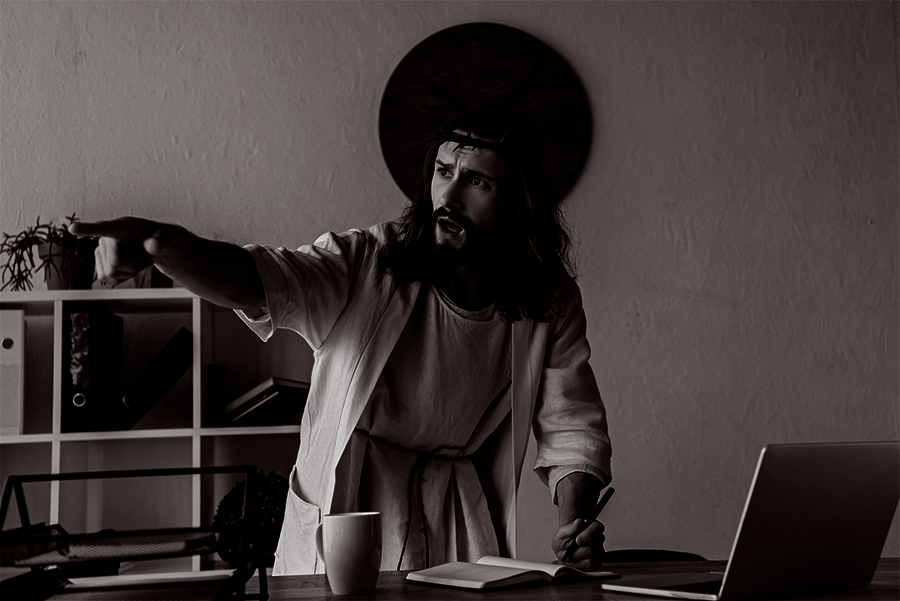
Many parts of the Old Testament are filled with the temper tantrums of an angry God. For example, there’s the time when Moses complains to God in the Book of Numbers that the people are asking, “Where’s the Beef?” after God has just delivered manna from heaven during a previous crisis.
God responds to his upstart people by sending clouds of more quails than they can eat, then kills a bunch of the complainants when they try to wolf down as many of the beasts as they can:
Then a wind from the Lord sprang up, and it brought quail from the sea and let them fall beside the camp, about a day’s journey on this side and a day’s journey on the other side, around the camp, and about two cubits above the ground. And the people rose all that day and all night and all the next day, and gathered the quail. Those who gathered least gathered ten homers. And they spread them out for themselves all around the camp.
While the meat was yet between their teeth, before it was consumed, the anger of the Lord was kindled against the people, and the Lord struck down the people with a very great plague.
— Numbers 11:31–33
Yeesh.
The Bible is full of stuff like this. I won’t bore you with more details. The director of the movie “District 9,” Neill Blomkamp, does a better job than I can with his quick summation in his movie short called “God:1”
Unlike most people who question the inerrancy of the Bible, I read a passage from it every day. It’s been a part of my routine for some time because, even though I have to slog through the genocide and jealousy of an angry and petulant God, I’m comforted by the main theme of forgiveness that, believe it or not, runs through both testaments.
I’m not particularly alarmed at God’s cruelties of the Old Testament, because I don’t believe them. Most of the Old Testament was written by male scribes representing a barbarian culture that was in its earliest stages of stumbling into civilization.
These old scribes mostly had an agenda to extend the patriarchy with Christianized Sharia law. One way to do this was to warn that if you didn’t match up to their ad hoc laws, God would lop off your head or give you leprosy.
The stunningly beautiful Ecclesiastes, however, seems to stand out. I don’t think it was written by angry scribes. I think it was written by the big man himself, Jesus.
Hear me out.
There is some poetry in the Psalms, Proverbs, and even the Book of Job. But most of it can be sourced to some of the old scribes I’ve mentioned.
But Ecclesiastes stands out in its beauty.
The ancient rock group, The Byrds, liked it enough to bring it to song:
The Byrds’ rendition was inspired by this passage from Ecclesiastes:
For everything there is a season, and a time for every matter under heaven:
a time to be born, and a time to die;
a time to plant, and a time to pluck up what is planted;
a time to kill, and a time to heal;
a time to break down, and a time to build up;
a time to weep, and a time to laugh;
a time to mourn, and a time to dance;
a time to cast away stones, and a time to gather stones together;
a time to embrace, and a time to refrain from embracing;
a time to seek, and a time to lose;
a time to keep, and a time to cast away;
a time to tear, and a time to sew;
a time to keep silence, and a time to speak;
a time to love, and a time to hate;
a time for war, and a time for peace.— Ecclesiastes 3:1–8
When I read Ecclesiastes, I’m reminded of things Jesus said in the Gospels. If you love literature, I recommend you read this gorgeous piece of Old Testament from end to end. And open your mind to possibilities.
Whenever I read it, I wonder, Did Jesus write Ecclesiastes?
The very opening of the book, declares the author, are:
the words of the Preacher, the Son of David, the King of Jerusalem
— Ecclesiastes 1:1
“Son of David” is a common reference to Christ. Traditional theologians make the argument that the author is Solomon, but many scholars discount that because of linguistic and historical discrepancies.2
But mostly, it’s the “feel” of the book that makes me think it’s Jesus speaking to us. When I consider some of the magical realism in apocryphal texts found in the Nag Hammadi Library,3 which were discovered in Egypt in 1945, and some of which are considered heretical by traditional churches, I feel even more strongly about the wild possibility that Jesus wrote Ecclesiastes.
The writing style is unique.
The author’s feigned “confusion” over the nature of humanity suggests deep wisdom, and there are hints throughout that the author, “The Son of David,” and the wisest King of Jerusalem (Ecclesiastes 1:16–2:10), who has tasted the full experience of humanity, finds human desire to be lacking in substance.
He speaks frequently of most of our earthly pursuits as being a vanity, and that:
I hated all my toil in which I toil under the sun, seeing that I must leave it to the man who will come after me, and who knows whether he be wise or a fool? Yet he will be master of all for which I toiled and used my wisdom under the sun.
— Ecclesiastes 2:18–19
I also spent three years reading A Course in Miracles, which its author, Helen Schucman, claimed was channeled by Jesus Christ. Aside from demonstrating that perhaps Jesus needed a better editor, the complicated tome has “Ecclesiastical” vibes with its overarching theme that nothing matters aside from love and forgiveness.
Sadly, all society has really gotten out of A Course in Miracles is Marianne Williamson’s presidential runs.
Ecclesiastes was written long before Jesus’s time
If Ecclesiastes was written before Jesus’s time, how could he have written it?
Ecclesiastes provides the answer:
That which is, already has been; that which is to be, already has been; and God seeks what has been driven away.
— Ecclesiastes 3:15
This is another common theme throughout A Course in Miracles.
There was a time when Bible readers had to take a leap of faith to believe all this nonsense about the existence of things before they existed, but modern scientists are beginning to prove it with mathematics and experiments.4
It’s all about Quantum physics
In other words, we’re talking Quantum physics, an invention of God that human scientists will probably spend eternity unsatisfactorily trying to understand.
The reason biblical scholars would never think of Christ as the author, so my theory goes, is that they don’t take quantum physics into account.
But here’s the thing. According to the Gospels, Jesus existed before time began:
Therefore do not be ashamed of the testimony about our Lord, nor of me his prisoner, but share in suffering for the gospel by the power of God, who saved us and called us to a holy calling, not because of our works but because of his own purpose and grace, which he gave us in Christ Jesus before the ages began.
— 2 Timothy 1:8–9
Jesus would have been able to materialize the words of Ecclesiastes into their earthly realm long before his corporeal appearance on Earth.
There are no limits to how God can use Quantum physics
Christians can’t believe in things like a virgin birth (which isn’t part of every Christian tradition), a variety of miracles like raising the dead, healing the sick, and enough bread to serve thousands from two loaves, and not believe he could have left the Book of Ecclesiastes lying around somewhere in the great temple for the janitor to find.
Ecclesiastes 12:11 states that the wisdom of the book comes from “the great shepherd,” another common reference to Christ.
The author of Ecclesiastes describes the human experience of being a king, including acquiring riches and concubines and pleasure.
Given that, the author can’t be Jesus Christ, right? Surely, the Jesus we know wasn’t into concubines. Ah, but God can experience everything we humans experience, even if vicariously. Most Christian clerics believe that the Holy Spirit is embedded inside you. He experiences everything you do. Always has.
The king described in the book sounds a lot like Solomon.5 But to tell his parable, might God have simply relayed a wise analysis of what Solomon experienced?
Jesus messaging us about his truths
My interpretation is that rather than representing Solomon, the author is representing the whole of humanity. The author’s main point is that the frustrations of worldly pursuit in all its forms are overcome by faith in God:
Remember also your Creator in the days of your youth, before the evil days come and the years draw near of which you will say, “I have no pleasure in them”;
before the sun and the light and the moon and the stars are darkened and the clouds return after the rain, in the day when the keepers of the house tremble, and the strong men are bent,
and the grinders cease because they are few, and those who look through the windows are dimmed, and the doors on the street are shut
— when the sound of the grinding is low, and one rises up at the sound of a bird, and all the daughters of song are brought low
— they are afraid also of what is high, and terrors are in the way; the almond tree blossoms, the grasshopper drags itself along, and desire fails, because man is going to his eternal home, and the mourners go about the streets
— before the silver cord is snapped, or the golden bowl is broken, or the pitcher is shattered at the fountain, or the wheel broken at the cistern, and the dust returns to the earth as it was, and the spirit returns to God who gave it.
Vanity of vanities, says the Preacher; all is vanity.
— Ecclesiastes 12:1–8
The author’s lamentations about earthly life are not an invitation to think about suicide. It’s a discussion about the folly of earthly pursuits, especially in comparison to the pursuit of faith. Jesus also talks about this in John 12:
Whoever loves his life loses it, and whoever hates his life in this world will keep it for eternal life.
— John 12:25
It is after we have reined in our earthly and fleshly desires and replaced them with a desire for spiritual wholeness that our desires become legitimate. This is because God doesn’t give us dreams of success with a mind to disappoint, which is why he encourages us to work hard toward our goals after we discover our faith:
through sloth the roof sinks in,
and through indolence the house leaks.
Bread is made for laughter,
and wine gladdens life,
and money answers everything.— Ecclesiastes 10:18–19
There’s sarcasm in his message, just like there is in the gospels, but he also hopes you can discern the difference between pursuing money and consuming it at a cost against others.
If you believe in Quantum physics, there is no reason not to believe that God uses it for his own purposes.
Jesus may well have been passing through Jerusalem one day on one of his journeys through the portals of time, like a divine Dr. Who, and dropped off a little parchment for us to ponder.
He may have even done this tomorrow.
NOTES
If you think this is all a bunch of hooey, I understand. It’s a thought exercise. I had a friend who used Mr. Potato Head as his higher power to work through an alcohol problem, and I thought that was just fine. I always lose a few subscribers when I talk God anyway. Given our current political environment, I can understand why.
Thanks for reading!

Footnotes
I’m pretty sure this movie short was the inspiration for this:

ESV Study Bible.” 2020. Crossway. 2020. https://www.crossway.org/bibles/esv-study-bible-case/. page 1193 Introduction to Ecclesiastes
“Nag Hammadi Library.” 2025. Gnosis.org. 2025. http://gnosis.org/naghamm/nhl.html. You might think, well, that makes me a Gnostic. No. Labels and religion are a stupid idea. We are what we are and who we are. We can’t be grouped, despite what organized religion tells us. The 2,000-year-long Abrahamic wars over theocratic dominance are proof of this.
“I. Experimental Evidence for Quantum Mechanics.” n.d. https://web.mit.edu/course/5/5.73/oldwww/Fall04/notes/Experimental_Evidence_for_Quantum_Mechanics.pdf. (PDF)
Bartholomew, C. G. (2009). Ecclesiastes. United States: Baker Publishing Group.
Charles, I read this post with great interest. I must confess, though, that I think attributing Ecclesiastes to Jesus on the basis of QM is a bit of a stretch. I am with you on the Bible though. I am no bible scholar, but it can be good reading. I do not put much stock in the OT, or even much of the new. I am a gospel girl. I have read the four gospels carefully, to understand and get to know Jesus. Raised as a Catholic, I have serious questions about many tenets of Catholicism. I don't care about the 'virgin birth'. I don't even care if Jesus rose from the dead. What I do believe in is Jesus' message, as espoused in the Sermon on the Mount.
It's absolutely a total stretch! :-) Agree completely on the lost message. I'm sure he does, too. Thanks for the read and comment.