

Full Disclosure: I haven’t yet seen “Disclosure Day,” Steven Spielberg’s latest megahit. I’m looking forward to it now, though, much more than when Hollywood first started teasing us with its trailers.
One of the reasons for my interest, aside from always being a fan of anything Spielberg does, is the word from reviewers that the movie covers the topic of how religion and, more importantly, religious people, would handle the revelation that we are not alone.
Note: If this ends up feeling like a promo piece, it’s because it kind of is.
As a writer, I’m always fascinated by religious concepts, especially those that challenge the status quo. As a Christian, and yes, I realize that’s a word that often automatically triggers the “unsubscribe” button, I’m particularly interested in the messianic aspect of otherworldly life.
The question has never been a complicated one for me. C.S. Lewis attacked the problem eons ago with his Perelandra series.
We live in an age when fundamentalist Christians are the only Christians who receive attention from the media,1 but there are many of us with much healthier relationships with the Bible than fundamentalists. Our voices are never heard. For me, Christian theology was boiled down to one word by Jesus more than 2000 years ago: “Love.” The rest can be tossed, as far as I’m concerned.
This original message has been torn asunder by organized religion and its sanctimonious patriarchy ever since, and here we are, with “Christianity” as a dirty word.
This is the same sanctimony that is now asking the question on online forums of Disclosure Day, “Would beings from other planets have to accept Christ as their savior?” It’s a primitive question.
It’s also an uncomplicated one for me. As a universalist, I can’t believe in a God that throws you into hell for not believing in Christ. I’ve made the argument many times in the past that atheists, rather generally, don’t need to believe in god because they already have a solid moral foundation. The god I know is a specialist at pulling the rest of us out of the moral fires we gravitate towards.
So it’s easy for me to get to the next part.
The notion that God would present himself as a human to other beings is absurd. Such a possibility relies on the impossible dogma that Copernicus had to fight through when he declared that the sun didn’t revolve around the Earth, that humans are the center of existence.
We probably already have other sentient beings on Earth, after all. Many scientists believe that dolphins (as one example) are sentient. It would be rather silly to expect them to believe in Jesus or face the consequences of a hellfire in their oceans.
I explore this more fully in this short story:
Born a Savage

They sing of the great changes that roiled Earth’s oceans long before the dawn of humanity. Their songs describe the wreckage humans wrought, too, during a period that, to them, has happened within the wink of an eye.
It’s a science fiction story about a messianic dolphin in the oceans of Europa, brought there by humans generations earlier than the events of the story.
In other words, if there is a god, and he/she decides that it’s important to pay a visit to his creations, he’s going to represent himself in a way they’ll relate to, not as a white dude with a beard (Jesus was not a white dude, by the way).
My personal favorite look at other worldly messiahs is laced with comedy, and is probably more than a tad insulting to the rest of the Christian flock. It’s a whimsical tale about a messiah on a planet of sentient felines:

My wackiest short story ever was about a messianic, sentient planet:

I swear I was not on LSD when I wrote this. If you read it, you will probably not believe me, and that is your right.
Almost all of my takes on religion focus on one common theme: That there is nothing more dangerous in human existence than religious dogma.
Part of that theme is the simpler, “My way is not your way” philosophy that has long guided my spiritual journey. My path to spiritual growth, acceptance, and understanding is not your path. It’s always been a tragic human mistake to make it so.
The Abrahamic Wars have been ravaging the Middle East ever since the days of the first child sacrifice. I have no interest in organized religion, but I am fascinated by theology and the nature of God and God’s lesser companion, evil. I’m also fascinated by the theocracy of war, which is what the Abrahamic religions all adhere to.
I don’t have much doubt that there are demonic forces at work on our little planet, but I believe their time is fleeting. Their motivations have always fascinated me, too.
In one novel in various stages of development (but not yet good enough to present at this stage), I write about a man who dies and is offered the chance to experience other people's evil at a visceral level. He feels every “thrill” of their wayward actions, which he becomes responsible for cultivating in a demonic afterlife.
He is told that his happy time will perish at any moment, that the demons who run Camp Demon, so to speak, are helpless because its final days are not up to them. Their fun could end tomorrow, or in ten thousand years. The man in this novel rolls the dice. The difficulty I’ve had writing the novel is that I can’t relate to the things I want him to do.
Villainy is essential to much fiction, but I find it easier to write about when it’s described by the opposition. I like heroes a lot more than villains. My writing generally reflects that.
I finished another novel about the nature of evil a long time ago, but I wasn’t happy with it, so I relegated it to the “rewrite” folder. In that story, a woman is assigned the task of saving her wayward brother, who is literally consumed by demons through drug and alcohol addiction.
This novel is my oldest, and has been through many iterations, none of which I’ve been happy enough with to release to the world. It was inspired by a college housemate several decades ago, whom I quite seriously wondered was the second coming of Satan. Just thinking about the dude still gives me the willies all these years later. I should look him up. Today, he’s probably an oligarch.2
The question of what motivates demons is a fascinating one for me. Why abandon a righteous god? What can be gained from that?
Even my one stab at a horror novel, about vampires, touches briefly on the religious aspect enough that it’s called Psalm of Vampires (first installment of the sequel will be here this week!).
It’s a dark comedy about a bible-thumping online influencer who happens to be a vampire. It doesn’t get into theology. The title makes its presence felt when he recites a “Psalm of Vampires” as a prelude to a nasty brawl. Aside from that, pretty much the only references to God are when his peers chide him for his beliefs.
But for me, despite the unserious nature of the novel, there’s an underlying question: If there were beings such as vampires, why would they be excluded from salvation, if such a thing truly exists? It’s a question that is adjacent to the questions posed by “Disclosure Day.”
I’ll never answer any of these questions to my satisfaction because it’s all far above my pay grade. But they make for great fun in the world of fiction.
Thanks for reading!

Notes
If you have Kindle Unlimited, you can download Psalm of Vampires for free. I’m told by the few people who’ve read it that it’s pretty good.
If horror isn’t your thing, try a little sci-fi fantasy that also explores a bit of theology. It’s an expletive-free zone, and is probably more young adult than gritty adult:
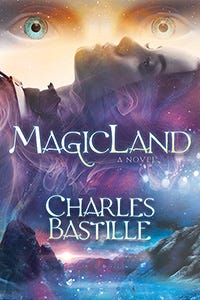
You can buy it at most online bookstores:

Here’s a review:

Footnotes
Pope Leo is changing this somewhat, it seems
I’ll never write about the nature of Trump’s evil, because, like everyone else in the world, I’m just too sick of him and will be happy when his soulless orb disappears from the planet. All I’ll ever say about him is that although he is technically sentient, he has no more soul than the scorpion you squash with your boot.
"Christian theology was boiled down to one word by Jesus more than 2000 years ago: “Love.” The rest can be tossed, as far as I’m concerned. This original message has been torn asunder by organized religion and its sanctimonious patriarchy ever since..."
I'm with you on Jesus - but I think we've got it backwards - we've created god in our own image. It's all we know.