

If you read John Steinbeck’s East of Eden, you won’t find much of it in Netflix’s adaptation of John Steinbeck’s thick doorstop of a novel.
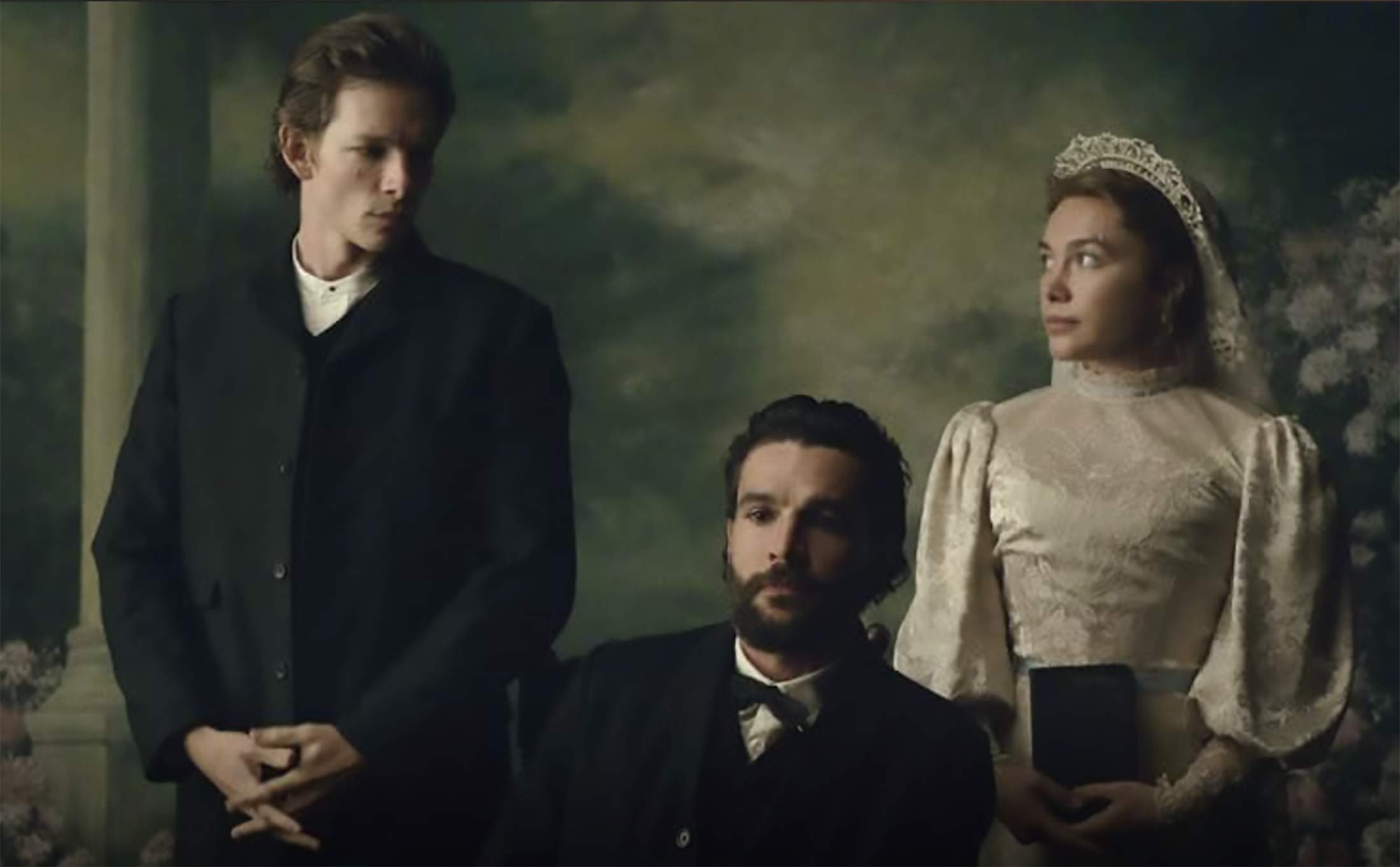
What you’ll find instead is the story of a female survivor, portrayed by Florence Pugh, shaking her fist at a patriarchy determined to shatter her bones as soon as her pretty face can pull its first quiver from a man’s groin, which, of course, occurs at a very early age.
Trigger warnings: Uncomfortable subject matter, “movie” spoilers
Steinbeck’s novel was an epic look at two families, the Hamiltons and Trasks, that land in California’s Salinas Valley, which he describes in the opening paragraphs of his opus with less fanfare than what likely lured its migrants:
From both sides of the valley little streams slipped out of the hill canyons and fell into the bed of the Salinas River. In the winter of wet years the streams ran full-freshet, and they swelled the river until sometimes it raged and boiled, bank full, and then it was a destroyer. The river tore the edges of the farm lands and washed whole acres down; it toppled barns and houses into itself, to go floating and bobbing away. It trapped cows and pigs and sheep and drowned them in its muddy brown water and carried them to the sea. Then when the late spring came, the river drew in from its edges and the sand banks appeared. And in the summer the river didn’t run at all above ground. Some pools would be left in the deep swirl places under a high bank. The tules and grasses grew back, and willows straightened up with the flood debris in their upper branches.
The Salinas was only a part-time river. The summer sun drove it underground. It was not a fine river at all, but it was the only one we had and so we boasted about it—how dangerous it was in a wet winter and how dry it was in a dry summer. You can boast about anything if it’s all you have. Maybe the less you have, the more you are required to boast.
But Netflix’s adaptation isn’t about the beckoning of the West or the determined spirits of settlers faced with the harsh realities of their fool’s gold.
It’s about a relatively minor character from the book, Cathy Ames (Pugh), who discovers early in life that the men around her are like the violent, misogynistic, rapist frat boys of Cornell, unnamed in her world, but everywhere, following her, tracking her every move like lascivious Halloween spectres, until, as a young adult, she is left in a broken, bloody heap crawling to the front door of two brothers, Adam and Charles Trask.
Adam and Charles live on a ranch far east of the mysterious land of California (Eden), which has enough potential to pull one of them, Adam, west while the other, Charles, remains intent on developing their ranch to its full promise.
Their oppressive father had previously left the ranch for Washington, D.C., to tend to veterans’ affairs, a busy job in the wake of the Civil War. As the turn of the century approaches, dad expires and bequeaths significant, but possibly ill-gotten, wealth to the brothers.
While imposing discipline on the boys with a cane, their father had boasted of his Civil War exploits to his friends, but Adam discovers upon his father’s death that it was all war stories of the fictional kind. His limp and cane were left to him not by war wounds, but by an early mishap in that era’s version of boot camp. He was given a discharge by the army before he saw battle.
The boys discovered that he had been a fraud all along. Grand tales of Gettysburg and other exploits told to his friends and sons were fabrications.
But he left them with money. Charles considered it psychological blood money, but Adam, who is portrayed in the series as the softer, gentler of the two brothers, is happy to begin exploring his California dreams.
That’s when Cathy shows up at the door, her broken, bloodied body found by Charles.
Adam nurtures her back to health while Charles looks on with condescension and a prescient fear of what she will ultimately bring to the table. Even through the slits of her swollen eyes, Pugh portrays a woman determined to get the best of the new, hapless men in her life, and to make a mockery of the male ego in the process, even though she can barely utter a word out of her damaged body.
We often hear that “East of Eden” is a long retelling of Cain and Abel, but director Zoe Kazan’s version of it finds Cathy pulling the marionette strings of the two competing brothers, both of whom had strained to seek their father’s good graces but are now competing over the beautiful young patient in their guest bed.
It’s not a competition for her charms. It’s a competition over how to treat an unexpected visitor who has broken a recent truce between the two brothers with her mere presence. Adam, while tending to the patient like a dedicated nurse, slowly, unsurprisingly, falls for her so completely that he quickly loses himself.
Florence Pugh’s brilliant acting makes sure that you understand that Cathy is fully aware that Adam is now her captive spirit, absolutely under her spell, with no chance at all of escape. This takes place early, even as she, bedridden, can barely manage a feigned smile through her tumid face.
Charles, meanwhile, wanted her gone as soon as Adam dropped her damaged body onto the bed. At first, he just didn’t want the bother. But it doesn’t take long for him to declare her a villainous vixen as he warns Adam that she’ll ruin him.
Zoe Kazan, with one long directorial wink of an eye, does a brilliant job of pretending that Cathy is simply a demon happily luring Adam into her clutches as their relationship grows. He begins by dabbing her face with a warm cloth and ultimately proposes to her.
When Florence Pugh’s Cathy says yes, she is winking at us, too, without actually winking, and we all know that Charles was right all along. Adam is doomed.
Thus begins a long journey of meta vengeance, as Cathy demonstrates her opinion about men in increasingly violent fashion, from the moment she leaves Adam to her arrival at the nearest brothel.
Not everyone will cheer this on. But as I watched her use psychological trickery to conquer the madam of the brothel she worked at, I couldn’t help but smile as she walked out of the madam’s room. I, along with Cathy, who walked away with her arms raised, the fingers of her right hand touching the framed wall art as she marched victoriously through the expansive hallway to her room, wanted to raise my arms in delight.
This was the moment when she captured the madam with the same charms she had captured Adam, whom she had not so long ago left in a bloody heap of his own. Terrible, I know, but that was the way of the few survivors in those days who could rise against a patriarchy that gave women no freedoms.
Even Adam, who for so long we were sure was such a gentle soul, had dragged Cathy to California against her will, because, after all, he was the husband. It was his decision. She had no say. The punishment she delivered was swift and pure, even if it makes the viewer uncomfortable.
For Cathy, no man is deserving of a first chance, much less a second, because in her mind, all men are, at their very best, enablers of the torture chamber that her society is for women.
Modern women will notice the allegory.
Survivors of sexual abuse and violence should feel no guilt urging Cathy on, because, after all, it’s only fiction. Not everyone gets to slash and burn their way to victory and justice, but Florence Pugh’s character allows you to vicariously deliver the kind of justice the boys of Cornell and others like them deserve.
Notes
Director Zoe Kazan’s grandfather, Elia Kazan, directed the original movie version of “East of Eden,” starring James Dean, along with such classics as “A Streetcar Named Desire” (1951), and “On the Waterfront” (1954), both starring Marlon Brando.
You may have heard about Hoon Lee’s performance as Lee, a Chinese migrant. He’s also fantastic in this, and for me was the glue that held the show together in scenes Florence Pugh wasn’t in.
Obviously, this production was made before Cornell entered the news cycle the way it did, but the subject matter is as old as time itself.
I’ve begun re-reading East of Eden, the novel. I read it in my youth and barely remember it.
Thanks for reading!

You can now purchase a PDF of all my Substack Fiction. Only $4.99. That’s less than a Starbucks Venti Latte.
Enter SUBSCRIBER_SPECIAL to get a 20 percent discount.
It’s also now available on Amazon/Kindle in ebook, paperback, and hardcover formats (the Kindle version is free if you have Kindle Unlimited):
If you are a paid subscriber, it’s available free as a Perk. Just go to the “Perks” page via the web page menu to find it.
You can help me reach more people by subscribing (paid or free), sharing, restacking, and commenting.
