

Restive Souls is an alternative history novel in which the Brits win what in our timeline is called the Revolutionary War, and emancipate North American slaves in the wake of the war. Still (forever?) in final edits, so there may be goofs, evil dangling modifiers, and other shenanigans.
This excerpt did not make the final cut, but will instead be part of a second book that follows the first volume of the Restive Souls series.
Elliot Fae was introduced in a previous chapter as the warlord who runs Savannah, Georgia, in the midst of the growing African American nation that surrounds it, called the Carolina Union. He is a lone holdout who has figured out a way to maintain slavery, as the Union does not yet have the military resources to deal with him.
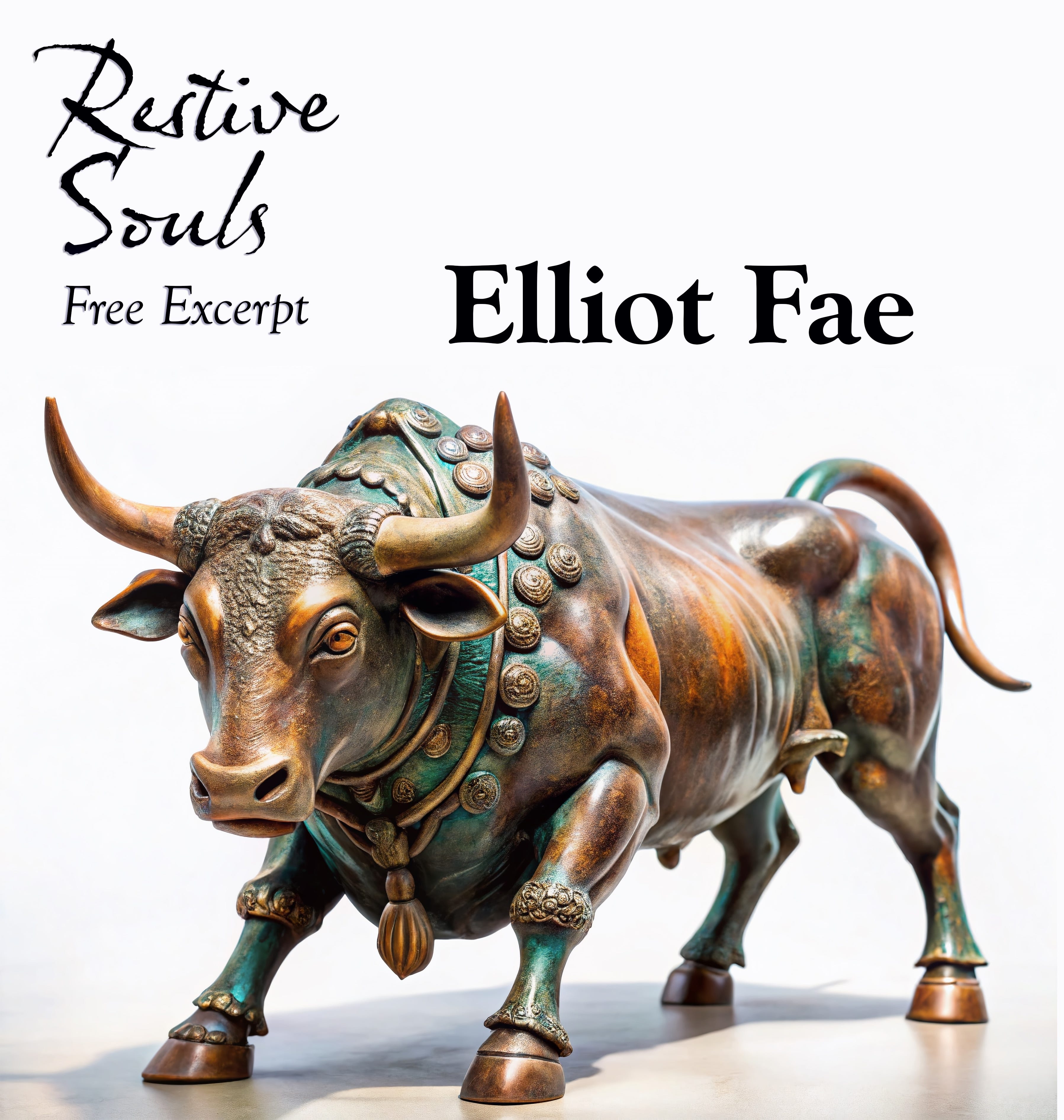
In this excerpt, the reader is aware that he’s about to begin a celebration over the Phalaris Bull, a sinister event that only someone like Fae could conjure.
This excerpt will only be available for a limited time.
Excerpt from Part II of Restive Souls: The Story of the Phalaris Bull (1820)
Ultimately, all was right with Fae’s prized bull. The evening of the feast descended upon Savannah at the end of a humid May day that dripped sweat from the Spanish moss dangling from two grand live oak trees in front of the entrance to the congregational courtyard. The two facing trees met in an embrace over a long walkway filled with pedestrians attending the festival.
“You look grand,” said Mae Tanner to Fae as hundreds of guests finished settling in at their tables. Servants had built a wooden platform for Fae that circled the Phalaris Bull. Mae was with Fae inside the rectory on the north end of the courtyard.
Fae was shorter than Mae, who was an average-sized woman for her time. She straightened his white collar and offered his ephod from behind his shoulders. The ephod was embroidered in the Old Testament way, with gold, blue, purple, and scarlet yarns. The ephod bore the Breastplate of Judgement, consisting of twelve square stones stacked in rows of three. Each was a different stone: emerald, topaz, amethyst, beryl, onyx, and more. Fae glided his arms inside and turned to face Mae.
“Thank you, my dear.” Mae was twenty years his junior and quite smitten by Fae. Along with a coterie of other women from town, she had done much to organize the festival. Fae had never recovered from the death of his wife, who had been killed by a horse in a coach accident many years prior. He was not at all inclined toward Mae but appreciated her interest in him.
She was a beautiful English woman with perfect manners and a delightful thin smile that at times weakened even his pious heart. He sometimes allowed for a rush of that heart, just for the feeling of it, but he also thought Mae to be a likely Jezebel, someone who could ruin the piety of the Savannah he had spent so much effort developing.
Her wide brown eyes blinked at his as she said, “I am so looking forward to the speaking of the bull this year, Elliot.”
Fae smiled at that. “Yes, yes, that is your favorite, I know.”
She looked out the window. “The moon is red,” she said, marveling at the engorged red orb ascending over the trees. An orange tint colored by the setting sun reflecting through thin clouds distilled the scene into a perfect painting.
“Tis a Pentecostal blood moon.” He gently touched her forearm. “You will walk me to the encirclement?”
“Of course,” she smiled with a show of unnaturally straight teeth. Fae always noticed them; perfectly white, clean, straight, whereas his were ungracefully decaying as if they were ragged stumps along the banks of the Savannah River, mangled by its eroding sediments.
He couldn’t understand what she saw in his somewhat portly exterior. He was certain she saw nothing, that it was his interior that she felt drawn to. “That’s fine,” he said, thinking that, but also in response to her charms.
Abara’s drum shook the building. Fae’s garb was traditional except for his head covering, which was not. Rather than the expected turban that had become common among East Coast clerics, Fae wore his old top hat, which he grabbed from a table and placed upon his head.
Mae hooked an arm around his elbow as they walked to the stage circling the bull. She clung tightly as they strode up the five steps to the stage. Then she released him and disappeared into the crowd.
Fae watched his audience. The crowd was seated in groups of twelve, each group at a round table. The seating arrangements were designed to represent the twelve apostles who, on Pentecost, received the Holy Spirit. The tables were draped in red cloth. The live oak trees inside the courtyard were trimmed of any moss, which was replaced by long streams of red fabric of many shapes and sizes and origin, all designed and crafted by various Savannah families.
The bull was at least twenty feet away behind the circle-shaped stage upon which Fae would deliver his sermon. Fae knew that, even at that distance, he’d feel the heat from the red fires lit under the bull’s belly, which would create a most glorious incense that would blow through the bull’s nostrils and fill the surrounding air as he spoke. By the time his sermon was over, Fae knew, his body would be sweating profusely. It was all part of the holy sacrament that made up this holy day.
Fae motioned for the Man of Light, who appeared in a long red vestment threaded with illustrations of fire along the length of his chest. The man’s face was covered by a red hood as he made his way to the Phalaris Bull carrying a long, lit torch. He bent down and lit the bowl underneath the bull. Fae motioned for the chattering crowd to be silent.
“We are here today,” he began, “to ingest the Holy Spirit, to formally take in his presence. We must feel the fullness of our sanctification in our blood and bones.”
The bull began to smoke from its nostrils. Sparks shot out of its nose, producing red, glowing flashes of light.
“Above, in the sky, my brethren! The moon is the blood red that it was when our apostles first breathed in the Holy Spirit. As it is said!” Fae began to quote from the Bible’s Acts. “And I will show wonders in the heavens above and signs on the earth below, blood, and fire, and vapor of smoke; the sun shall be turned to darkness and the moon to blood, before the day of the Lord comes, the great and magnificent day. And it shall come to pass that everyone who calls upon the name of the Lord shall be saved!”
He stopped to survey the crowd. “Listen!”
The bull made a horrific noise, a tortured bellow, but songlike as if a great tenor was acknowledging his torture with full acceptance and grace while expressing the purity of his punishment in an overture of his dying outcry. “That is the sound of Satan you hear, my brethren! He is wounded by your acceptance of the Holy Spirit, and oh, oh, how he moans!”
The crowd gasped in astonished unison. Many in the crowd closed their eyes as they clasped their hands together in prayer. Most had witnessed the same scene in previous festival years. The bull continued its beautifully horrific sonnet. Smoke poured from its nostrils. Mattingly, thought Fae, had tuned the instrument well.
He continued quoting from the Bible:
“Brothers, I may say to you with confidence and as it is written about the patriarch David that he both died and was buried, and his tomb is with us to this day. Being therefore a prophet, and knowing that God had sworn with an oath to him that he would set one of his descendants on his throne, he foresaw and spoke about the resurrection of the Christ, that he was not abandoned to Hades, nor did his flesh see corruption. This Jesus God raised up, and of that we all are witnesses. Being therefore exalted at the right hand of God, and having received from the Father the promise of the Holy Spirit, he has poured out this that you yourselves are seeing and hearing. For David did not ascend into the heavens, but he himself says, ‘The Lord said to my Lord, sit at my right hand, until I make your enemies your footstool.’
“Let all the house of our great city therefore know for certain that God has made him both Lord and Christ, this Jesus whom you crucified.”
Fae stopped, satisfied with the crowd as nearly everyone by now was in solemn prayer. “Alight, Satan! Be gone!” he cried out, knocking his hat off his head, then squeezing his temples with both hands. At that, the red and brown smoke from the bull’s nostrils turned white. The moaning from the bull became an eerie whistling silence. Soon after, only the crackling of the fire beneath the bull could be heard.
Fae paced around for several moments on the wooden stage in silence. His audience lost none of its patience as he looked across the tables at his raptured followers.
“Once again we are required to fulfill a heavy destiny,” he said in measured solemnity. “Today, the day of this feast, marks great celebration, but also a tradition I am always loath to embark upon.”
Everyone remained silent. Most knew what was next on Fae’s agenda.
“‘Tis the Day of Reckoning, my friends. The day one of you must come forth and confess to his or her attempt to interfere with the faithful progress of one of our dear Servants of the Lord.” He then returned to his louder voice. “I believe most of you know how this works. I will walk amongst you, and one of you shall confess to your sins.
“For it is said, in Malachi Chapter two, verses two and three: If ye will not hear, and if ye will not lay it to heart, to give glory unto my name, saith the Lord of hosts, I will even send a curse upon you, and I will curse your blessings: yea, I have cursed them already, because ye do not lay it to heart. “Behold!” Fae bellowed. “I will corrupt your seed, and spread dung upon your faces, even the dung of your solemn feasts; and one shall take you away with it!”
After retrieving his stovepipe hat from the stage floor, Fae walked down some steps at the front of the stage. He began to walk among the tables and mingle with the crowd of happy but somewhat stricken festival diners. There were fruit baskets, straw plates of bread, and large iron plates of beef in the middle of each table. The plates of beef were held above sets of small, fat candles by thin crisscrossing iron bars. Each table also had large pots of boiled corn.
“Mr. and Mrs. Holcombe,” he said to the first table he encountered. “You look well. And your little one, Beth, why, she’s grown a foot since last week!” Fae reached toward Beth to gently tweak her nose. Beth, a young girl of about five, giggled shyly.
“And you,” said Meeker Holcombe, “The Lord has been good to you.”
“Ha!” laughed Fae. “The Lord saw fit to distribute his good looks to your fine family instead of me, and I graciously accept his decision.” As he began to circle the table, Mrs. Holcombe offered him a small rose. “Thank you kindly, ma’am. Your heart is blessed by our Lord.” He meandered about the rest of the round table with similar bouquets of opulent charm.
Before proceeding to the next table, he halted. “I hope our transgressor, who sits amongst us, will not have forgotten the duty God imposes upon us. For our sins, we repent! But God also forgives. Never forget that, my friends. Be not struck down by shame, lest God strikes you down for the appalling lie of your refusal to repent.”
Fae then proceeded to charm another table.
Fae never mentioned the transgressor he had in mind as he made his rounds. These were what he called comfort visits, designed to welcome even the most established congregants into the fold as if it were their first visit to a congregation event. After he circled each table, he announced the importance of repentance.
Fae was certain of one thing. Someone had given aid to several Servants of the Lord and helped the miscreants leave Savannah territory. Whoever had provided this assistance did it out of ignorance. Fae was certain of this. His congregation was filled with people who held no malice in their hearts. One can forgive a breach in judgment, but it was important, he thought, that the transgressor be named publicly, and this was the correct forum for doing so.
Fae therefore paced, made his rounds, and preached. He hoped for an outcome like the familiar ones of past festivals. Yet he sensed a hesitancy among the people on this day, a resistance, powered most assuredly by the devil himself. Rooting out the transgressor was proving to be most difficult on this day.
As the feast continued, Fae at last alighted upon his last table. He had reached deeply into the Bible, yet there was still no confession forthcoming. He was becoming irritable as he fantasized about Shick flogging each man at every table until the devil’s many sentries were flailing about the grounds like demonic, ghostly entrails.
“Perhaps,” he said, eyeing his final direct audience, “The instigator of this crime shall not part with his deed, and will keep it close to his chest.” This was a break from his usual warmth toward the diners at this feast, and those sitting at the last table, full of wine and bread and meat, must have wondered where they had gone wrong to draw his ire when others hadn’t.
“Who have we here?” he asked. “Why, I see Ennis and Portia McGinnis and their fine boy Aladdin. Such a curious name, Aladdin,” Fae sniffed with an upturned nose. “Curious indeed. Not a very, is it rude of me to say this? Not a very Christian name, is it?” Fae bent down into Ennis’s gaunt face. Ennis was a young cobbler and no saint. Thin but strong, he was well known in town for becoming mired in brawls within the boozy thickets of late nights at the local public houses along the docks.
“Ah, and the beautiful Rachel Williamson,” who sat alone next to the McGinnis family, sandwiched between them and the newlywed Porters of Hastings Street. “How does such a lovely lass remain un-betrothed for such a length of time as you?” he wondered aloud with an impish grin that pushed one side of his long, curling mustache to the right side of his face. He tipped his hat and moved to the Porters.
“Interesting that you sit next to Mr. Porter here rather than Missus, is it not?” Fae shook his head and clicked his tongue in a sign of disgust. “Very improper. I shall have to speak to Miss Tanner on this highly visible affront to our Lord.”
Rachel Williamson stood up to face Fae. “For a prostitute can be had for a loaf of bread, but another man’s wife preys on your very life,” she said resolutely. “How would you have him be?” she said to Fae angrily as she looked at Brian Porter, who didn’t return the gaze as he stared ahead with glazed eyes.
“Ah, Proverbs chapter six, verse twenty-six,” said Fae, returning the determined stare. Rachel was taller than Fae. They stood toe to toe, Rachel showing no fear. Fae nodded. “You know the Word. That at least is very commendable.”
Rachel firmly grasped Fae’s shoulders and whispered into his ear, “And I know my men.” She promptly sat down and folded her napkin delicately over her lap. Fae found himself strangely amused by the incident and wondered what might be uttered in the Porter household after the event.
Undaunted, he continued to circle the table.
He stopped, alarmed, looking at a tall man in a red cape; a freeman colored like a cherry-tinted dark whisky. Fae’s heart raced at the ghastly sight. The man was almost unspeakably perfect in design aside from his unfortunate color. He wore a peculiar ensemble, not of this region. Under his heavy red cape, much too heavy for this climate, Fae thought, was a tight white shirt, of cotton, Fae believed, not at all becoming a gentleman. Fae could see multiple stretches and layers of finely toned muscles under the cape that gave evidence of substantial athletic prowess. He wore long, flowing blue pants that several people could have fit in, so much bigger were they than necessary.
“I don’t know you,” Fae hissed.
His alarm magnified tenfold when he noticed who was sitting next to the stranger. How had he missed it? The Mayor of Savannah, James Wayne, stood up. “My friend,” said Wayne. “You look like you’ve seen an other-worldly apparition.” The stranger also stood up. “I’m afraid I owe you an explanation. This is Ransom Cane. He disembarked only moments ago, and I snuck him into your fine celebration,” laughed Wayne.
“I’m sure I don’t understand,” stammered Fae, still dumbstruck.
“Mr. Cane represents the Seminole Nation. He is here on a trade mission.”
“The Seminole Nation.” Fae was horrified. He had heard stories that the Florida peninsula had been overrun by savages, but this man appeared to be an appalling amalgamation of two inferior races — the natives of Florida, presumably, and the slave race. Cane’s head was wrapped by a purple turban topped by one small feather and dotted with semi-precious stones such as emeralds and rubies. The turban didn’t fully cover the top of his head, revealing black curly hair that looked like it was sprinkled with large grains of salt. He was more African than Indian, thought Fae, more slave than Indian, more savage, he assumed, than either.
Cane’s face featured almond-shaped eyes and a wide nose that further gave notice of his heritage, but his skin, although brown, contained a modestly reddish tint accentuated by the reddish light of twilight. He wore one small ring in his right nasal passage that made Fae want to strike the man down on the spot. He wondered what kind of horrific false idols the man worshipped. More hideous than Baal, no doubt, he thought.
Cane was only slightly taller than the average man, but he appeared taller than most of the people around him; his athletic, wide body dominated the surroundings. The man who had been sitting next to Cane was an even larger specimen, Fae noted. The two men were like the dominant buildings of a small town.
The man next to Cane was dressed somewhat differently, Fae noticed. His head wore a thick blue wrap, the same general color as one wrapped around his neck, except that the one around his neck had a much lighter shade. Another turban, thought Fae as a chill struck down his spine, cursing under his breath the presence of infidels. The neck wrap covered something that looked to Fae like leopard skin, prompting him to wonder if there were leopards in Florida. He didn’t seem to be wearing pants, but instead a long, flowing, rippled blue skirt the same color as Cane’s pants. Given only a glance, and Cane’s billowing pants, Fae would have had a difficult time discerning which man wore the skirt.
Cane bowed respectfully and offered a hand. Fae reluctantly shook it.
“A word,” said the mayor, gently handling Fae’s elbow to lead him away from Cane and the table. Cane, aware of the situation, nodded graciously and sat down.
“He arrived on an ironclad steam frigate not an hour ago.”
“That explains why I haven’t seen you here until now,” said Fae. In truth, Fae hadn’t noticed. He held little regard for the powerless mayor. Then he found himself again taken aback. “Did you say an ironclad frigate? Are the French in league with these heathens from Florida? And do tell. What, precisely, is an ironclad frigate?”
“The man didn’t let on as to its precise technical specifications, but she was seen ashore by dozens of witnesses. It is a large warship, Elliot, wrapped in metal. T’isn’t a wood craft, nor with sail. Mr. Cane and his entourage arrived by way of a set of smaller craft, leaving the metal beast off the docks.”
“Did you see this thing?”
The mayor nodded. “Indeed I did.”
“Guns?”
“None that I could see. But she was too far out for me to truly ascertain.”
“This is the work of the French, no doubt. Or perhaps the Spanish.” Fae thought about this quietly for a moment. “What in heaven’s name could be their game?”
“There’s more. While I was accompanying Mr. Cane and his entourage, he informed me that his Seminole Nation has sent five warships to Haiti, to enforce a treaty, he said.”
“Nonsense. It’s all a demonic ruse of some kind. Sounds like something the Spanish would do rather than the French, does it not? Such a ruse?”
“I couldn’t say. But the Seminole have rousted the Spanish from Florida some time ago.”
“What other outlandish news have you for me?”
“Only this. Mr. Cane is the elder statesman for the Seminole Nation.”
“By this, you mean to suggest he believes himself to be the barbarians’ head of state?” chuckled Fae.
“I’m afraid so.”
“I will need to have the premises cleaned and well sanitized after the feast. God knows what parasitic creatures live on that beast. Why must you have brought him here to me? Could you not have kept him above a tavern by the docks with the other malodorous trollop-chasing heathen from the Caribbean who occasionally infest our port?”
“Would I have known you should have preferred that I could have considered it,” snorted Wayne, who enjoyed wordplay. His straight, perfectly trimmed eyebrows always angled upwards but in a more pronounced way with those words. Fae marveled at how Wayne’s brown-gray hair seemed to stand straight up as a permanent fixture without being affected by wind or rain as a gusty breeze whipped through the festival grounds, then dissipated. He wondered if the hair consisted of a set of thin decorative wires.
“And if he is as wicked as you appear to think,” continued the mayor, “perhaps he would have found his way to your rice coast and lured the Servants of the Lord toward his cause, and Savannah would have found a similar fate as so many other port towns along the most southerly portions of the coast.”
Fae held one finger up. “I did not imply any wickedness. I merely am pointing to his barbarian ancestry. Never mind all that, I thank you for the information. I’ll oblige him with the respect I’d offer any head of state. And in that regard, I shall remind him we have several gunboats of our own, quite within the vicinity.”
“I don’t believe he has come here to deal in threats.”
Fae hoped that was so. He knew well that the Admiral of the Savannah Fleet was an ancient mariner whose time had long passed and would have trouble outmaneuvering his command ship around a large floating tuna carcass. “What, then?”
“Trade.”
“Indeed?”
“I suggest you hear him out. Based on his surname, one can assume he will propose what he considers a sweet offer.”
“I have my doubts, but I shall be gentlemanly, if only to curry favor with the Lord, who insists we treat world leaders, aghast as it makes me breathe such words regarding heathens, with appropriate respect.”
Wayne nodded as the two men ambled back to Cane’s table. When Fae approached Cane, Cane stood up and bowed slightly. “Mr. Cane, I am told by the good mayor you represent the Florida peninsula’s trade interests?”
Cane smiled wryly.
Notes
Image credits: Adobe stock.
This excerpt was not paywalled. My upcoming chapters for the sequel to Psalm of Vampires will be my first paywalled story. All non-fiction and most other fiction will remain free. New novels will follow the “serial” format of yore.
As for Restive Souls’ release date, sorry, I still don’t know yet.
Thanks for reading!
