

Hi. I’m a mass murderer. I’m just gonna get that out there right now.
Funny name, though, right? While you’re running for your life from one of my massive forest fires or one of my wild hundred-year hurricanes, I’m looking in the mirror, thinking, “Why did I end up with such a goofy name? ExxonMobile? What is the etymology of that? 1 And, most importantly, where else can I extract more yummy black glue?”
Anyway, my lawyers (I have lots of them) told me back in 2010, after the U.S. Supreme Court decision known as Citizens United2 (Citizens United v. Federal Election Commission), which said corporations are people, that I may want to start covering my tracks a bit.
They said to me, “E, we’ll be straight with you. You’ve killed a whole lot of people in your time. You’re gonna burn in hell, but we can try to help you in the meantime.”
The irony of burning in hell for my alleged crimes is not lost on me.
See the Notes at the end of this article for more background information.
Why am I admitting to my crimes while fighting this case all the way to the Supreme Court, you might be wondering?
Well, I’m not proud of this, but I knew way back in 1977 that climate change was going to ruin the planet:
Exxon Knew about Climate Change almost 40 years ago3
Exxon was aware of climate change as early as 1977, 11 years before it became a public issue, according to a recent report.
It’s in the record. I can’t deny it. Gotta try other stuff.
The 1970s were when people began to worry about the environment. Even me!
See, back in the 1970s and early 1980s, I worked with these big-time scientists. I gave them a ton of money. I mean, in today’s money, it would be like 50 Teslas in the garage kind of money.
And I said, “Hey, look into this nasty habit I have of sucking carbon out of the earth. It makes me a tad nervous.”
So they went to work and did a deep dive into examining carbon dioxide samples and such.
They developed these kick-ass climate models even before computer modeling was the big thing it is these days.
Oh, side note! Did I tell you I was once the richest person on earth before companies like Apple upended me with her dumb smartphones?4 And NVidia, yeesh. Talk about ruining the planet. Those guys suck more water out of the earth5 than the Sun will when she becomes a red giant.6
Although I gotta say. Apple, she’s pretty sexy. And she’s still got it. But that’s another post. I’ll admit, though, that I’m a little disappointed to hear they’re working on their child labor problem.
Anyway, I spent a million bucks or so to customize a supertanker so I could see how much CO2 was absorbed by the oceans.7 I did lots of things like that.
I gotta be honest. I became a little worried after the project’s initial findings, so I asked some eggheads to take a deeper dive.
Keep in mind, my dear friends, and I say this with absolute respect for you and your family, and not because you may end up being part of a jury of my peers, that this was in the late 1970s. We were all high on ditch weed back then, so we didn’t know what the hell we were doing.
Well, I’ll let someone else tell the next part:
A year later, Black, a top technical expert in Exxon’s (that’s me!) Research & Engineering division… warned Exxon scientists and managers that independent researchers estimated a doubling of the carbon dioxide (CO2) concentration in the atmosphere would increase average global temperatures by 2 to 3 degrees Celsius (4 to 5 degrees Fahrenheit), and as much as 10 degrees Celsius (18 degrees Fahrenheit) at the poles. Rainfall might get heavier in some regions, and other places might turn to desert.
“Some countries would benefit but others would have their agricultural output reduced or destroyed,” Black said, in the written summary of his 1978 talk.
— Inside Climate News, September 16, 20158
Honestly, the news was so bad I thought something should maybe be done about it.
One cool dude, Harold N. Weinberg9, wrote a memorandum to yours truly that said:
“This may be the kind of opportunity that we are looking for to have Exxon technology, management and leadership resources put into the context of a project aimed at benefitting mankind.”
It was the 70s! Everybody was into the environment in those heady pre-Reagan days!
But my dad said no. So I didn’t. In fact, I dug in my heels and pretended everything was just fine.
My troubled family history
I’ll admit it. I do have some daddy issues.
My dad was born in 1870. He was created, sort of like the Frankenstein monster, by a dude named Rockefeller.

Honestly, my family history is just a confusing jumble of name changes and legal crap that I won’t bore you with. And there may be incest involved. So I don’t want to talk about it.
The bottom line is quite simple: Dad began the process of sucking oil out of the ground, and the family has been at it ever since. Some mean people say he was into kink and oil. I dunno, I never talked to dad much.
I will confess to the fact that we had a very, very nasty habit of leaving big messes behind, like the Exxon Valdez oil spill.
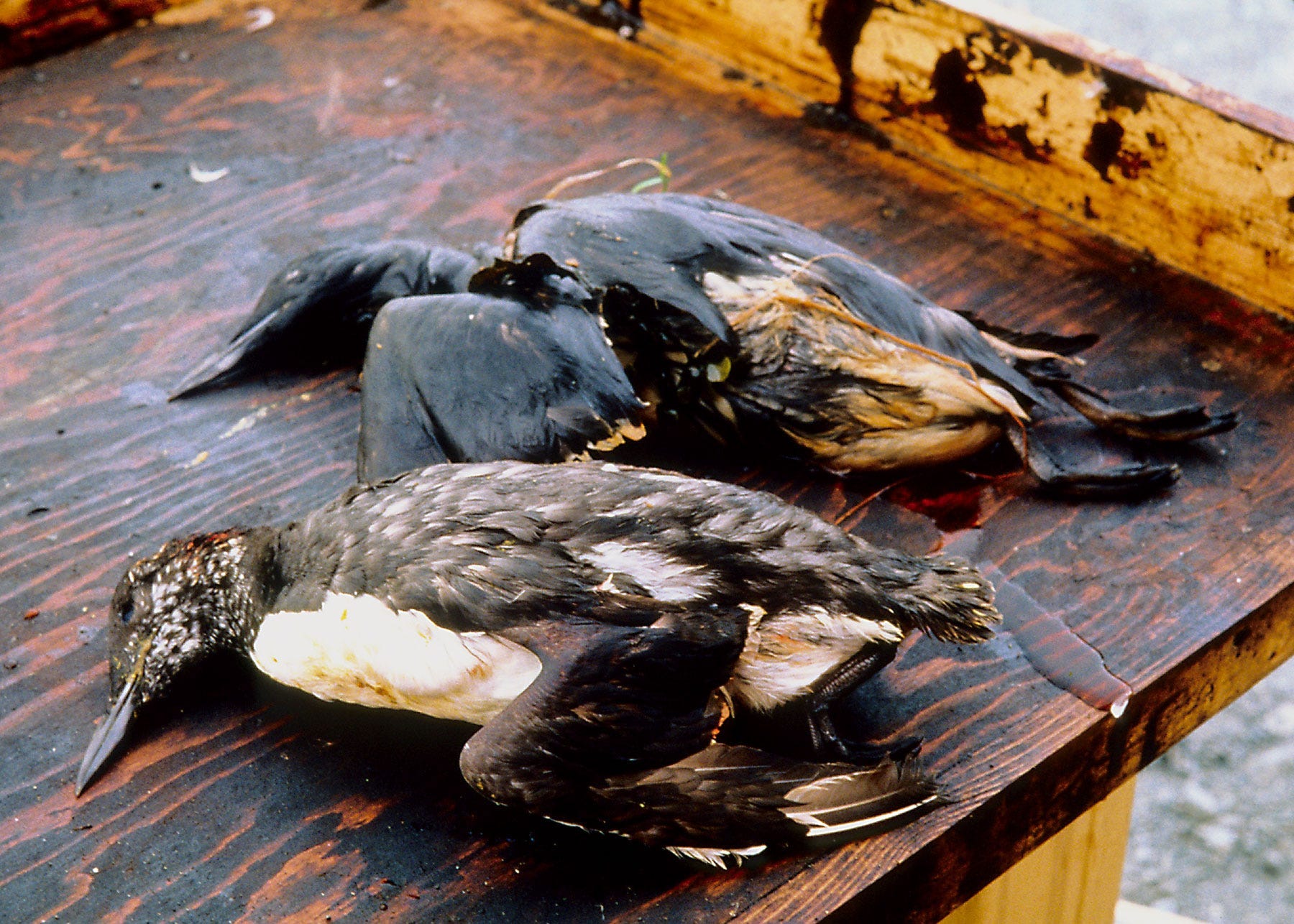

I mean, it wasn’t that big a deal. A tanker of mine spilled 10.8 million gallons of oil10 into Alaskan waters, but, hey, Alaskans are hardy folk. They’re like hobbits, only a lot bigger.
There were a few other messes, too, like Greenpoint in Brooklyn,11 where something like 17 to 30 million gallons seeped into the soil over a few decades. Sorry, Brooklyn! That’s why God made water filters, so hey, you’ll be fine.
Oh, and there was a little mess in Baton Rouge, too. It may have affected fishing folk a bit. Sorry for that. But hey, thank God for those Baton Rouge razor clams:12

Oh, oops, speaking of Baton Rouge, I almost forgot about the Baton Rouge benzene leak.13 A lot of headaches and respiratory issues.14 Because benzene. But hey! It was a long time ago. And probably not as bad as this Epstein business.
Oh, and Kevin Costner yelled at me for dumping some oil into the Yellowstone River:
Okay, that may have been about something else. People are always yelling at me about stuff, so excuse me for getting confused sometimes.
But you know what? I dunno about you, but I think the contrast between blue and brown water is kind of cool:

It’s like candy canes. Or mustard and ketchup. Right?
Switching gears is fun!
Long story short. In 1989, I looked at the facts on the ground (or in the ground, in the case of Brooklyn, lol!) and said to myself, “Screw this. I’m in deep doo-doo.” (as one of my purchased GOP presidents liked to say)
So I switched gears and helped start the Global Climate Coalition. All warm and fuzzy sounding, it was my way of sticking my tongue out at all you suckers and saying, “Nah, nah, no climate change here!”
The Global Climate Coalition spent the next couple of decades doing things like testifying to Congress that everything was just fine and oh, here’s a few hundred million dollars for your time. And running ad campaigns with soaring birds at ocean sunsets, telling the public everything was okay.
And, especially, cuddling up with right-wing radio hosts and Fox News.
I had to hide this, though:
That was one of the scientific documents (by real scientists!) created in 1982 that laid out some pretty scary scenarios about climate change. There were a few more of these, but shush about that, K?
The document said that the only way to fix things
“would require major reductions in fossil fuel combustion.”
“Yikes. Where do I hide this?” I wondered.
I mean, good golly Miss Molly, I’m on TV and stuff saying climate change is fake news! And I have this thing lying around?
So anyway, as I’ve gotten older, I’ve come around to thinking I’ve done some bad things.
I guess it’s realistic to say that my activities have killed millions of people.
It’s true. It’s my true confession.
I wonder what the Supreme Court would have to say about this. I’m a person, right?
Ha. They won’t care. Not a bit. Because I know, and you know, that corporations are only people when it’s convenient for the powers that be.
Pass the napalm, I’m gonna party!
Notes
Author’s note: I tried to add some levity to a grim situation. We’re dealing with quotes like this:
“15 years ago, a 100,000-acre fire would be the largest fire of your career. Now, we have one-million-acre fires. It’s hard even for us to comprehend.”
— New York Times, 10–11–202215
And this:
Thousands of toxic sites across US face risk of coastal flooding
— The Guardian16
Last week, the United States did not send a representative to the yearly climate change confab, COP30. Instead, Gavin Newsom showed up.
This story was inspired by the recent news that, as a seven-year-old climate deception lawsuit in Colorado finally moves forward, ExxonMobil and Suncor, the defendants in the case, have made a desperate plea to the U.S. Supreme Court that the matter be dropped because it will damage the companies’ finances.17
The suit was filed by the city of Boulder, Colorado.
ExxonMobil and Suncor have long feared the possibility that this case will become for the fossil fuel industry what cigarette liability cases became for the tobacco industry. It’s a legitimate fear, although it’s not like the tobacco industry went out of business despite getting hammered for giving half its customers lung cancer.
The two companies aren’t shy about announcing their motives:
There are few, if any, more consequential questions pending in the lower courts concerning the relationship between state and federal law. The Colorado Supreme Court’s decision was incorrect, and it provides this Court with the opportunity definitively to address whether the state-law claims asserted by dozens of States and municipalities can even proceed—and to do so before the energy industry is threatened with potentially enormous judgments.
They go on to beg the court to just let the Trump regime decide everything:
At a minimum, the Court may wish to call for the views of the Solicitor General in order to receive the perspective of the new Administration on whether certiorari should be granted.
Yikes.
Thanks for reading!

Footnotes
Standard Oil to Exxon to ExxonMobile when Exxon merged with Mobil Oil, if you must know.
Hall, Shannon. 2015. “Exxon Knew about Climate Change Almost 40 Years Ago.” Scientific American. October 26, 2015. https://www.scientificamerican.com/article/exxon-knew-about-climate-change-almost-40-years-ago/.
Dormehl, Luke, and Luke Dormehl. 2025. “Today in Apple History: Apple Becomes World’s Most Valuable Company.” Cult of Mac. August 9, 2025. https://www.cultofmac.com/apple-history/apple-most-valuable.
Chua, Manfreid. 2024. “Water vs. Sustainable Cooling in Data Centers | ZutaCore.” Zutacore.com. ZutaCore Inc. October 14, 2024. https://blog.zutacore.com/zutacore-blog/data-centers-are-getting-thirsty.
If the sun evolves into an aging red giant, its corona will reach into or close to Earth’s orbit, meaning we all ultimately end up cremated.
Scientific American, ibid
Song, Lisa. 2015. “Exxon’s Own Research Confirmed Fossil Fuels’ Role in Global Warming Decades Ago - inside Climate News.” Inside Climate News. September 16, 2015. https://insideclimatenews.org/news/16092015/exxons-own-research-confirmed-fossil-fuels-role-in-global-warming/.
“Harold N. Weinberg - inside Climate News.” 2015. Inside Climate News. September 15, 2015. https://insideclimatenews.org/news/15092015/harold-weinberg/.
Contributors. 2001. “Oil Spill.” Wikipedia.org. Wikimedia Foundation, Inc. December 10, 2001. https://en.wikipedia.org/wiki/Exxon_Valdez_oil_spill.
Contributors. 2007. “Large Oil Spill near New York.” Wikipedia.org. Wikimedia Foundation, Inc. February 11, 2007. https://en.wikipedia.org/wiki/Greenpoint_oil_spill.
From The Advocate:
Stout razor clams may be on the cutting edge of oil spill cleanup, according to University of Louisiana at Lafayette researchers.
After simulating an oil spill, faculty and student researchers found coastal sediments that held razor clams retained 25 percent less oil than areas where the mollusks weren’t present.
That could mean clams are either absorbing oily residue or might be burying it. Either way, they’re acting as frontline custodians combatting environmental crises, said Paul Klerks, a UL-Lafayette biology professor and one of the project’s investigators.
Special. 2019. “Razor Clams Don’t Mess around after Oil Spills, UL-Lafayette Researchers Find.” The Advocate. February 4, 2019. https://www.theadvocate.com/acadiana/news/business/article_8c9fa6ba-288c-11e9-b60f-9fdb4901e08c.html.
Also from The Advocate:
The Louisiana Department of Environmental Quality issued a compliance order and notice of potential penalty against ExxonMobil Chemical on July 19 that in part states the facility did not notify the state and other agencies when estimates of a leak amount June 14 substantially changed.
According to the order, on June 14, a leaking plug at a tank was discovered, and naphtha, which includes a number of compounds including benzene, was released. The incident was reported to DEQ and other required agencies. The next day, it was estimated that 1,364 pounds of material was released, according to the order.
On June 18, facility representatives told DEQ officials that ExxonMobil Chemical staff had determined June 14 the release was a “Level 2 incident classification” which meant a significant response by the facility was needed.
However, according to the order, the facility did not tell DEQ on June 14 that the facility’s estimated of the amount of material was “substantially different that what was previously reported to the Department.”
“La. DEQ Demands Timeline on Spill from ExxonMobil.” 2025. Archive.org. 2025. https://web.archive.org/web/20130502002220/http://theadvocate.com/home/3423221-125/la-deq-demands-timeline-on.
“Plant Neighbors Complain of Ailments.” 2025. Archive.org. 2025. https://web.archive.org/web/20130501234054/http://theadvocate.com/home/3602499-125/plant-neighbors-complain-of-ailments.
McDonald, Brent, Sashwa Burrous, Eden Weingart, and Meg Felling. 2021. “Inside the Fight against the Dixie Fire.” Nytimes.com. The New York Times. October 11, 2021.
Ruminato Gift Link 🎁 https://www.nytimes.com/interactive/2021/10/11/us/california-wildfires-dixie.html?unlocked_article_code=1.4E8.9Jdp.odOhkPOEo5mB&smid=url-share 🎁
Yang, Maya. 2025. “Thousands of Toxic Sites across US Face Risk of Coastal Flooding.” The Guardian. The Guardian. November 20, 2025. https://www.theguardian.com/environment/2025/nov/20/toxic-sites-us-coastal-flooding.
https://www.supremecourt.gov/DocketPDF/25/25-170/369227/20250808130855966_Suncor_pet.pdf
Corporations should be stripped of personhood status and be forced to abide by a Bill of Corporate Responsibility. It's nonsensical that they were granted that status in the first place.
I see the millions of disposable plastic side bottles and garbage that flow down a river into the ocean.
This piles up on the beaches and washes around in the tides and currents.
This is form of pollution is the worst IMO.
Carbon dioxide is absorbed and used in photosynthesis.
Carbon monoxide is toxic and not spoken of.
Why are they not capturing carbon monoxide?