

Trigger warning: Christianity! Sort of.
Writing a book review of a book written by God is a bit intimidating.
According to the Foundation for Inner Peace,1 the publishers of A Course in Miracles, that’s what I’m doing. The 700-page book (very small font), they say, was channelled by Jesus Christ.
It’s easy to scoff at such a notion, especially during our cynical, modern times. Western history is full of weird religious cults and bizarre takes on Christianity. It would be perfectly normal to drop A Course in Miracles into that bucket.
I first took notice of A Course in Miracles a long time ago, during the Bill Clinton presidency, when its chief proponent, Marianne Williamson, was said to be Clinton’s spiritual advisor. My memory doesn’t serve me well enough to recall if that was before or after Clinton’s very public battle and bottoming out with his sexual addiction that climaxed (sorry) with lurid rumors of interesting ways to use cigars in the Oval Office.
I bring Clinton up because, along with love, redemption and forgiveness are the central focuses of A Course in Miracles. I can’t answer whether Clinton healed. But Williamson’s association with Clinton is what first brought the book to my attention.
In reviewing this book, I doubt that I could pull off what Marianne Williamson did when she made a fortune interpreting A Course in Miracles, which was supposedly written by the man himself, Jesus, through a channeling process with a woman who was — no way to sugarcoat this — a bad writer.
Williamson wrote A Return to Love: Reflections on the Principles of A Course in Miracles, and made enough money that she was able to eventually run for president.
I love miracles, don’t you?
I get the sense, though, after reading A Course in Miracles, that God doesn’t much care that Williamson made a mint off it.

Williamson was able to distill a thousand-page tome into a 336-page bestseller. Pretty good trick.
I doubt I could replicate Williamson’s feat in a full-length book, so I’m certainly not going to try in a Substack post.
Instead, I’ll provide a quick background, briefly cover a few basic tenets that I believe are central to the book, and sprinkle it all with some of my interpretations.
Some background
A Course in Miracles, referred to from this point forward as ACIM, was released in 1976 by Helen Schucman,2 who said at the time that the entire text of the book was dictated to her verbatim by Jesus Christ through a process she called “inner dictation.”
My first thought as I began my journey into ACIM was, “Couldn’t the Lord have chosen a better writer?”
Because, wow, this thing is dense.
And then, I encountered my first miracle upon reading the book.
“No,” a voice seemed to say in my head. “If I had chosen a good writer, that writer would have used her creativity to change the words, and thus the meaning, of the paragraphs within.”
The changes wouldn’t be caused by malevolent intent. It’s just what we writers do. It’s doubtful that our imaginations would favor verbatim channeling. We’d get in the way of the thing. If it was me, I’d probably toss in a story about a Bible-thumping vampire while I was at it.

So, the universe’s master of ceremonies chose a clinical psychologist and researcher with a very dry, difficult-to-read writing style who’d interpret heavenly messages pretty much the way they were delivered.
The Basic Tenets of ACIM
Most interpretations of ACIM tend to veer away from the Jesus Christ angle, probably for fear of scaring off potential readers. I’ll do the opposite and say that the Christ angle is a feature, not a bug.
Surprisingly, Jesus Christ, if he really channeled the book (and I’m not here to convince you that he did), spends a hefty number of pages disavowing Christianity. You’d think the dude was an atheist. He seems appalled at the way Christian churches have applied the tenets of Christianity.
Further, he disavows the concept of original sin, which is the basis for much of Christianity’s toxicity and the core of much of its teaching.
It’s all about love
The core message of A Course in Miracles is clear: Our very essence, because we are all children of God, consists of love. Christ, according to ACIM’s narrator, is our sibling.
This is in line with Ephesians 1:5:
In love he predestined us for adoption to himself as sons through Jesus Christ
ACIM goes so far as to say that we are all Christs and that the only difference between our resurrection and Jesus’s is that Jesus didn’t have to sit in the waiting room after his body ceased functioning (and since time is a human invention, neither will we).

According to ACIM, nothing matters except love and how we apply it to our daily lives, and, most importantly, to the people around us. And the most direct application of love we can individually provide is through forgiveness.3
The ACIM edition I own features a long set of lessons that build on its first lesson, which asks the reader to establish a rote practice upon every encounter, living or not.
If we see a chair, we say to ourselves that the chair doesn’t matter. If we see a squirrel, it doesn’t matter (try telling that to your dog, however).
If someone harms you, it doesn’t matter.
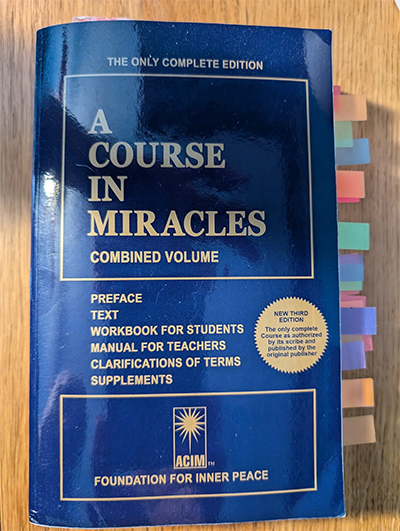
If you look at the top photo of my personal copy of the book, you’ll see a gazillion sticky tabs where I record favorite passages. Almost all of them cover the topic of forgiveness and how to achieve it.
To achieve forgiveness, which can be difficult, we need to understand that we have separated ourselves from God by making everything else in the world more important, including the smallest things in life.
This is similar to what the Bible often refers to as a fallen world, but ACIM doesn’t describe it in terms of a woman snatching forbidden fruit from an apple tree.
Instead, our downfall involves our willful determination to create perceptions about ourselves. These are fed first from childhood experiences. As we continue through life, we drift further away from God as we seek to establish our identities and assign more importance to everything on earth than we do to God.
The more effort we put into this process, the more fear creeps in:
You have every reason to feel afraid as you perceive yourself. This is why you cannot escape from fear until you realize that you did not and could not create yourself. (ACIM, T-3.IV.3:8–9)
We spend most of our lives trying to create ourselves, which, the narrator assures us, is impossible.
ACIM acts as a training manual in that regard. The road to discovering enough enlightenment that we no longer need to create our identity must be paved without the obstacles that block love and forgiveness.
Everything we do is driven by our Ego
The ego, according to ACIM, is a monumental failure, very nearly a living creature, that is in a constant state of conflict with the loving nature of our souls. But our loving nature gets buried by our constant attempts at defining ourselves within the context of society’s expectations.
ACIM opens its chapter on the ego by saying:
“Either God or the ego is insane…Each is internally consistent, but they are diametrically opposed in all respects so that partial allegiance is impossible… The ego, then, is nothing more than a delusional system in which you made your own father. (ACIM, T-11.in.1:1–7)
It’s difficult to parse a paragraph like that without context. The text of the book before this passage emphasizes the point that most of the little time we spend contemplating God involves creating him in our own image.
Christians, especially, have created false representations of God for 2,000 years.
In ACIM, God is not an allegorical father. He is our father, and we are his children, and Christ is our sibling, equal and not superior to us. He has reached a stage of ascendance, but so have we. We just aren’t aware of it.
The narrator’s critique of Christianity is harsh and relentless. Christian thought leaders and theologians have focused all their energy on creating a monster God who sacrificed his son and threatens your spiritual survival 24 hours a day by demanding an endless stream of repentance.
Their God is a god who will apprehend you the moment you die, and perhaps teach you brutal lessons. If you don’t believe in Christ, this God may, depending on whose manufactured God is in charge, torture you for eternity.
The truth, according to ACIM’s narrator, is quite different. In the spiritual realm he describes, no demands are made of you. You are his child, the beneficiary of endless, unconditional love.
We exist in a painful world because we are all in the midst of a birthing process that represents a short flicker of time in our material world. There are no requisites for reaching the other side of the birth canal. The birthing process simply concludes, and we become whole within the entity that is God.
Fifty percent off Ruminato until October 6 at 11:59 pm

The problem with the ego, according to ACIM’s narrator, isn’t that it is evil. Evil does not exist in the narrator’s vision. The problem is that the ego doesn’t even know what it wants, because it is nothing more than the embryonic fluid of spiritual birth that only exists as the manifestation of our temporary separation from God.
The ego only has vague ideas about what it doesn’t want as it tries to build you in its own confused image instead of God’s:
In any situation in which you are uncertain, the first thing to consider, very simply, is “What do I want to come of this? What is it for?” ³The clarification of the goal belongs at the beginning, for it is this which will determine the outcome. ⁴In the ego’s procedure this is reversed. The situation becomes the determiner of the outcome, which can be anything. The reason for this disorganized approach is evident. ⁷The ego does not know what it wants to come of the situation. ⁸It is aware of what it does not want, but only that. ⁹It has no positive goal at all. (ACIM, T-17.VI.2:1–9)
The ego blocks love, according to the narrator, and when we block love, we block the kind of interaction we need with people to move forward in life with contentment, no matter how materially successful we are. This is one reason why you see endless levels of greed among the very rich.
No matter how much wealth they achieve, happiness and joy are beyond their reach because they don’t process human interaction with love. The more you attain without love, the more you want. The ego blocks your attempts at love because it has determined that it will get in the way of your success, and an endless cycle begins:
The ego is a wrong-minded attempt to perceive yourself as you wish to be, rather than as you are (ACIM, T-3.IV.2:3)
And who are you? The ego will ask, but it can’t answer, because it is incapable of answering questions, only asking them. It builds more questions as you strive endlessly for success in a world not of God’s making.
All temptation is derived, according to the narrator, not from a little devil on your shoulder prodding you to do something, but because the ego is always asking you questions about your material contentment on this earth. Are you happy? No, generally not is a rather typical answer, especially among those striving for human goals.
Freudian psychology rejected
According to Sigmund Freud,4 the ego is
“that part of the id which has been modified by the direct influence of the external world.”
The narrator doesn’t explicitly disagree with this definition. But he disagrees that it should form the basis of psychiatric examination.
The author argues that we should simply ignore the ego at every turn and wish it out of existence. The guided meditations in the back of the book provide specific instructions on how to do so.
ACIM’s Relationship with the Bible
I had a prerequisite of sorts for reading ACIM. I wanted to be sure I had read the Bible first. Even though I was baptized a Christian in my youth, I resisted it mightily until my mid-fifties for the reasons most atheists do.
But then a few miracles entered my life that I couldn’t explain away, so after a couple of years of reading the Bible daily, I finally wanted to explore this book with “miracles” in the title.
If ACIM seemed counter to the Bible’s teachings, I reckoned it wouldn’t be right for me.
Most conservative Christians will tell you that the ACIM’s teachings fly directly in the face of Christian teaching. In a sense, they’re right, if you’re thinking about human teachers.
But I found that its essence was very much in line with Christianity as Jesus taught it. Two books of the Bible struck me as in perfect alignment: John and Ecclesiastes.
This passage from John, Jesus’ High Priestly Prayer, sums up the ACIM quite well for me:
And I am no longer in the world, but they are in the world, and I am coming to you. Holy Father, keep them in your name, which you have given me, that they may be one, even as we are one,
— John 17:11
The concept of the ego being in direct conflict with our inner Christ is represented in the Bible, in this case, 1 John 4:3:
…every spirit that does not confess Jesus is not from God. This is the spirit of the antichrist, which you heard was coming and now is in the world already.
The ego, in other words, is an antichrist.
The Bible has no consistent definition of hell. Jesus describes it in a metaphor occasionally, but only in reference to how we create our own hell on earth when we damage our psyche and hurt people.
There’s a good reason for there to be no formal, reliable definition for hell, according to ACIM’s narrator: Hell doesn’t exist outside of our overactive imaginations, which are fed by our ego:
The belief in hell is inescapable to those who identify with the ego. Their nightmares and their fears are all associated with it. The ego teaches that hell is in the future, for this is what all its teaching is directed to. Hell is its goal. For although the ego aims at death and dissolution as an end, it does not believe it. The goal of death, which it craves for you, leaves it unsatisfied. (ACIM, T-15.I.4:1–6)
In the end, the narrator insists, the ego’s goal of hell cannot be reached because hell doesn’t exist. The only possible outcome of our birth into God’s moral universe is a complete convergence with God.
Abundance
The narrator doesn’t talk much about abundance, but he does indicate that we are not given dreams we can’t fulfill. Furthermore, he insists that humility does not demand that we settle for anything less than greatness, even during this painful birthing process we call mortal life:
Humility will never ask that you remain content with littleness. But it does require that you be not content with less than greatness that comes not of you. (ACIM, T-18.IV.3:1–2)
Humility is misunderstood, according to the narrator. It isn’t about acquiescing to others or to a condition less than we deserve. Humility is simply the act of forgiving anyone who opposes us, even if that act of forgiveness is nothing more than a prayer.
But it isn’t a lesson we must learn:
Humility is a lesson for the ego, not for the spirit. (ACIM, T-4.I.12:2)
Our holy spirit is not capable of humility, ACIM says, because it isn’t bound to the human contrivances of our ego’s definition of God, heaven, and hell, and the resentments that supercharge our existence. There is nothing, in other words, to be humble about when we fall fully within the embrace of God.
The Crucifixion
The narrator rejects Christian teaching that the Crucifixion was a murder on behalf of a cruel Father God. He says, instead, that the Crucifixion is a reflection of the attempt by the ego to crucify everyone we meet at one point or another:
The crucifixion had no part in the Atonement. Only the resurrection became my part in it. (ACIM, T-14.V.10:1–2)
As you can see, there is no question here about whether the narrator believes he is Christ and was resurrected.
The Crucifixion, according to the narrator, was very much a human event. Not one led by God. The narrator uses the Crucifixion tale to declare that forgiveness erases the need to crucify one another or take revenge. Each time we engage in an act of love toward someone who has not earned it, one more nail is removed from the metaphorical wrist.
Quantum physics
ACIM contains doses of quantum mechanics, just like the Bible, when Jesus prays to his father:
Father, I desire that they also, whom you have given me, may be with me where I am, to see my glory that you have given me because you loved me before the foundation of the world.
— John 17:24
References to quantum mechanics are sprinkled throughout the Bible:
He was foreknown before the foundation of the world but was made manifest in the last times for the sake of you who through him are believers in God, who raised him from the dead and gave him glory, so that your faith and hope are in God.
— 1 Peter 1:20–21
Even Ecclesiastes, in the Old Testament, gets into the act:
That which is, already has been; that which is to be, already has been; and God seeks what has been driven away.
— Ecclesiastes 3:15
Time has no existence in God’s universe:
But Jesus, knowing in himself that his disciples were grumbling about this, said to them, “Do you take offense at this? Then what if you were to see the Son of Man ascending to where he was before? It is the Spirit who gives life; the flesh is no help at all. The words that I have spoken to you are spirit and life.
— John 6:61–64
If you believe in the historicity of the crucifixion, then it’s helpful to understand God as a quantum creature. Every good act reduces his suffering on the cross, even though within our perception his suffering already has occurred. From ACIM:
Every situation, properly perceived, becomes an opportunity to heal the Son of God. And he is healed because you offered faith to him, giving him to the Holy Spirit and releasing him from every demand your ego would make of him. (https://acim.org/acim/en/s/229#2:1-2 | T-19.I.2:1–2)
However, Christ’s description of his suffering suggests that the suffering occurred not on the cross, but occurs now during this birthing process we share with him within the expansive tableau of the universe he shares with us, which, to partially borrow the phrase from a popular movie, is everywhere, all at once, and within the scope of all times.
It isn’t sufficient to merely do good acts. We must, ACIM says, help others do good acts, too, if we wish to limit his suffering, and by extension, ours, since we share his space in the continuum.
My conclusions now that I am more certain than ever that I know nothing
Was ACIM really channeled through Christ? I have no idea. But I do know that the book comports with my belief system.
I don’t believe in a monster God. I believe that Christian theologians and clerics have wrecked the teachings of Jesus.
I don’t believe in a God who would create a place like hell. Or that those who don’t believe in God will suffer some sort of wild, evil eternity populated by fiery beasts with claws.
What, then, of the Hitlers and Mansons of the world? Where in our metaphysical world do they reside? Again, I don’t know. They may have been nothing more than mounds of uninhabited flesh. Such people may live among us, ruled exclusively by the ego that is determined to send that person to a hell of its creation, and, quite simply failing, leaving nothing behind in its wake upon passing.
These are all questions well beyond my pay grade.
One thing I’m certain of is that the God I believe in is the one who tells us in 1 Corinthians 13:
Love is patient, love is kind. It does not envy, it does not boast, it is not proud. It does not dishonor others, it is not self-seeking, it is not easily angered, it keeps no record of wrongs.
That’s a perfect summary of A Course in Miracles. If you can grasp that Bible passage, and live it daily, you don’t need to read ACIM.5 That paragraph says it all.
NOTES
This introduction to A Course In Miracles was admittedly terribly brief, even though it was a long read by social media standards. Much will be lost in my lame translation. If you’re interested in learning more about it, I recommend searching a bookstore for books that provide an introductory framework into its teachings.
I can’t offer recommendations because I haven’t read any of them. If you have, please leave a comment for others to see!
If you’ve read ACIM, your interpretations may be quite different. I’d love to hear them in the comments. Be nice.
The full text of A Course in Miracles can be found here:
If you think this is all a bunch of hooey, I understand. To many, the very concept of a god is laughable. To others, the concept is so bereft of fairness and justice that they consider religion an enemy.
Given our current political environment and the 2,000-year Abrahamic Wars over the act of simple interpretation, I can understand why.
I’m no evangelist. I’m just a guy trying to sort out the meaning of life before these old bones become the dust of the universe.
The bulk of this post first appeared on the Medium platform in September 2024.
Thanks for reading! Check out my new novel, Psalm of Vampires, about a Bible-thumping vampire who runs into a whole lot of problems.
Kirkus Reviews says it’s “A fun, witty, and innovative contemporary fantasy adventure, Get it!”
Every chapter is also available here to all subscribers on the Ruminato Substack:



Half off paid subscriptions
This half-off offer is valid until 11:59 October 6
Or…
Footnotes
“Home • Foundation for Inner Peace: Publisher of a Course in Miracles (ACIM).” 2019. Foundation for Inner Peace: Publisher of a Course in Miracles (ACIM). March 13, 2019. https://acim.org/.
Contributors. 2004. “American Clinical and Research Psychologist (1909–1981).” Wikipedia.org. Wikimedia Foundation, Inc. May 24, 2004. https://en.wikipedia.org/wiki/Helen_Schucman.
When I originally wrote this “book review” on the Medium platform, I received this great comment from a Muslim reader that I’ll include unedited in its entirety:
As I reflect on your experiences, I am reminded of the Islamic concept of Tawbah (repentance), where we seek forgiveness and redemption from our mistakes.In Islam, we believe that Allah is the ultimate source of guidance and mercy, and that He has sent prophets to guide us towards the path of righteousness. The Quran reminds us that “And whoever does not judge by what Allah has revealed - then it is those who are the disbelievers.” (Quran 5:44) This verse emphasizes the importance of following the guidance of Allah’s revelation, rather than seeking enlightenment through personal experiences or self-help books.
While I understand the appeal of the Course in Miracles’ message of love and forgiveness, I would like to respectfully offer an alternative perspective. As Muslims, we believe that our salvation lies not in our own efforts or spiritual growth, but in surrendering to the will of Allah. The Quran teaches us that “And if Allah should guide one, no one can mislead him; is not Allah Exalted in Power, Wise?” (Quran 6:116)
In conclusion, I encourage you to consider the wisdom and guidance offered by Islam, which has been perfected for humanity by Allah’s revelations. I invite you to explore the beauty and depth of Islamic teachings, and to discover the mercy and forgiveness that comes from surrendering to Allah’s will.
“Id, Ego, and Superego.” 2025. Simply Psychology. March 13, 2025. https://www.simplypsychology.org/psyche.html.
Don’t fret, I don’t live it daily, either.
I guess if we see God as really a quantum force, along with all the uncertainty that results from that, then there isn't much difference between Christianity and what I believe in, which Dylan Thomas called "the force that through the green fuse drives the flower." I am convinced that Whatever "god" is s/he doesn't give a flip about individual people in terms of judging what we do. The point is we have no clue.
I was just talking to my daughter about the idea that for all we know, Heaven is whatever we most want it to be. In my case it would be a place where all books are in ebook form, and all free. And there are comfortable chairs. (BTW, my favorite reading chair DOES matter. It was my Dad's and is over 75 years old, and is a connection forever to him. I hope that chair shows up next to the Kindle Of Heaven.
Meanwhile, the moral position of the message is well worth heeding. As you point out there are chunks of that lesson even among the vindictive rants of the OT.
And I have no quarrel at all all with the power of love and forgiveness, but I don't think we need a god to tell us that it is important. I just ask that we have a society which tries to STOP evil from happening: stop Manson first, then forgive him if you wish. Stop ICE first, then take time for forgiveness if you wish. Just be sure that forgiveness doesn't encourage ICE or Manson to think it is cool to be what they are.
One question: if this thing was Jesus being channeled, isn't it HE who is a bad writer? Possibly because he's trying to use a language that didn't exist during his time on earth?
I enjoyed this post very much. You had me at the subtitle. Hard to remember that these days. Also, forgiveness is harder to come by than ever before. And, this time, not a stretch to work in Quantum Mechanics! As I read that section of your post, the end of the 'Glory Be' began to echo in my mind. I'm sure you are familiar with it. 'As it was in the beginning, is now, and ever shall be, world without end. Amen.' In my mind, analogous to a superposition of time. That doxology (new word for me today!) is thought to date back to the 3rd century, possibly earlier.