

I’m only a partisan Democrat because I have to be. There is currently only one legitimate political party, and even that is largely beholden to corporate interests. Aside from a few token guardrails, almost everything you see coming out of the Democratic Party requires a group chat with its corporate sponsors.
The other national “political party” is a crime syndicate that consists exclusively of insurrectionists, murderers, child abusers, misfits, thieves, and other criminals who do the bidding of a sick wannabe king.
A big reason for this decapitation of democracy is that, as you know, elections are dominated by money more than ever.
The electoral capitalization frenzy became endemic when the Supreme Court declared in Citizens United that corporations are people, too.1 That ruling made it impossible to run for office without massive budgets resulting in headlines like “record spending” during every campaign cycle.
Elections became sponsorships. If politicians were honest, they’d wear sponsorship logos on the front of their suits and dresses. Preferably on the crotch.
I lead off with this to point out that the insurrectionists who control all three branches of government benefit from a compliant corporate media that covered the recent passage of a reasonably decent housing bill by describing it as a Republican effort that somehow miraculously became a bipartisan one, even though their Dear Leader refused to sign it.2
What has been left mostly unsaid is that one of the bill’s most important provisions comes through an amendment authored and sponsored by Democratic U.S. Senator Raphael Warnock of Georgia, one of the few politicians in our broken system that we can say appears to be one of the good guys.3
The only impact Republicans had on this part of the bill was that they looked the other way and pretended not to notice.
Called S.Amdt.4343 to H.R.6644, or, more appropriately, “F*ck institutional investors,” it bans the purchase of homes by entities that own more than 350 single-family homes.4
That seems like a lot of homes for one entity to own. And it is. But before the bill passed, there were no limits.
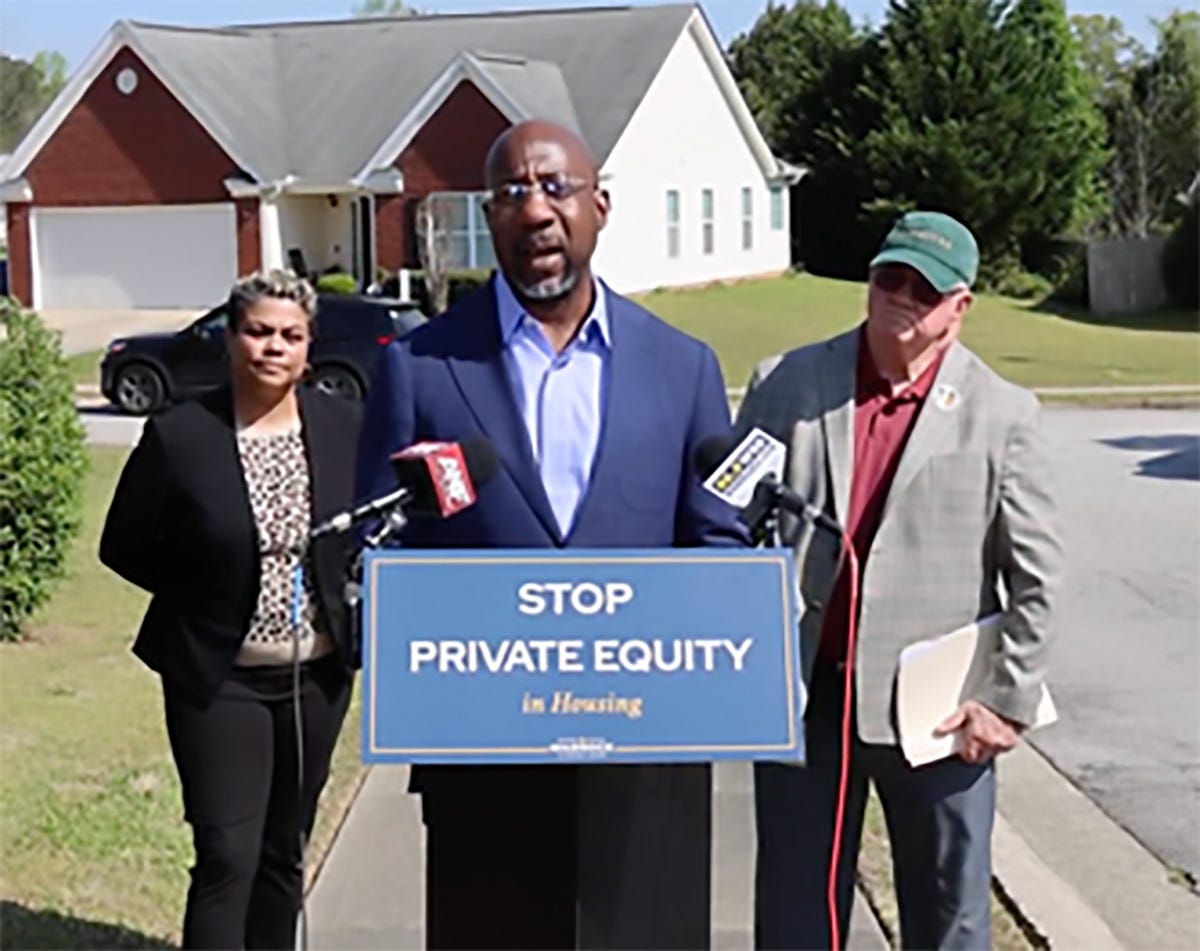
When Senator Warnock introduced the amendment, he stood with supporters in Paulding County, Georgia, a rural county in the Appalachian foothills near Atlanta where corporate investors own nearly 4,000 single-family rental homes.
Metro Atlanta is even worse. There, more than 70,000 single-family homes are owned by large corporations or institutional investors. According to Warnock’s office, this amounts to one quarter of all Atlanta single-family home rentals.
The homes get rented out, refurbished and flipped, or, more often than you’d like to think, remain vacant.
Schoolhouse Rocks Note: An amendment to a bill is made when a legislator proposes an addition to a bill, names it, and files it for the record as part of the bill before it comes to a final vote.
In January 2026, there were approximately 4600 homes for sale in Atlanta, according to MLS data. One institutional investor, American Homes 4 Rent, owned 6000 single family rental properties in Atlanta in 2025.
The company’s financial reports make it clear that they specialize in the kinds of homes that young people would like to own as their first real estate purchase. The typical American Homes 4 Rent house in Atlanta is a 2200 foot, $235,000 structure.5
This kind of activity snatches homes away from young buyers. You wouldn’t be hearing so many stories about starter home buyers plopping down cash and pushing those who rely on mortgage loans out of the market were it not for these big companies eating up local housing markets.
Warnock admits his amendment to the bill is just the first step. Nobody needs 350 single-family homes. Especially private equity firms that use them as investment vehicles designed to shut out people looking for starter homes.
But the problem when cleaving that number is that there are a lot of small operations consisting of people who invest in two, three, four, or maybe five properties. For legislators governing a late-stage capitalist system, the question becomes one of where to set the limit. Ten? Probably not. Not in America. Twenty?
Hey, how about 350? So that’s the number they came up with.
The 3% fallacy
Opponents of the amendment have tried to argue that the nationwide rate of corporate or private equity single-family home ownership is only about 3%.
Numbers are not easy to reconcile among multiple sources, but recent trends indicate that private equity and large investors have been scooping up single-family homes at unprecedented rates.
Some estimates claim that institutional investors have bought as much as 40% of homes during the last few years. BatchData’s Investor Pulse Report puts the 2025 number at 34%.6
Interestingly, that same report headlines that institutional investors sold 23% more homes than they purchased. But digging through the data in the report reveals that most of those sales are to other institutional investors.
Most single-family rental homes owned by corporate investors, like in Atlanta, are starter homes rented out to the same people who would, in better economic times, rather take the plunge into owning their own place.
Protections against shell companies
You might expect that the first reaction from private equity firms will be for each of them to call their corporate attorneys and try to spin off a few thousand shell companies to deal with Senator Warnock’s restrictions:
“Saul, we’ve got 3500 single family rental properties in Chicago. How soon can you spin off ten shell company LLCs? 24 hours? Great! Make it so!”
But not so fast. Warnock wasn’t born yesterday. He grew up in public housing in Savannah, Georgia.7 He thought this through. The law specifically addresses the inevitable shell game. So he added language specifying the following rules defining an owning entity:8
The term ‘‘large institutional investor’’—
means an investment fund, corporation, general or limited partnership, limited liability company, joint venture, association, or other for-profit entity that is a legal entity structured in a manner that is not afore-mentioned that—
is engaged, in whole or in part, in the business of investing in, owning, renting, managing, or holding single-family homes; and
alone or in concert with 1 or more other entities, beginning after the date of enactment of this Act, directly or indirectly has investment control of not less than 350 single-family homes in the aggregate, not including any single-family home purchased in an excepted purchase made after the date of enactment of this Act; and
(ii) does not include any local, State, Tribal, or Federal government entity or instrumentality thereof.
There’s more in the Footnotes regarding how ownership is defined, too. Just click or tap the cute raised number!9 Footnotes are fun for the whole family. Check ‘em out.
Let’s talk about this
This is where you come in.
The only way to fight mainstream media’s right-wing bias and servility to the Trump administration is to help bring awareness of stuff like this to low-information voters who will be swayed by headlines like “Republicans Pass Housing Bill.”
How you do that is up to you. It can be as simple as just calling it Raphael Warnock’s Housing Bill. Nope. He didn’t write it all. But this was his amendment. In an era of disinformation, this is more than close enough.
Notes
I was hoping to release Chapter Two of Vampire Elegy, the sequel to Psalm of Vampires, today, but the narrator, Jade, is in Romania hunting down Andrew Tate and chilling with other vampires. He tells me that there’s a particularly harrowing bit of information regarding Charly he wants me to include in Chapter Two, but I can’t provide any more teaser than that because that’s all he said about it.
But you haven’t read the prologue or Chapter One yet, anyway, have you? Well, now’s a good time:

(I think the name is changing to something cooler, but not yet!)
Thanks for reading!
You can help me reach more people by subscribing (paid or free), sharing, restacking, and commenting.


Footnotes
221. “Citizens United, Explained.” Brennan Center for Justice, January 14, 2025. https://www.brennancenter.org/our-work/research-reports/citizens-united-explained.
He attempted to take the housing bill hostage by demanding passage of a voter suppression bill. The bill passed with large enough numbers that Congress would have overridden his veto, and the child predator hates to lose, so he simply chose to ignore it.
This link is interesting because it represents what I’m noticing as a trend lately: Local affiliates of MAGA networks like Fox and CBS are beginning to tilt the news away from their corporate masters and insurrectionists. Here, the local CBS news affiliate specifically credits Warnock in the headline:
Bynum, Zachary. “Sen. Warnock’s Ban on Private Equity Firms Buying Single-Family Homes Becomes Federal Law.” CBS News. CBS Atlanta, July 12, 2026. https://www.cbsnews.com/atlanta/news/sen-warnocks-ban-on-private-equity-firms-buying-single-family-homes-becomes-federal-law/.
Bynum, Zachary. “Warnock Pushes Bipartisan Plan to Curb Corporate Home Buying in Georgia.” CBS News. CBS Atlanta, April 2, 2026. https://www.cbsnews.com/amp/atlanta/news/warnock-pushes-bipartisan-plan-to-curb-corporate-home-buying-in-georgia/.
American Homes 4 Rent 2024 Annual Report: https://s29.q4cdn.com/671712101/files/doc_financials/2024/ar/AMH-2024-Annual-Report.pdf (PDF)
But BatchData counts small mom and pop operators as “institutional investors.”
BatchData. “Investor Pulse - Q3 2025 - BatchData,” June 8, 2026. https://batchdata.io/investor-pulse-q3-2025.
Wikipedia.org. “Raphael Warnock - Wikipedia,” 2020. https://en.wikipedia.org/wiki/Raphael_Warnock#Early_life_and_education.
RULE OF CONSTRUCTION.—For purposes of this paragraph, an entity has direct or indirect investment control over a single-family home if the entity—
owns, or has primary authority or fiduciary responsibility to make material investment or management decisions relating to, the single-family home;
is, or directly or indirectly controls, the general partner or managing member of the entity that owns the single-family home;
is or controls the investment manager, management company, or investment advisor of the entity that owns the single-family home;
owns or controls more than 25 percent of any class of equity interests of the entity that owns the single-family home, unless such entity is a passive investor; or
otherwise controls the entity that owns the single-family home.
https://www.congress.gov/bill/119th-congress/house-bill/6644
Thank you for this key information. Private Equity is a voracious monster. The New Yorker published an article 2-3 years ago about how Private Equity owned over 70% of all hospice providers. Hospice? And - managers took over pushing nurses to “sell” hospice services to people who didn’t need them. Disgusting. Apparently the term “private equity” is getting a bad reputation (haha) and may change their industry name to “Alternative Asset Management”. Pure theft.