

It’s easy to think that with all these bank, software company, and government outages that the U.S. is experiencing a zero-day type of cyberattack or that AI is running amok, and that it’s time to head to Costco and hope they’re still operating by the time you get there to stock up on canned goods, portable generators, energy drinks, and vodka.
It’s extremely unlikely that is happening. If it is, whoever is responsible for it isn’t very good at their job of death, destruction, mayhem, and blackouts.
Before I was writing and ranting here on Substack, I was a software engineer for some pretty big companies. I was nothing special. Just a guy. I was just like a lot of guys (mostly guys — men severely outnumbered women in the business, especially in my early days).
I was good at my job, but I wasn’t a brilliant software mind who did things like invent code that everyone flocked to.
So when I really want really big answers, I look outside the limited knowledge base of my own brain. For example, regarding this mess with all the software outages lately, my brain thinks, what does Dave Winer think? Winer is one of the nation’s best-ever software guys. He doesn’t play the Silicon Valley political game, so most of you haven’t heard of him, but he’s the dude who invented RSS feeds, podcasting, and, really, if we’re being honest, blogs.
And he’s always tinkering, trying to poke holes in the system, trying to find ways to de-enshittify the web. Not as many people pay attention to him these days as they once did, but he’s still one of the best around. He’s one of the few people in the world I rely on for hard truths in the software business.
Surely he’s had something to say about all this craziness on his Scripting News blog, right? Nope, he’s busy tinkering with Markdown, a markup language. Hasn’t said a word about it on his blog that I’ve seen.
I’ll admit I spent a couple of minutes wondering if some hackers might be probing for vulnerabilities, but I think sometimes the fiction writer in me gives me those kinds of ideas.
To explain why I’m not worried, I’m going to tell you a little story of eleven lines of code that nearly broke the internet in 2016.
How left-pad ruined everyone’s life for a day
A long time ago, when Netscape was still the dominant web browser, a scripting language called JavaScript took the web community by storm. Before JavaScript, browsers were pretty much just text-reading machines.
The primary interaction was clicking a link.
JavaScript entered the picture and made it possible to consume and interact with data: Data like banking info. Before much longer, the big banks were online. Everybody was happy because nobody was willing to try using banks online. Too scary.
Obviously, that has changed.
JavaScript was, by the standards of modern languages, a clumsy little software language. It was an “untyped” language, for one thing, which means that things like integers were not defined as integers — they had to sort of be interpreted as such by writing some extra code.1
No big deal. All software languages have their quirks. It was a lot of fun to work with, so software geeks lined up to learn it and use it. It became ubiquitous. These days, if you know how to turn off your browser’s JavaScript, you won’t be able to use most websites.
Hot tip: I use a JavaScript on/off extension to read some news sites that have paywalls because some paywalls are still handled on the “client side,” meaning the browser’s JavaScript. Many of those popups you see for paywalls are made in JavaScript code that basically says, “Show the rest of this page,” or not.
Most news sites have wised up to this old tech and are handling paywalls server-side, meaning it all happens on code stored on servers, but at one time, my method almost always worked. I’d guess that only about 20% of news sites handle paywalls on the client side these days, though.
Surprisingly, the Washington Post was one of the last to convert.
JavaScript became so popular that it became a server language, too. This means that the code used to send and interpret data to your browser was handled on the server. This is separate from JavaScript in your browser, which is all located right there in your browser app.
This was a big change because before then, languages like Perl, PHP (which is middleware based on Perl), Java, and Microsoft’s Active Server Pages (ASP — which technically isn’t a language but an instruction set — middleware — based on a language) were the primary drivers on the server side of things.
Eventually, an open-source server-side JavaScript library called npm (Node Package Manager) emerged.
Definition: open-source software is software that is written by a community of developers and made publicly available for free for everyone to use and contribute to.
It became wildly popular, especially after Facebook used it to help create a JavaScript user interface library called “React.”
Soon, Node, which was the name software developers gave the JavaScript server-side library, was used by major companies all over the place. When I was a UI/UX lead2 at PayPal, one of our big projects was to transition from Java on the server-side to Node.
It was a lot of fun. Seriously, it was. It was like going into work and solving puzzles every day. If you love puzzles, you’d love software development.
This brings us to something called left-pad. left-pad consisted of eleven lines of code. All the code did was add characters to the left side of a string.
The code was simple:
module.exports = leftpad;
function leftpad (str, len, ch) {
  str = String(str);
  var i = -1;
  if (!ch && ch !== 0) ch = ' ';
  len = len - str.length;
  while (++i < len) {
    str = ch + str;
  }
  return str;
}
There was no real reason to use the code because anybody can write something like that, but it was added to a variety of npm-related libraries, so it didn’t matter if you rolled your own “left pad” JavaScript function or didn’t use the left-pad function for anything.
You still had the dependency if you used certain npm packages. So when you made a code change and then tried to deploy it in either a testing environment or to production (often referred to as “going live”), the software that deployed your code failed because it couldn’t install npm without errors, which “broke the build.”
Definition: When a software developer breaks the build, it means they wrote some code that prevented the production or QA testing environments from collecting all its files properly and passing basic automated tests. When that happens, QA (Quality Assurance) or “build and release” teams (usually at big companies) send people with heavy weaponry to the perp’s cube and threaten an unpleasant death unless the perp fixes it within thirty seconds. Or something like that. I can’t remember for sure. It’s been a long time.
npm has a registry of software libraries that developers include in their build configuration files, which are, generally speaking, text files that say things like, “Include this specific code library.”
Most build environments used something called Babel to run their builds. Because Babel (and React) had a dependency on left-pad, builds broke all over the place when the bug was discovered (it was sort of discovered by everybody, everywhere, all at once).
How did faulty software enter important npm libraries with lots of code dependent upon it? It didn’t. What happened was that the developer who created the code pulled left-pad out of the npm package library set because of a dispute with Kik Interactive, the company behind Kik Messenger.
The software developer, Azer Koçulu, had created a library named kik. Kik interactive wrote him a little note one day:3
We don’t mean to be a dick about [the kik package], but it’s a registered Trademark in most countries around the world and if you actually release an open source project called kik, our trademark lawyers are going to be banging on your door and taking down your accounts and stuff like that — and we’d have no choice but to do all that because you have to enforce trademarks or you lose them. Can we not come to some sort of a compromise to get you to change the name without involving lawyers? Is there something we could do for you in compensation to get you to change the name?
Koçulu called them “dicks” when npm, Inc., which manages the npm library, sided with Kik Interactive and asked him to rename his kik library. He used a series of expletives to say, “Howz about I just yank all my code out of your repository and we go our separate ways?”
So npm sent him a command-line instruction for doing so, which Koçulu implemented, thus deleting 273 modules he had contributed to the npm open source project.
One of those was left-pad. Builds broke almost instantly.
The tech world went insane for about three hours until a fix was deployed. The average user didn’t see the problem, because the errors all happened during the build stage of website software releases, but the bottom line was that eleven lines of code a first-year computer software programming student could write in their sleep broke thousands of software deployments after one guy hit “Enter” when entering a delete command in his terminal.
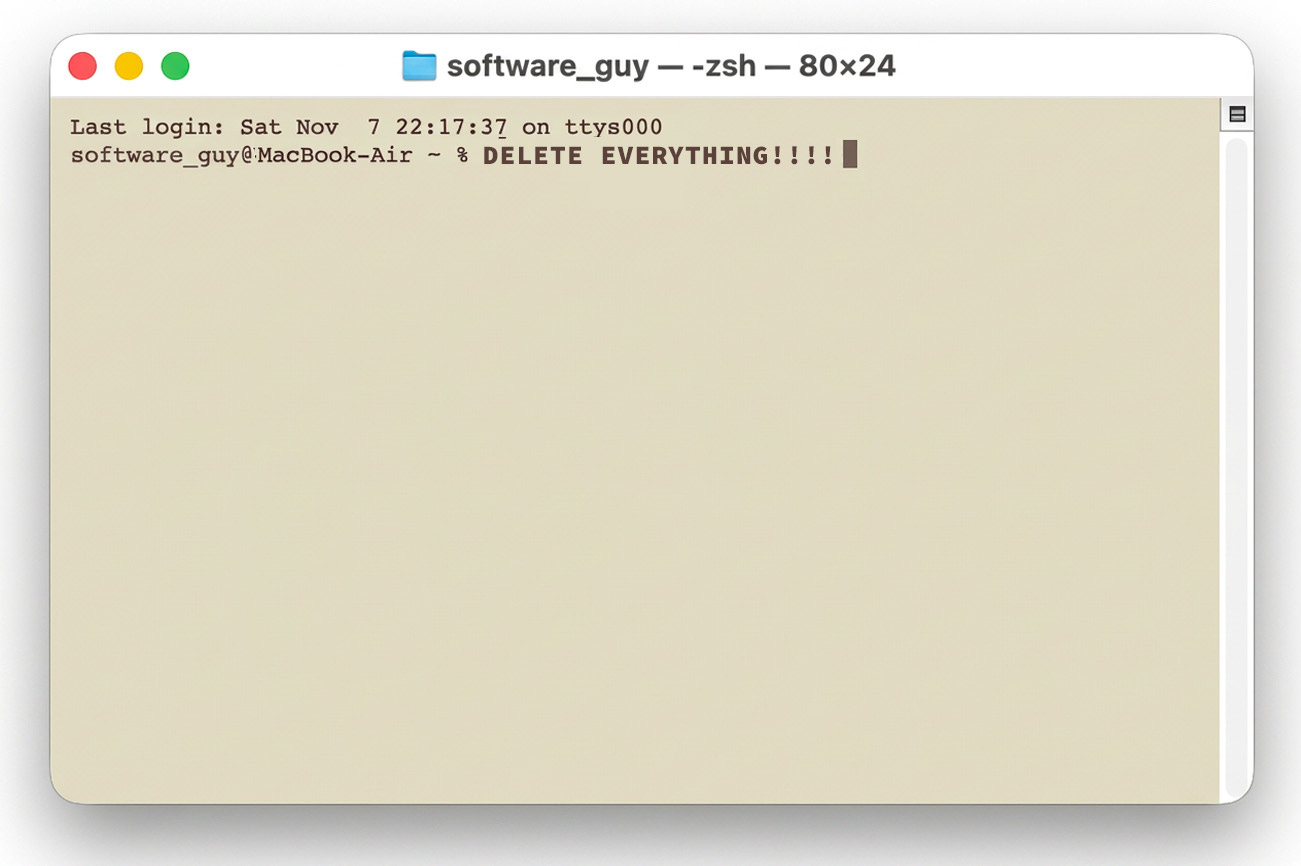
The deletion caused what is called a dependency-tree outage. A small, basic function was removed from a codebase somewhere, and all hell broke loose.
This kind of thing happens more than companies would like to tell you. After an outage, a company will often write in its press release, “There was a problem with a configuration file.”
That’s usually true. Configuration files are frequent culprits because configuration files are text files that typically don’t change much in any given year, but they do what it sounds like they do: They tell a software system how to configure things.
Here’s a basic, not real-world example of a configuration file:
# Basic application settings
app_name: My Website
port: 8080
debug_mode: true

database:
  host: localhost
  username: admin

allowed_users:
  - alice
  - bob
This is a tutorial-type example of a configuration file written in a markup language called YAML.
Real-world configuration files are considerably more complex, but that’s enough for you to see how an error, even a simple misspelling (such as misspelling the database name), can break everything.
These are static files, meaning they are simply text files with no coding variables aside from choices (such as those found in a comma-delimited array or something).
Coding errors are usually avoided because all large organizations have QA environments where there’s a lot of testing.
But sometimes, a change will be made to a configuration file that gets missed in testing. Then it goes live, and boom, you’re on the news.
And yes, even the NSA uses configuration files.
Next question
But still, why so many outages at one time?
Well, the FAA thing doesn’t count. It was pure incompetence on the part of the Trump regime. They tried to lay a pipe, and the pipe didn’t work, and they didn’t think that was possible, so they didn’t have redundancies, and they obviously didn’t test it in any way. So let’s skip that. They’ll do something like that again, anyway.
That leaves things like banks, software companies, and other government agencies. I’m pretty sure I saw Microsoft mention that their big outage was related to a configuration file, which makes sense because so many disparate parts of their system went down.
If you look at the example configuration file I showed you, I bet you can imagine how one small mistake in a very large, complex configuration file containing lots of entries could affect a lot of systems.
The same thing is probably happening with the other outages you see. A bad port number here or there can blow up a big chain of software packages.
Why is this all happening now? Because it’s the end of the year. Folks are rolling out configuration changes because the holidays are near. It’s really that simple. Get everything ready before the New Year starts.
It’s even possible that some of these outages are happening because folks are using the same configuration files for certain software deployments.
What about AI?
Another thing that has people freaked out is the AI scare within this scenario. An AI ‘attack” is unlikely because you’d be a fool to give AI the kind of file permissions needed to make wholesale changes in configuration files. At a bare minimum, one would hope that if you do let AI write your configuration file, you’d write tests for it. It’s not hard.
But even if you do give an AI agent authentication privileges to make those kinds of changes, the chances of an AI bot having such permissions across multiple domains (different companies and government organizations, etc.) are negligible.
AI makes code changes all the time, but not across different companies and organizations. That would be a permissions and authentication nightmare.
Disclaimer: Never discount the possibility of the stupidest thing imaginable by the current regime in charge of the U.S. bureaucracy.
Or, go to Costco
Keep in mind, this is one person’s opinion, but I think it’s solid. If you still feel like going to Costco to stock up, I won’t hold you back, but if you really want to doom prep, you should probably do it right:

Notes
This post is a strong argument why DOGE should never have been allowed anywhere near the federal codebase. They were messing with configuration files, according to some reports I read. I shook my head, and have been waiting for the fallout ever since.
My readers are pretty logical types, so many of you might be wondering: Why do software engineers include so many libraries like that little left-pad thingy when they can just write that kind of code themselves and not be part of a massive dependency tree?
Well, the problem is, as I mentioned, the code was already in big libraries that developers rely on. The general question of reliance on such libraries is a legitimate one, though. The event I described launched a big debate in that area:
NPM & left-pad: Have We Forgotten How To Program?
Thanks for reading!

You can now purchase a PDF of all my Substack Fiction. Only $4.99. That’s less than a Starbucks Venti Latte.
Enter SUBSCRIBER_SPECIAL to get a 20 percent discount.
It’s also now available on Amazon/Kindle in ebook, paperback, and hardcover formats (the Kindle version is free if you have Kindle Unlimited):
If you are a paid subscriber, it’s available free as a Perk. Just go to the “Perks” page via the web page menu to find it.
You can help me reach more people by subscribing (paid or free), sharing, restacking, and commenting.

Footnotes
For those of you software engineers out there who see the beauty of untyped languages, I won’t enter that debate. I’m “type” agnostic.
UI = User Interface, UX = User Experience
Feldman, Brian. “One Man Deleted 11 Lines of Code From the Internet and Broke Hundreds of Apps.” Intelligencer, April 20, 2019. https://nymag.com/intelligencer/2016/03/how-11-lines-of-code-broke-tons-sites.html.
I'm going to have to disagree with your basic premise, that we are not under attack. I believe that we are being attacked. We are under attack by an abundance of incompetency. A slew of top-ranked officials were culled from reality television, podcasts, and Twitter accounts then set loose on everything from food safety, medical principles, science trust, military... well, you get it. none of these individuals were proficient or even educated in the positions they were awarded. This was done with one objective: to invalidate in the public's mind the validity and reliance on of the form of government we currently have. Yes we are under attack. We are being attacked by the current administration.
This is the best advice, Charles. lol (Too bad it's an ongoing issue for them).
"Disclaimer: Never discount the possibility of the stupidest thing imaginable by the current regime in charge of the U.S. bureaucracy."