

Imagine 3,000 Black schoolchildren, children of ex-slaves, marching around a race track singing the song, “John Brown’s Body:”1
Old John Brown's body is a-mouldering in the dust,
Old John Brown's rifleís red with blood-spots turned to rust,
Old John Brown's pike has made its last, unflinching thrust,
His soul is marching on!
This was the scene one early May morning in 1865, in the aftermath of the Civil War, when nearly 10,000 newly emancipated slaves gathered around a race track to honor not only Union soldiers, but to celebrate ten days of effort by two dozen African Americans from Charleston, South Carolina.2
The two dozen newly freed slaves had spent that time digging up the graves of Union soldiers from a mass grave site left by Confederate soldiers, bringing honor to desecration.
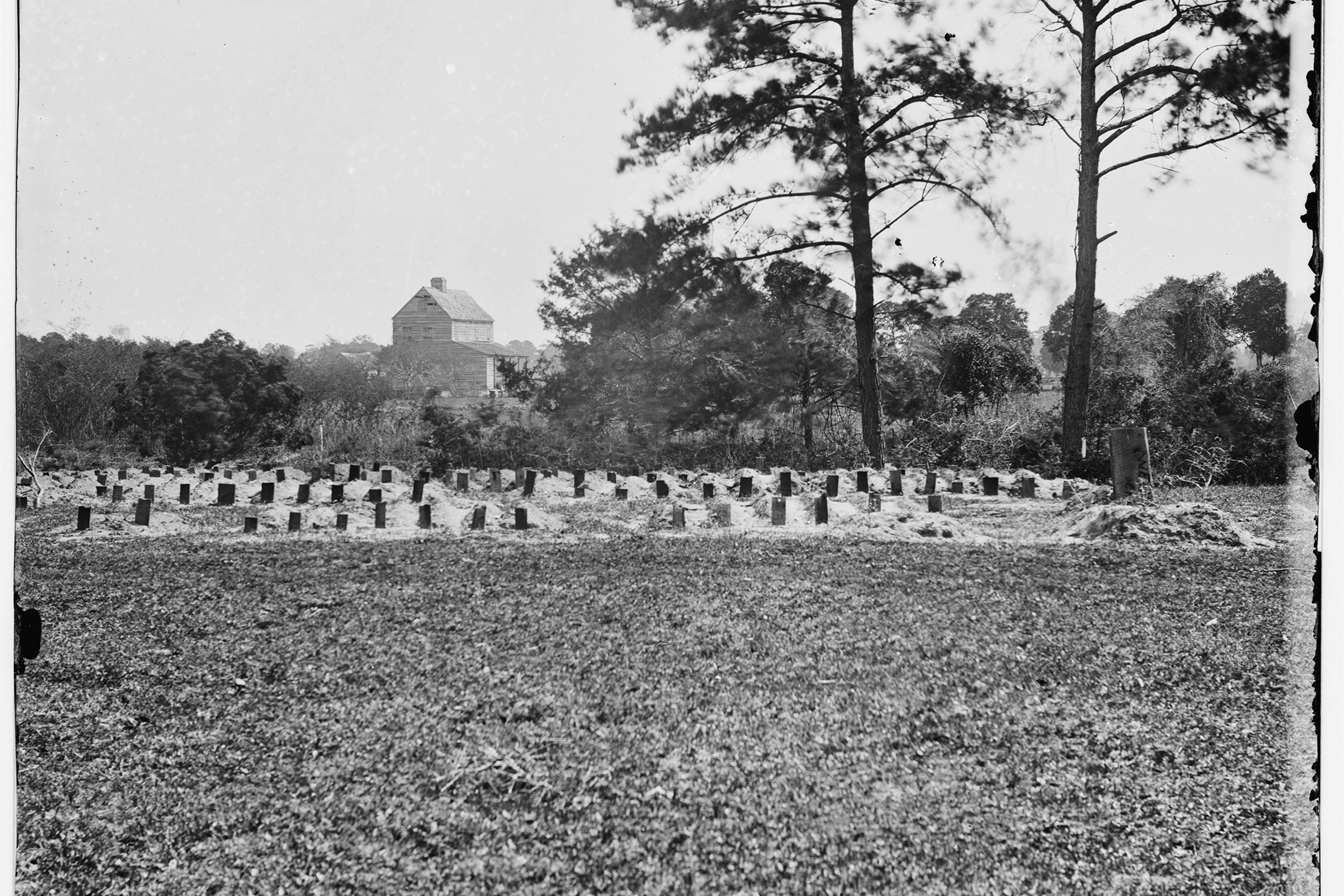
The confederates had piled the bodies into a mass grave site at a Confederate prison.
To honor the Union soldiers, those two dozen freed slaves re-interred the bodies and created several rows of graves. They didn’t do this unpleasant work at the end of a whip. They weren’t forced at gunpoint. Nobody shoved the point of a bayonet against their neck. I’m also pretty sure they didn’t do it cheerily. They were moving human corpses, not rocks or lumber.
This was grueling, ugly work, but they felt that it had to be done. It was their way of saying thank you to the soldiers who gave their lives to end slavery.
Locals from all walks of life, mostly Black, but many allied white, too, decorated the finished graves and helped introduce a new tradition called “Decoration Day” to honor those who fought in the war to end slavery. There was much food to be had at the end. It’s fair to wonder if the precursor to the Weber grill also found its origin story in those early moments after the Civil War.
The ceremony spread quickly.
Decoration Day eventually became Memorial Day.
So far, the racist U.S. regime has yet to erase all of this history from government archives:3
One early memorial day account occurred in Boalsburg, PA, where a trio of women decorated the graves of fallen soldiers in October 1864. Another was held in Charleston, SC, where Black freedmen and White “Northern abolitionist allies” hosted an enormous and historically significant program on May 1, 1865, at the “Martyrs of the Race Course” cemetery where 257 Union dead were buried.
The message conveyed by this largely Black assembly honoring U.S. troops on land previously occupied by wealthy White southerners expressed the same message as Quartermaster General Montgomery C. Meigs when he appropriated the Robert E. Lee estate to become Arlington National Cemetery. Unlike that scenario, Charleston organizers could not have foreseen the temporary aspect of the racecourse site; the Army removed the dead to nearby Beaufort National Cemetery within a few years.
Between 620,000 and 850,000 people from both sides of the war, most of them soldiers, died during a conflict that still shapes what’s left of American politics. In 1870, the U.S. Census counted 38,558,371 souls.4 The war impacted every one of them, and never in a good way.
It’s a war that ended with an armistice, not a formal truce. The end’s formality consisted of nothing more than a surrender of General Robert E. Lee’s troops.
No peace treaty was signed. This became quickly evident by behavior from the racist quarters of the South, who went back to work immediately to find ways to oppress Black citizens. This process has climaxed into today’s American condition. In fact, the Confederacy has expanded. It includes places like rural Utah, rural southern Illinois, Indiana, and even swaths of California.
Nothing exemplifies the expansion of the Confederacy better than the simple fact that blue New York City spawned the ultimate demon of the Confederacy, who now sits raging at 3 am in a truly bizarre, sick, cancerous outgrowth of America’s worst internal conflict.
It’s not unreasonable to suggest that the actions of the Trump regime are a true, “The South Rises Again” response to social justice and reform. But it’s also a reminder that the sickness that gave the Confederacy political and military legitimacy was never cured.
To many of us, the Confederate flag has become a symbol of hate similar to the Nazi insignia. To others, it’s displayed with pride, and as a middle finger to those of us who understand that the Civil War was fought to fight for the equality of “men” (mid-19th century wording, not my fault) in the face of declarations of secession like that of Texas, which stated:5
We hold as undeniable truths that the governments of the various States, and of the confederacy itself, were established exclusively by the white race, for themselves and their posterity; that the African race had no agency in their establishment; that they were rightfully held and regarded as an inferior and dependent race, and in that condition only could their existence in this country be rendered beneficial or tolerable.
Subsequent wars, such as World War Two, gave rise to the Antifa movement, which simply refers to “anti-fascism,” and has no organization or even organizing principle, no matter what the racist regime in Washington, D.C. tries to tell you.
Even our many conflicts after World War Two were sold as noble causes. The Iraq War, which violated international law, resulted in more than 100,000 Iraqi deaths (some estimates say as high as one million), and gave rise to ISIS and other terror groups, was, in theory, an Antifa war against Saddam Hussein.
Many folks question whether or not we should celebrate Memorial Day.
My answer is that the Civil War lives on.
George Floyd, Renee Nicole Good, Alex Jeffrey Prett, and many others whose names have slipped my feeble memory became unwitting foot soldiers in the extension of a Civil War that never truly ended.
So, no, we don’t celebrate. Instead, we participate in a ceremony of honor. And just like those incredible Black originators of the holiday, after we pay homage to those who have died for the Antifa cause,6 we enjoy a little food with our friends and family to continue the tradition.
Thanks for reading!

Footnotes
This song eventually evolved to include the now-famous chorus:
Glory, Glory, Hallelujah!
His truth is marching on!
American Experience. “History of ‘John Brown’s Body.’” Pbs.org. American Experience, January 7, 2019. https://www.pbs.org/wgbh/americanexperience/features/brown-history-john-browns-body/.
Waxman, Olivia B. “The Overlooked Black History of Memorial Day.” TIME. Time, May 22, 2020. https://time.com/5836444/black-memorial-day/.
National Cemetery Administration. “VA.Gov | Veterans Affairs.” Va.gov, 2026. https://www.cem.va.gov/history/Memorial-Day-history.asp.
Hacker, J David. “Recounting the Dead.” Opinionator, September 21, 2011. https://archive.nytimes.com/opinionator.blogs.nytimes.com/2011/09/20/recounting-the-dead/#more-105317.
Texas.gov. “DECLARATION OF CAUSES: February 2, 1861 A Declaration of the Causes Which Impel the State of Texas to Secede from the Federal Union. | Texas State Library,” 2026. https://www.tsl.texas.gov/ref/abouttx/secession/2feb1861.html.
If you are against racism, you are Antifa.
Thanks, Charles. Personally, I despise the Confederate flag; it's a symbol of ignorance.
Excellent piece! History we all need to know.