

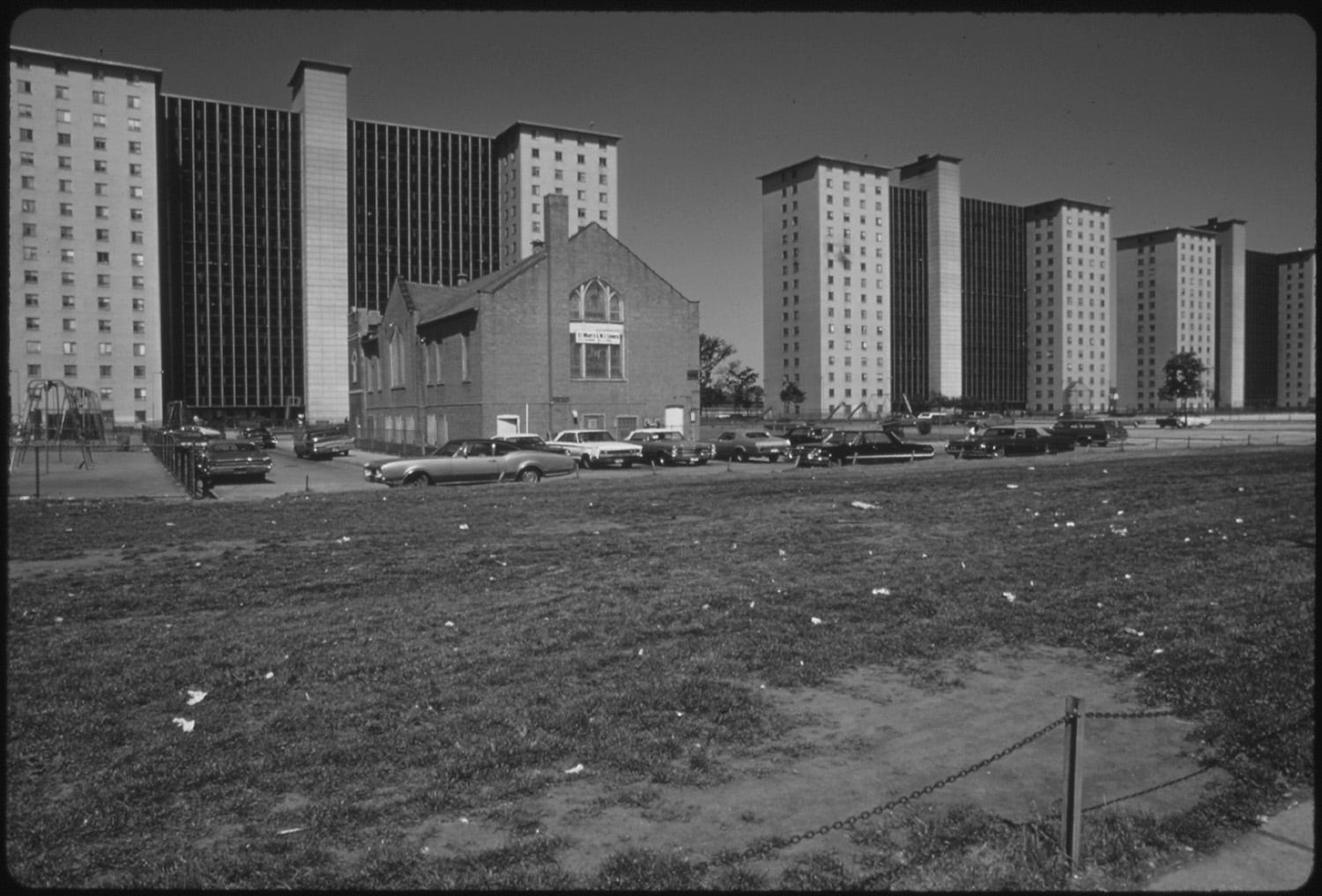

When I was about ten years old, my dad occasionally drove me up the Dan Ryan Expressway to meet up with a friend in the Robert Taylor Homes of Chicago.
My dad liked to tell me that my friend was part of the only white family in the projects. The Taylor Homes didn’t have the national reputation of the more infamous Cabrini-Green projects, but both were equally well-known in Chicago.
The Robert Taylor Homes complex, in Chicago’s Bronzeville neighborhood, was at that time the largest public housing project in America. It consisted of 28 high-rise buildings that were so identical that you could easily imagine them in an old Soviet bloc city in Eastern Europe.
It was the late sixties. Times were different. Racism was baked into almost every process imaginable, but I was oblivious. My friend’s family was poor, but I was only vaguely aware of their station in life. Like my family, they had no color TV, which was a measuring stick of sorts in those years.
We often played some basketball with other kids when I was there. In those days, basketball hoops at the Homes always had netting. As time went by, the white fabric netting gave way to metal netting, then eventually disappeared.
The dark pavement of the courts wasn’t yet full of cracks, crevices, or gaps from broken asphalt. Other kids in the projects raced by, laughing, screaming, giggling, dodging in and out of the tall concrete towers that loomed over us.
Some of us played dice games in one of the stairwells where older kids scowled as they furtively walked past us. Occasionally, a sly smile suggesting trouble painted the face of the last kid of an older group bounding up the stairs, his head turned at us as he followed his pack up toward a mysterious secret realm, as if he was announcing that there were grand plots and agreements in upper chambers beyond our uninformed, childish domain.
Nicknames like Boomer, Tye, and Colt echoed in the cold, poorly lit vestibule. “Roll that hot die,” came the refrain as dice cracked against the wall. Dogs barked outside. The occasional muffled sound of a baby’s cry that could have been from any of a hundred homes infiltrated the stairwell.
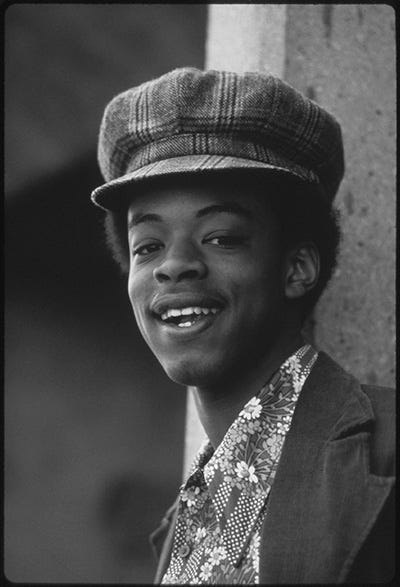

My friend and I learned how to play chess from an old man who talked proudly of family reunions with his extended family in Mississippi. When he deployed the castling maneuver, I accused him of cheating. He guffawed like he had been holding laughter back for decades for just that moment, and when I tried to do the same thing with my bishop, he laughed like that all over again.
That’s when he taught me chess. I don’t remember much other than his repeated urgings. “Attack the center! Attack the center!” he would say. I can still hear it, the musings of a sweet old man living poorly but with joy because he was teaching a child chess.
Times were different. There was an overall sense that change was in the air. I was ten years old, but even I could feel it. I didn’t know what any of it meant, other than there was an unformed electrical charge of energy that bolted through the air around me when I was at the Taylor Homes.
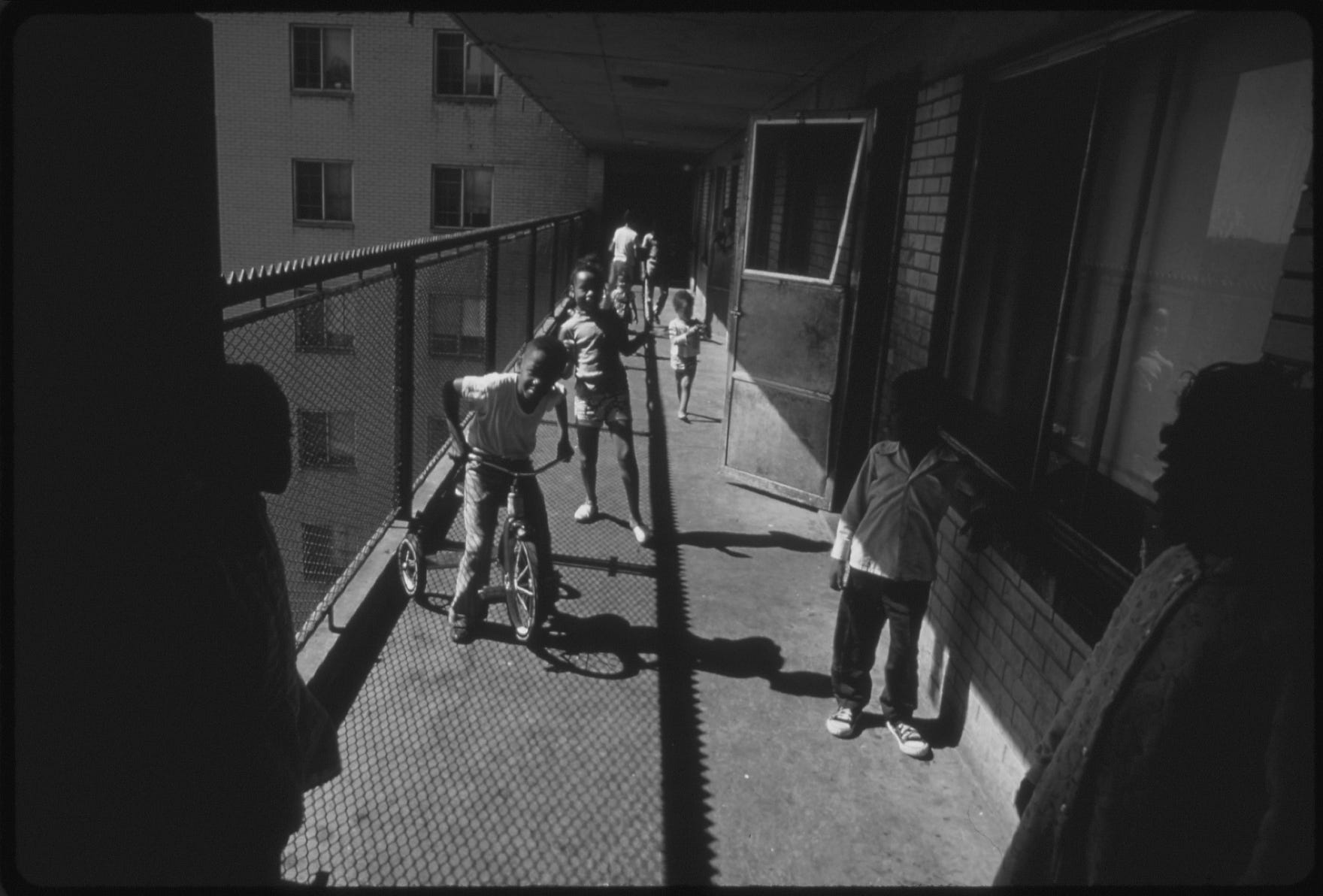

I didn’t know that the kids I played with were the children or grandchildren or nephews or nieces of people who had migrated from a place where they weren’t allowed to drop an election ballot into a box.
The old man from Mississippi didn’t tell me about that stuff. He didn’t tell me about Jim Crow in the South or redlining in Chicago. He didn’t tell me about Southern apartheid. He just taught me chess with a smile that broke into lightly whiskered cheeks filled with deep coriaceous lines that had been formed by decades of family moments and memories.
There was hope in the air. I could sense it. I felt it. There was tension, too, and poverty. There was anger. But something else. I didn’t know that only a few years prior, the Voting Rights Act of 1964, which has since been gutted by the Roberts Court, had passed.
A few good vibes had managed to roll in. American democracy was only a few years old to the people at Robert Taylor. Something good maybe, finally, was happening. But I couldn’t know that. I was ten.
Instead, we rolled dice in stairwells and played basketball and sometimes dodged bullies who always lurk in the shadows no matter where you live.
Then, Martin Luther King Jr. was shot. A pall that descended on the Robert Taylor Homes spread an unspoken gloom into that same previously electrified air. Even a ten-year-old could feel tragedy sucking the life out of our surroundings, as if everyone who lived in the towers had lost the same father at once.
There had always been fights among the kids my age. Nothing major. Just kid stuff. But when King was shot, it seemed like fights broke out more frequently. They were meaner, too. What would have once been a black eye became a puffy face with eyes swollen shut. Anger and scowls and cursing began to replace laughter and trash talk.
The atmosphere was such that some of the local kids were in gangs, but not the kind of gangs we hear so much about today. Some of the older kids belonged to something closer to the kinds of gangs we know about, but gangs hadn’t yet threaded themselves into every street and corner.
Many gangs, like the Black Peace Stone Nation, the Gangster Disciples, and the Vice Lords, were still in their formative years. They seemed far away, like soldiers of a distant war.
The gangs the younger kids belonged to were more informal, and if you strayed away from your clique, you could get on the wrong side of a pile of fists.
It happened to me once when I strayed away from my friends.
I don’t remember it well. I remember looking at a tree while it happened. Even as I was getting pummeled, I marveled at how the branches merged into a perfectly round top.
While I marveled, a girl was kicking me hard in the balls while other kids held me down. I’m thankful that our bodies teach us how to wipe away those kinds of memories, leaving me only with the rounded treetop and, unfortunately, the gleeful expression of my tormentor.
But the pain? I don’t remember that.
As I got older, I wondered if she would have looked so gleeful had King not been shot. Not because I was white. But because she was angry. Everyone was angry. I wondered, too, if I would have even been accosted at all on that hot, humid Chicago afternoon in a neighborhood that wasn’t mine.
But I was ten. I didn’t really know why the mood changed. Why, I wondered, were things getting rougher in my friend’s playgrounds?
When I asked my dad, he blamed “The Blacks. That’s just how they are.”
I objected. That made no sense. I didn’t put any of the pieces together until later.
The Robert Taylor Homes were originally designed for 11,000 people. At its fullest, long after I made my last stop there, 27,000 people filled the poorly maintained buildings. After King Jr. was shot, gangs that had been on the periphery started to claim more territory.
Eventually, they became warlords of a broken settlement.
The same federal government that had so reluctantly offered token democracy had abandoned the settlement they had promised would help take its denizens to a better life. Politicians began to yell about welfare queens and laziness.
Nobody asked how blocks of buildings in a territory as big as a small town could be self-sustaining. They were not surrounded by any stores or even fast food joints. The “town” was a vast food desert. There were no jobs within walking distance. There was no industry, no services.
An economy eventually grew around the area to fill the abandoned lots. It was the kind of economy policed by drug lords and gang leaders.
When I reached my twenties, I drove by my friend’s old apartment building. The neighborhood was broken down. Storefronts with boards instead of windows. A lone liquor store with five men hanging out, passing around a bottle. Trash and paper littering the streets. The long colored swirls of taggers and the heavy black logos of gangs adorning nearly every wall. Streaks of black ash decorating the tops of several windows.
In many ways, we are seeing the same thing happen in rural America today. Formerly thriving downtowns rotting to the core. Crumbling roads and bridges. Grinding poverty, family violence, rampant drug addiction, and obesity. All while the politicians who run them scream breathlessly about drag shows and naughty books peeking out of the library’s classics section.
This story, then, is about the glacial pace of change in America. The wrong kind of change. A backwards lurch into a more primitive existence despite an unyielding growth in technology, sucking the life out of everyone but the rich and famous, and leaving us with empty-headed mouths of rage touring the countryside, trapped in a murderous hate cult, hoping nobody really notices what is happening to them.
Thanks for reading!

You can now purchase a PDF of all my Substack Fiction. Only $4.99. That’s less than a Taylor Farms salad, and a lot better for you! Enter SUBSCRIBER_SPECIAL to get a 20 percent discount.
It’s also now available on Amazon/Kindle here in ebook, paperback, and hardcover formats (the Kindle version is free if you have Kindle Unlimited):
If you are a paid subscriber, it’s available free as a Perk. Just go to the “Perks” page via the web page menu to find it.
You can help me reach more people by subscribing (paid or free), sharing, restacking, and commenting.

A version of this essay originally appeared on the Medium platform in the Illumination publication.
I've read that lynchings are taking place in the US again. Not mentioned in the legacy media.
Yet another reason to avoid the country.
I grew up in the South Jersey suburbs of Philadelphia. My mother and I would get on the bus to Philly to get school clothes and shoes each July or August. I lived in a neighborhood with mostly white people, with a very few members of other races. When I got to high school, it was in a town about 7 miles away that had mixed races, and I met people who did not look like me. There were no serious issues with race, but once I remember two girls fist fighting, one white, one black. I don’t remember how it ended, but it never happened again during my years in high school. As a result, I did not recognize prejudice against those of different races, we had interracial friends, it was considered normal.
I hate racism, just like I hate misogyny. Both punish people for something over which they had no control. If I’m going to treat someone with disrespect, it will only be because they did something to earn it.