

There are two irreversible results of America’s decade-long obsession with Donald Trump:
Climate change, which is about to ravage the world in catastrophic ways we are still mostly blind to.
China’s takeover of the world economy.
The first item demands its own post(s). I recommend you read Geoffrey Deihl’s Substack on climate change. All you need to know, if you have the courage to read it, is there.
This post concerns the other thing. Given the continued bellicosity over a potential war with China from both U.S. political parties, I’m here to say that the war has already begun, and that the United States lost without China firing a single round.
The result, barring a miraculous change of American policy, will be an impoverished nation dependent on a one-way supply chain of Chinese goods pouring into the country dictated to Americans by the whims of the victor.
Arguments over vaccines and data centers will become moot because the U.S. will transform into a purely consumer nation full of illiterates in which only a few will be lucky enough to brag about the prestigious job of dodging Amazon warehouse robots (made in China) for a living.
Since consumption requires money, the economy will transform into one that, aside from a wealthy few who find a way to thrive while having one foot out the door (Peter Thiel in Argentina), will be weighed down by a huge dependent American peasant class relying on government handouts.
This ironic result of Republican late-stage capitalism is unavoidable. An exciting, charismatic leader, maybe AOC, will dominate the next presidential campaign as the economy collapses, or the one after that, and all the Republican fears about socialism will come to pass with wild abandon.
But socialism won’t save us, because it will be too late. A bankrupt nation will not be able to compete with China, which will, based on current trends, control every aspect of the world economy through vast investments and an absurdly dominant position in technology.
As it stands now, while the U.S. dithers, a fraction of its aware population barely stands on the back of its heels in protest as a rancid, foul-mouthed regime of hate spends its limited resources on tracking down ways to line the pockets of its primary donors and send important segments of its population into concentration camps or other countries.
Meanwhile, China is discovering glueballs and other edgy teasers of quantum computing while its auto industry, with more than 100 car manufacturers, laughs at the dying embers of what used to be the pride of American manufacturing.
About those glueballs
If you read Nature magazine, you might be aware that glueballs, particles made out of gluons, were recently discovered by Yanhping Huang at the Beijing Spectrometer III (BESIII) Collaboration, according to scientists reviewing recent peer-reviewed papers.
And what are glueballs, the ever-inquisitive reader queries? Everyone knows that they are particles that are, in the words of Nature, clusters of gluons that are “made entirely of force-carrying particles.”
Okay, that doesn’t mean much to me, either, but apparently this is a big deal in the world of quantum physics because the silly little particles can hold the opposite states of quarks (for example) at the same time.
I guess this means that the Gulf of Mexico can be the Gulf of America at the same time, and the Strait of Hormuz can be owned and not owned by Iran at the same time.
This might explain a lot about the insider trading we see belching out of the White House every day.
Basu, Mohana. “A Particle Made of Force: Physicists Say They’ve Found Mysterious ‘Glueball.’” Nature, August 12, 2026. https://doi.org/10.1038/d41586-026-02498-1.
There are 743 auto-related manufacturers in China. Some of them, of course, are joint ventures with European and U.S. firms, but U.S. firms are finding their participation in China’s vast market increasingly tenuous.1
China produces three times as many cars as the United States.2
Chinese auto manufacturers are currently marketing a ridiculous 7,142 models of cars.3 U.S. car aficionados work themselves into a lather when Tesla announces one new model, which then takes six years to get to market, partly because Musk is too busy pumping right-wing noise into the echosphere with his Apartheid Twitter machine.
China built its auto industry almost instantaneously while the U.S. spent its time figuring out how much it should feed its growing monolith of hate and misogyny.
China didn’t build its massive auto industry with cheap labor. It built it with robots.
It’s not just cars
China has 1,527 companies or entities (some are government-run) building smartphones or their constituent parts.4 Americans haven’t heard of many of them because both Republicans and Democrats are afraid of what will happen if they allow them into the country. I suspect the fears run from the possibility of all of the Chinese-made devices blowing up simultaneously to simply knocking the U.S. cellular manufacturing industry to the ground.
This short bullet list of Chinese brands won’t mean much to most of you, because the United States either outright bans them or makes it difficult for them to establish U.S. market share:
Huawei
Xiaomi
Oppo
Vivo
Honor
Transsion (Tecno, Infinix, and Itel)
ZTE
But most Chinese are well aware of all of them.
While large portions of the U.S. population sit numbed by its addiction to drugs, booze, celebrity entertainment, and short, cheesy videos, China is building things at such prodigious rates that there is a cottage tourist industry devoted to exploring Chinese industrial and technical development. Hyped up trend names like “infrastructure porn” and “Chinamaxxing” lure tourists into China as they gawk at spectacular bridges, trains that run at 300 mph, and clean, glittering airports.
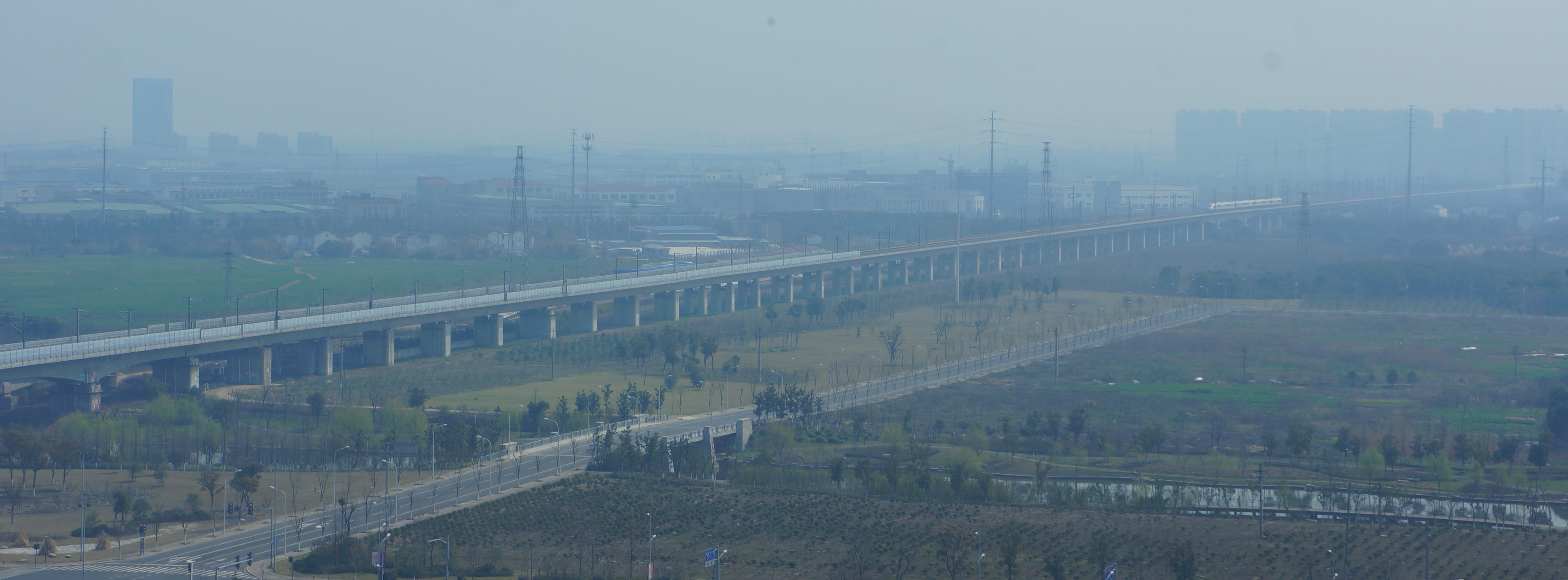
Meet the Danyang–Kunshan Grand Bridge. At 102.4 miles, it’s the longest bridge in the world. It connects Shanghai and Nanjing (among other cities) in Jiangsu province, mostly following the route of the Yangtze River.
The bridge also spans a 5.6-mile section of Yangcheng Lake in Suzhou.
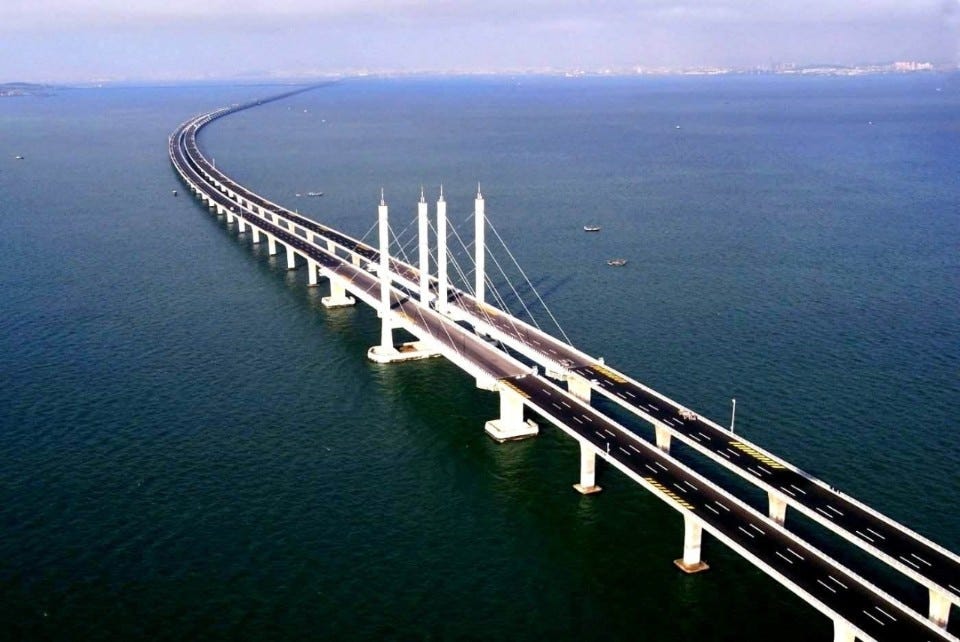
It cost $8.5 billion (U.S.) to build in four years, then opened in 2010.
China is also home to the longest span across the sea, a 34-mile beast that connects Hong Kong, Zhuhai and Macao.
The American fascination with Trump, which extends even to his haters through non-stop posts about him, has led Chinese citizens to consider the decade-long obsession enough of a blessing that there is a Chinese term for it: Chuan Jiangao, or “Make China Great.”
Wang Wen, writing for Renmin University’s Institute for Financial Studies, tells readers:5
Trump’s first term made at least three notable contributions to China’s rise.
First his presidency shattered the image of the US as a paragon of democracy for many Chinese…
…Second, Trump helped accelerate China’s push toward technological independence... By 2024, China had achieved significant strides in tech independence, including breakthroughs in semiconductor manufacturing. This shift was underscored by record-high chip exports in 2024, which surpassed $159 billion, doubling 2018 figures.
Third, Trump’s tariffs and trade restrictions pushed China to strengthen its ties with the non-Western world… China’s reliance on the US for trade fell from 17 to 11 percent.
Trump’s trade war with China has driven a rapid restructuring of global trade, leading more Chinese to recognise that the world is far larger than the United States.
Wen goes on to point out that Chinese industry leaders are reacting to tariffs not with fear and anger, but happiness at the opportunity to use this window of U.S. fecklessness to their advantage.
Worse, the notion of mutually assured destruction from a real war, which was long a centerpiece of the relationship between the U.S. and Chinese economies, has evaporated into the storm clouds of Chinese dominance. U.S. trade now accounts for only 11 percent of Chinese trade overall. Its economy would survive a war much more easily than the American economy would, assuming no nukes are involved.
And China’s military is nearing parity with the U.S., at least as measured by weapons system technology:6
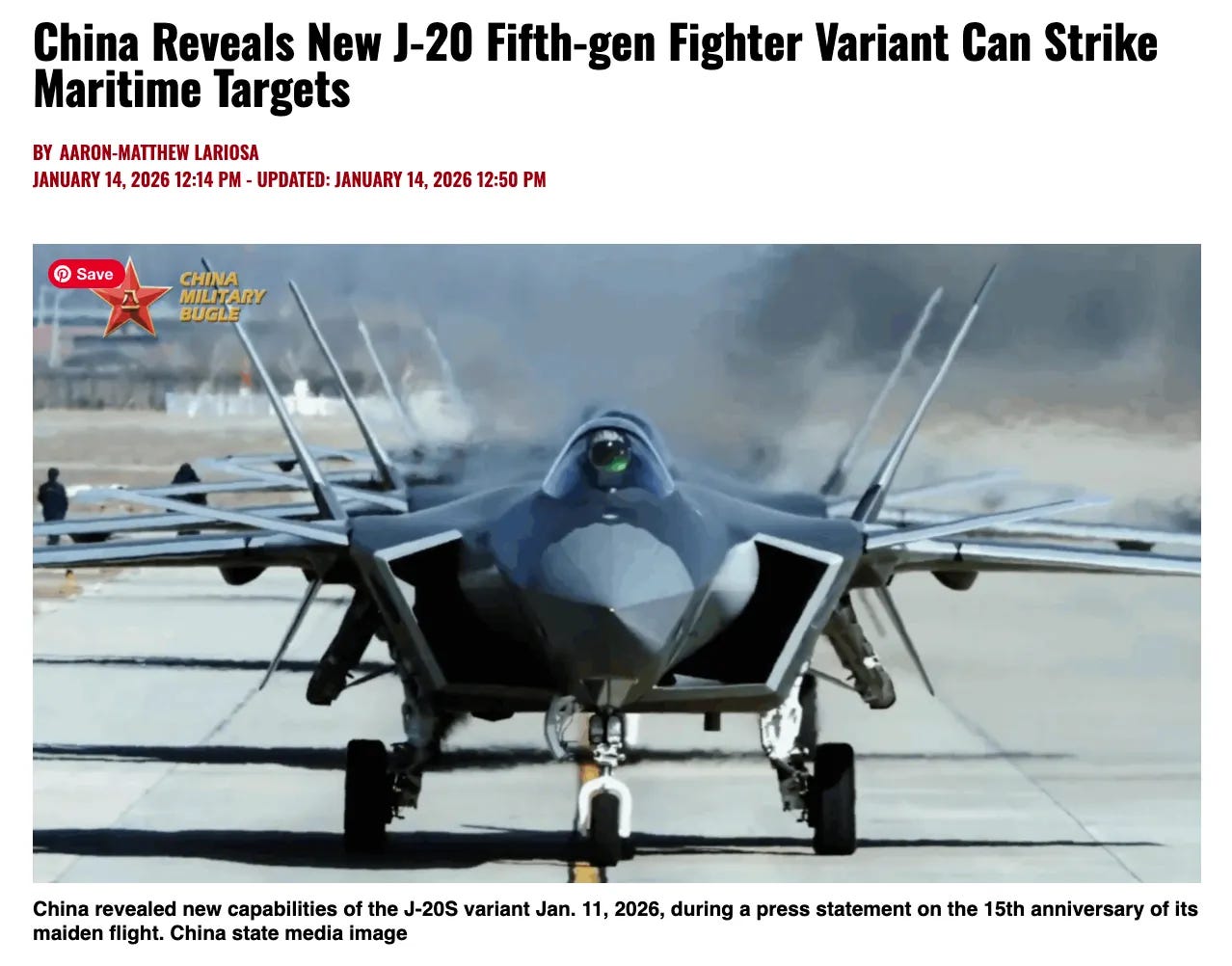
Right-wingers are quick to point out that China has achieved its technical apex by copying U.S. technology.
Welcome to the real world, numbskulls.
China has eagerly exploited Trump’s laser focus on ruining the U.S.’s relationship with the rest of the world, particularly its allies. Trump’s rejection of science in favor of the black magic of grift is triggering an exodus of researchers to other countries, and an exodus of allies into the arms of each other.
I’ve written about this exodus before, and it’s only accelerated since then:
The Drain on America's Brain

The United States is facing a mass exodus of researchers, engineers, and scientists. On the surface, much of it looks voluntary. People are willingly leaving, but it’s because the environment has become so hostile to both their professions and their safety that they’re unwilling to ask their families to endure it or tolerate the hostility themselves.
It’s a march of progress versus a retreat into the marshes
In 2023, China built more solar power capacity than the U.S. has in its history, according to a recent article in New Yorker magazine.7
China’s trade surplus is at $1.2 trillion, even though it is moving its exports away from U.S. ports and into other world ports. The U.S. trade deficit was $73.3 billion in June 2026. Trump’s trade war has barely knicked it. It was $77.6 billion in May.8 The difference between when he snatched the Oval Office and now is not much more than a rounding error.
The result of this small change isn’t more U.S. manufacturing. It’s simply less commerce. The other Atlas in the world capitalist fever dream, China, has simply shrugged and moved on to other countries.
There is strong evidence that at this point in the trade war, China considers the U.S. nothing more than a dangerous pest. Some of this has crept in through bipartisan efforts, but the real catalyst for the worst of it is the American obsession with all things Trump.
While we raise our fists in rage at the lunatic-in-chief, China builds.
It’s building the Xiaomi SU7 Ultra, with its 1548 horsepower engine and acceleration from 0 to 62 mph in less than two seconds.9
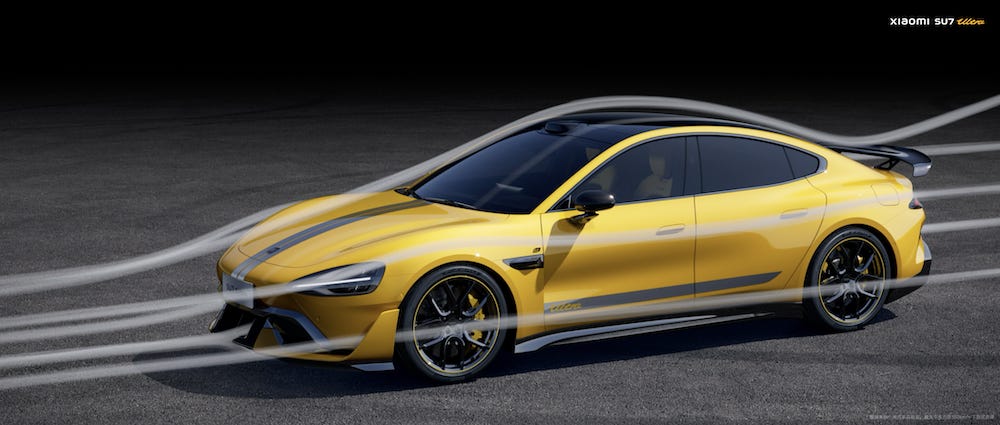
That’s like being fired out of a cannon.
Here’s Motor Trend, in a headline starting with “Just Wow,” describing the vehicle:10
In the short time it’s been on the market, the SU7 Ultra has already become one of the world’s most talked-about performance cars. It holds the Nürburgring lap record for the quickest production four-door vehicle, and with 1,526 horsepower and 1,305 lb-ft of torque, it ranks among the most powerful production cars ever built.
China is doing things like building seven-hundred-ton die-casting machines to make cars like this. On the regular. Every day. Churning them out like American ag companies splattering American consumers with corn syrup and fat and forever chemicals.
It’s building pharmaceutical companies like Akeso, which recently rolled out an experimental cancer drug that studies show blows a similar drug made by American mega-pharm company Merck out of the water.11
While Trump is denigrating scientists and researchers, China is investing in hunting for them wherever it can.
Chinese government programs extricate people from the hinterlands — people like AInnovation chief technology officer Fan Li, who was a hidden prodigy lodging quietly in a Chinese coal mining town before government recruits found him. Fan Li now presides over a company that has helped transform Chinese industry from a maker of schlockware into one that makes precision instruments.
His company makes, among others, a machine with an AI-driven high-resolution camera that inspects screws that roll out of high-capacity production lines in numbers unheard of on American production lines.
A few weeks ago I purchased a small desk. I knew before it arrived that its country of origin would be China. What I didn’t expect was the precision by which the thing was made. No more of those misaligned screw/screw holes that used to plague Chinese products we had to fight with when putting them together.
The directions still barely make sense. But it no longer matters. This thing was so simple that a five-year-old could have put it together, and everything fit like it had been handmade.
And it was idiot proof. Not even I could attach a piece to the wrong part of the desk. The design, probably driven by AI, simply wouldn’t let me.
I thought of Han Li, and then realized there are millions of people like him in China doing the same kind of thing he’s doing while we’re sitting at our laptops and tablets yelling about Trump.
Even Chinese beer promises to someday be better than what we find in America. Han Li’s company offers its AI services to dozens of Chinese firms, including Tsingtao Brewery:12
On a screen, Li pulled up an intricate diagram of a factory for the Tsingtao Brewery, one of his customers. He typed in a prompt: “Have they achieved their energy-saving goal in the past year? If not, why?”
Moments later, Li’s AI machine reports on anomalies it has detected in four devices in the Tsingtao plant, along with suggested solutions:
“Look for wet malt or jams at the mill; investigate steam and pump behavior in the pasteurizer.”
China cranks out nine industrial robots for every one in the United States. You might cheer this, happy that another American worker is saved from the unemployment line, but that worker is probably going to be removed by bankruptcy when the American firm he works for is hammered by Chinese automation.
Whether we like it or not, robotic automation is coming, even if it means that they’ll all be Chinese:13
There was another sprawling display of robotics expertise at the Spring Festival Gala, the most watched television event of the year. Humanoids marched, backflipped, and twirled nunchucks; robotic pandas gambolled.
This freaks out people in China, too, not just us. After all, they aren’t much different than us when it comes to AI fears. Viewer complaints about the television show displaying robotic athletic prowess were rampant.
But while people in China are expressing some alarm online over their robotic future, China continues to develop and build. And they’re doing it like they’re in the race of the century, because, guess what? They are.
In this race, China is doing things like developing the Galbot G1, which looks like a friendly Terminator.
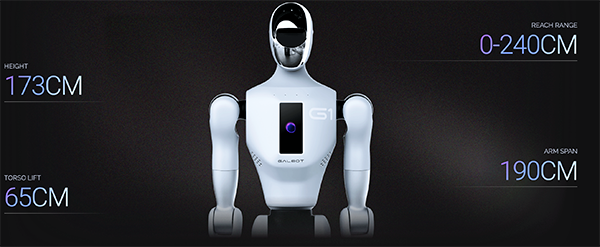
The Galbot, and its surprising dexterity, is used for everything from household chores to offering service options at convenience stores.
The company that makes it is led by robotics experts like He Wang, a Stanford PhD graduate who, like many Chinese Stanford grads, now lives in China. He is typical of the kind of immigrant the Trump regime has been chasing out of the U.S. since 2016.
That work, led by Stephen Miller, is now so thoroughly complete that many Chinese researchers are happily self-deporting because Trump has helped power the transformation of China into the world’s leading nation of science.
Elections have consequences.
Smart, educated immigrants from many nations are leaving the hostile environment of the United States, but none more eagerly and in numbers like those from the Chinese mainland.
This former Chinese diaspora, returning to a hero’s welcome in China, is helping to build next-generation solar equipment, batteries, electric vehicles, wind turbines, robots, cars, and dozens of other vital pieces of a modern economy.
Before 2016, in the days when they weren’t overtly hassled for being Asian, many Chinese Americans were happily ensconced within the American industrial machine. Since 2016, they’ve reverted to being Chinese Americans. The hostile environment in the U.S. became overt and, sometimes, dangerous. “Stop Asian hate” became a rallying cry against this development, but it never changed the facts on the ground very much.
This isn’t to suggest that American research is helpless without Chinese-born researchers. That would be dumb to say. American research prowess is, however, heavily influenced by immigration from all over the world, and many of them are leaving, too.14
I don’t think you’ll find many people who work at universities who don’t offer positive reports on the influence of foreign students and teachers, all of whom now face a hostile federal government.
But a few immigrants traveling back to their home country do not account for the growth of the Chinese juggernaut. It helps a bit, to be sure, but it isn’t what drives it. What drives the new Chinese economy is an industrial policy that directs resources into industries the government wants to succeed in, and possibly dominate.
The current U.S. government has an industrial policy, too. I call it the Trump Enrichment program. This is good for Trump and his cronies, but not so good for the rest of us.
Americans will have no say in their future
We can argue amongst ourselves all we want about whether robotics, AI, and CRISPR should be part of our future, but the argument is on the verge of being rendered moot by the long march of China.
Soon, Americans will have no say in the matter.
Notes
Correction: The image showing the Danyang–Kunshan Grand Bridge must be wrong, because the bridge is a viaduct for a high-speed train railway, and the picture clearly depicts car lanes. I noticed this when porting this story over to Medium.
Per Wikipedia, this is the bridge:
Jaded opinion warriors will note that the same fears were made about Japan several decades ago, and look what happened! A nothing burger!
If you think the situation is the same, I have a bridge in Nanjing to sell you.
Biden hinted at introducing industrial policy, and his vice president was routed from office by troglodytes.
But that’s what it will take to turn things around. I see little talk of it from either Republicans or Democrats.
Thanks for reading!
You can help me reach more people by subscribing (paid or free), sharing, restacking, and commenting.


You can now purchase a PDF of all my Substack Fiction. Only $4.99. That’s less than a Taylor Farms salad, and a lot better for you! Enter SUBSCRIBER_SPECIAL to get a 20 percent discount.
Footnotes
China, Auto. “Chinese Car Manufacturers and Brands — the Complete Directory.” Auto China, April 11, 2026. https://auto-china.com/en/guide/manufacturers.
Gorton, David. “6 Countries That Produce the Most Cars.” Investopedia, September 6, 2016. https://www.investopedia.com/articles/markets-economy/090616/6-countries-produce-most-cars.asp.
Auto China, ibid
IBISWorld. “Mobile Phone Manufacturing in China - Market Research Report (2016-2031).” ibisworld, 2025. https://www.ibisworld.com/china/industry/mobile-phone-manufacturing/639/.
“Vijay Prashad: Washington Bullets.” globaltimesnews, 2025. http://rdcy.ruc.edu.cn/yw/Teacher_Home/WangWen/Commentariesww/330666969b354971a182f3ac2d78d709.htm.
The Top Gun reputation of American fighter pilots is not Hollywood fiction. It is impossible to know how well Chinese fighter pilots would perform against American fighter pilots, and let’s hope we never find out. But there isn’t a military analyst in the world who doesn’t think American fighter pilots are the best in the world by a significant factor. Even Hegseth will need a few more years to ruin that.
Osnos, Evan. “The Future, Made in China.” The New Yorker, August 3, 2026. https://www.newyorker.com/magazine/2026/08/10/the-future-made-in-china (Paywalled)
TRADING ECONOMICS. “United States Balance of Trade.” Tradingeconomics.com, 2026. https://tradingeconomics.com/united-states/balance-of-trade.
Home, Mi Global. “Xiaomi Global Home.” Mi Global Home, 2025. https://www.mi.com/global/discover/article?id=4328.
Cortina, Miguel. “Just Wow: Driving the 2027 Xiaomi SU7 Ultra With Glorious Power, Bargain Price.” MotorTrend, May 28, 2026. https://www.motortrend.com/reviews/first-drive-2027-xiaomi-su7-ultra.
Osnos, Evan, New Yorker, ibid
Osnos, Evan, New Yorker, ibid
Osnos, Evan, New Yorker, ibid
I covered this to some extent here:

I got stuck on the glueballs and wandered off to Schrödinger's cat… 🐈⬛
I think I read something along similar lines from Thomas Friedman (NYT) several months ago. China wasn't as far ahead of us as it is now, but it was like looking at the negative of the Trump disaster: US demeaning universities, China growing them; US standing in the way of innovation, China urging it; US stopping anything related to climate change, China fast-tracking it. Not a surprise that just a few months later, here we are.