

Recently, someone in a Substack comment area made a plea to me that went something like this: “Please tell me how to handle the pro-war arguments made by people like Florida Senator Rick Scott, who says Iran has been attacking us for 47 years.”
I replied that the reply consists of two words and one name:
Mohammed Mossadegh.
To be clear, Iran has not been attacking us for 47 years. The radicalized, fundamentalist, theocratic dictatorship that took over Iran 47 years ago, which calls itself the Islamic Republic of Iran, has been the source of our discontent.
Most of the Iranian people think we’re pretty cool, even though we hired a lunatic to run things again for four years. Many of them have relatives in the U.S. and across Europe. They despise their government as much as we do.
Therefore, to properly frame the debate, we need to do something Republicans hate: revisit history.
Iran’s 2500-year history of monarchy
You’re not going to read it, and I’m not going to write it, but the fact of Iran’s 2500-year history of monarchy is vital to understanding what Iran is as a nation. So I’ll blurb it. Make it short. Digestible.
The Iranian monarchy’s 2500-year history is filled with all kinds of different monarchs. The first monarch to really gain the attention of most modern people is Cyrus II (approximately 530 BC), who defeated the Median empire and built an empire. He’s famous for being the fella who released the Jewish people from the grip of the Babylonians.
Sidebar: Reports out of Iran indicate that the Rafi-Nia Synagogue in Tehran was destroyed during US-Israeli airstrikes. The fate of a set of cherished Torah scrolls in the synagogue’s basement, which may have documented the return of Jews to their homeland under Cyrus, is unknown.1
From there, it was one kerfuffle after another that resulted in a combination of short, medium, and long dynasties, sometimes foreign, sometimes Islamic or Islamic Lite, others Zoroastrian,2 others more secular.
The string of monarchies came to a screeching halt in 1979.3 That’s when the Shah of Iran, Mohammad Reza Pahlavi, was overthrown by fundamentalist Islamic clerics taking advantage of a popular revolt against secularism and detribalism, economic decline, and lightspeed integration of American-style capitalism that began with the Shah’s father, Reza Pahlavi.
Currently, Iranians are stuck in the middle of the terrible regime that emerged from that popular revolt. The regime instantly made itself known as a group of thugs who make the Republican scourge in the United States look like a Disney movie. The ayatollahs are a repressive, misogynistic, hateful, ruthlessly repressive bunch.
That said, it’s fair to say that many of the Republicans who will argue for the necessity of bombing the crap out of Iran also admire the fundamentalist theocracy of the regime they profess to hate. The evidence of this is written all over Project 2025.

The ayatollahs have killed tens of thousands of their people, maybe hundreds of thousands, for the simple act of marching against hijabs or protesting a terrible economic situation. Most of us know that this is a Stephen Miller wet dream.

If Iran were a Christian theocratic dictatorship instead of a Muslim one, the current U.S. regime would have an embassy in Tehran the size of Cuba.
But they’re Muslim, so they get the classic Republican double standard treatment.
Americans have never been given an honest reason why the ayatollahs took over Iran in the first place.
You see, the monarchy was actually supposed to have ended long before 1979.
Here’s that story.
Two words, one name: Mohammed Mossadegh
It’s time to meet Mohammed Mossadegh.
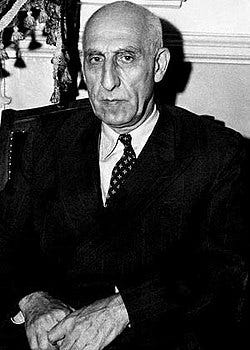
He was the Prime Minister of Iran who was overthrown by American and British spy agencies, an event that ultimately ushered forth wild-eyed ayatollahs, “death to America” chants, and the current terrorist Islamic state.4
Elected by the Iranian parliament, known as the Majlis, shortly after World War Two, Mossadegh leaned a bit too hard toward socialism for the taste of American policymakers of the 1950s.
When he proposed nationalizing the oil industry and claiming Iran’s resources as their own, multinational oil companies rallied the troops faster than Trump can rally Klansmen and insider traders.
The alarmed oil peddlers spoke into the ears of a CIA operative named Kermit Roosevelt Jr., Theodore’s grandson. Kermit had mastered the art of spycraft while working for the Office of Strategic Services during World War Two.
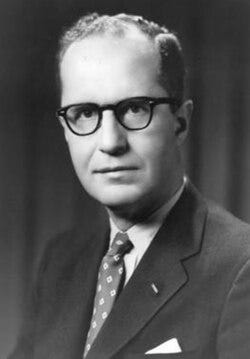
After the war, he was recruited by the CIA and joined the CIA’s Office of Policy Coordination. He had already impressed his superiors by meddling in Egyptian affairs and creating a general mantra that promoted American influence in several Arabian countries.
Shortly after the war, he joined an organization called the Institute of Arab American Affairs. Around the same time, in 1948, he and about a hundred or so Christian men joined the fight led by the American Council for Judaism to argue against the partition of Palestine that followed World War Two in favor of a nation whose government would be a coalition of Arabs and Jews.5
By the time the Second World War ended, there was an understandable visceral reaction to the plight of Jews seeking refuge in their ancestral homes.
The world was visibly shaken by Hitler’s rampage against Jews. He killed millions of them, often in a grotesque manner. It was one of human history’s ugliest events, if not the ugliest.
Relocation from Europe seemed like a good idea at the time. (See the Footnotes6 for a deeper dive into this)
Kermit wrote a policy paper arguing against Palestinian partition. He was against forming a purely Jewish state and preferred one new state that consisted of a coalition of Jews and Palestinians.7
This was part of a broader philosophy of interest in Arab affairs that helped him make friends in the Arab world and made his activities as an American spy much easier.
In Iran, Kermit helped arrange to remove Mossadegh from power at the behest of the British, who had been vying for control of Iran’s oil fields since World War One. The British talked President Eisenhower into helping depose Mossadegh, and Kermit went to work.
Kermit began a complicated plot that resulted in the legitimately elected prime minister’s overthrow. He hired Iranian mobs to protest8 Mossadegh, launched a massive local media influence campaign that branded Mossadegh a communist, and even tried to talk the Shah into deposing him.
It was a struggle that at first failed. So Kermit pulled on a string that almost always works with humans. He began distributing money. He paid hundreds of thousands of dollars to army officers to stage a military coup. When they did, a two-day assault involving Kermit-aligned Iranian tanks drove Mossadegh out of Tehran and out of power.
In 2000, American Secretary of State Madeleine Albright dropped this confession on behalf of American connivance:
“The coup was clearly a setback for Iran’s political development. And it is easy to see why many Iranians continue to resent the intervention by America in their internal affairs.”9
Unlike the target of some American interventions, Mossadegh was not some nasty dictator. He was a reformer and social welfare architect who showed promise of helping transition Iran into a modern economy with the best traits of Scandinavian-style government. He simultaneously maintained a firm respect for mosque country and good relationships with clerics in Qom, the beehive of Iranian Ayatollahs, while massaging the ego of the Shah.
Hot tip: When reading my long-form Substack articles, it’s fun to check out the footnotes, too!
He also didn’t come out of the blue. He was a legislator first. But before that, he was a Qajar.
Mossadegh the Qajar
Mossadegh began life as a humble servant of the Qajar dynasty, which was the dynasty that founded modernish Iran under Agha Mohammad Khan Qajar in 1779.
Agha did not have a pleasant childhood. He was castrated as a child by another Shah, Adel Shah, for the crime of being the son of an opposing tribal chieftain.
With an understandable fury that never left him, Agha Qajar, after being held prisoner by yet another Shah for sixteen years, fled to northern Iran and rallied locals to his cause.
Eventually, he won the day, sacking Tehran, uniting a fractured country, and founding the Qajar dynasty. It is Agha Qajar’s dynasty by which Mossadegh began his trek through Iranian history.
There’s an important sidebar here. You might think that Vlad Putin’s embrace of the Islamic Republic is out of pure spite towards the U.S. Not so. Iranian allegiances (and often, enmity) with Russia are more than 250 years old. It’s a deep, complicated relationship.
The tribes within the Qajar realm shared allegiances with Russian nobility. Many Russian Qajari held posts in the Russian imperial army, thus beginning a long tradition of shared ancestry with the Russian state.
Mossadegh became the finance minister under the Qajar dynasty, which, by the middle 1900s, was firmly established. He held numerous other positions, as well, before he became a legislator.
His mother’s family history was deeply rooted in the Qajar dynasty. She was Princess Malek Taj Najm-es-Saltaneh, the granddaughter of a Qajari prince named Abbas Mirza, and a great-granddaughter of the second Qajar Shah, Fath-Ali Shah Qajar.
Fath was the loser of the Russo-Persian wars of the early 1800s, which resulted in Persia (Iran) losing territories that now comprise Georgia, Dagestan, Azerbaijan, and Armenia to Russia.
Mosaddegh was respected enough by the Qajar royalty to receive a title of nobility. He was known as Mosaddegh-os-Saltaneh until he died of cancer in 1967 at the age of 84, well after the Qajar dynasty disintegrated.
He was schooled in Europe, earning a PhD in law from the University of Neuchâtel in Switzerland.
Mossadegh the politician
Mosaddegh had to tread carefully during his political life. As part of Persian nobility within the Qajar dynasty, he had to walk through the steep, roiling waters of a constitutional revolution that shook Iran from 1905 to 1911 and resulted in the creation of a parliament that is still known to this day as the Majlis.
The Qajar dynasty survived the nation’s transition to a constitutional monarchy, but had to accede to parliamentary approval over who became the Shah.
Today’s Majlis, of course, has been neutered into a rubber stamp legislative body similar to today’s American Congress, minus the memo writers of the opposing party that we in the United States are accustomed to.
But back in those days, the Majlis was a restive place, full of raised fists and lofty pronouncements. And although they had final say in who became the Shah, they didn’t really exercise that authority until the British and Americans bullied them into replacing the Qajar dynasty with the Pahlavi dynasty in the twentieth century.
When the constitutional revolution came to a close, Mosaddegh tried to jump into new opportunities so eagerly that he was told, “No dummy, you’re only 24. You’re not old enough to be in Parliament yet,” after he won election to a seat in Isfahan.
He was still basically a kid when he lodged his first protests against European colonialism.
In 1919, the British imposed something called the Anglo-Persian Agreement, which secured British oil drilling rights in Iran. But it wasn’t an agreement. It was an edict imposed upon Persia by Lord Curzon, the British Foreign Secretary at the time, on the Persian government. This was part of an overall effort by the Brits to fill a void left by the Russians, whose Tsar had exerted significant influence over Persian affairs. The Brits wanted more than oil. They wanted to subject Iran to the full British colonial treatment.
The young Persian parliament, the Majlis, never ratified the Anglo-Persian Agreement, but the British said they did. That one hits close to home these days, doesn’t it? Propaganda 101: Repeat the lie until it becomes true.
Mosaddegh objected strongly to the British decree. He also objected to Britain’s attempt to become Iran’s dominatrix.

He moved to Switzerland for a year, which he used as a base of operations for yelling at Brits and throwing flower pots out of fancy Geneva windows.
This began a chain of animosity that the Brits never relinquished during Mosaddegh’s political career until the fateful day of his overthrow.
Meanwhile, the Qajar somehow hung onto their dynasty.
When he wasn’t ministering over money as Finance minister for the Qajar dynasty, Mosaddegh was a governor for the Qajar Shah, or, more technically, a Vali, first in Azerbaijan Province, and later in Fars. But he also served in a regional parliament for Tehran, Iran’s capital, after the constitutional reforms. The guy got around, slowly but surely building political street cred with Iranian citizens on both sides of the street.
Mossadegh the rebel
In 1921, Iran was a mess. The Russian Revolution of the previous decade had reached its bloody fingers into nearby Iran. Other powers wanted chunks of Iran as Russia looked inward. Britain tried to use Iran as a base of operations to assault the Bolsheviks through the White Russian Army. About the only part of Iran the Iranian government controlled during that time was Tehran.
Meanwhile, a brigadier general for the Persian Cossack Brigade named Reza Khan was making his mark. The Persian Cossacks were modeled after Russian Cossack brigades, and usually included Russian commanders as part of Russia’s deep reach into Iran in those days.
But the Russian revolution ended Russia’s interest, or, more likely, ability, to control much in Iran. Britain filled the gap, eager to slurp up more oil.
Reza Khan’s dad was a Mazandaran Iranian, but his mother was a Georgian. This isn’t unusual for Iran, which is a diverse country that has always attracted immigrants from the region, especially the Caucasus and Arabian lands.
Khan joined the Persian Cossacks between the ages of 14 and 16. I would like to add here that when I was 14, I was trying to find a place to sneak one of my mom’s cigarettes while reading Mad Magazine. This dude was joining the Cossacks.
By the time he reached the lofty position of Brigadier General, Khan had established himself as someone with a keen eye towards Western politics, a growing prerequisite in a world preparing for a second world war.
During his time with the Cossacks, Khan declared that he would henceforth be referred to as Reza Pahlavi.
He became a rising star in Iranian military circles. A large faction in the Majlis wanted him to be Shah, so in 1925, they proposed removing Mosaddegh’s Qajar dynasty and replacing it with a new one led by Pahlavi.
With less than subtle help from the Brits, they won. The Qajar dynasty was deposed. Pahlavi became the new Shah. His son, Mohammad Reza Pahlavi, who would eventually become the last Shah of Iran, was named Crown Prince.
The new dynasty immediately had an important, influential enemy: Mohammad Mosaddegh. But Mosaddegh was not a violent man. He sought solutions politically.
According to Wikipedia, the new Shah embarked on a comprehensive modernization campaign that his son continued:10
During Reza Shah's sixteen years of rule, major developments, such as large road construction projects and the Trans-Iranian Railway were built, modern education was introduced and the University of Tehran, the first Iranian university, was established. The number of modern industrial plants increased 17-fold under Reza Shah (excluding oil installations), and the number of miles of highway increased from 2,000 to 14,000.
Reza Shah asked the League of Nations (a sort of mini-UN set up after World War One) to refer to Persia as Iran. He also created a 100,000 man army. But he also shut down clerical schools and confiscated land, including land in Qom, the clerical center of fundamentalist Islam in Iran. This began a period of conflict with clerics that grew more bitter under his son.
Mosaddegh’s influence in royal circles became more limited. He was not as able to traverse both major factions of Iranian political life. He still had friends in the clerical world as a legislator in the Majlis. But his influence in the Shah’s courts was minimal and often strained for reasons you can imagine.
But he didn’t have the heart for a major battle with a Shah. Rather than fight, Mossadegh retired from politics.
In 1941, the British forced Reza Pahlavi to abdicate, replacing him with his son.
Mossadegh greeted the news by running for parliament again. He won, but this time he branded himself an Iranian purist. No more foreign oil companies, no more foreign intervention, no more Brits. He led the newly formed National Front of Iran in 1949, which he used to direct traffic.
He publicized his goal: Nationalize the Anglo-Iranian Oil Company (AIOC).
Ironically, it was the Qajar dynasty, Mosaddegh’s friends, that enabled foreign powers, mostly Russia and later Britain, to treat Iran as something close to a vassal state.
But I guess he had had enough. He began to incite crowds to throw the bums out.
Mossadegh the prime minister
In 1951, the Majlis elected the increasingly popular Mosaddegh as Prime Minister.
Mosaddegh promoted and introduced important reforms, such as social security. A land reform act passed under his administration imposed a 20% tax on agricultural landholders. He used half those funds to pass some much needed cash to tenants who worked the farms. He used the rest of the proceeds to create a development fund for rural housing.
But he made the tragic mistake (for him) of pursuing his goal of nationalizing the Iranian oil industry, developed by the Brits beginning in 1913 through the auspices of the Anglo-Persian Oil Company (APOC/AIOC), which later became British Petroleum.
The Brits were apoplectic after modest efforts to reach out to Mossadegh, who felt strongly that Iranian oil belonged to Iran. One contemporary British scholar, L.P. Elwell-Sutton, wrote at the time:11
Really, it seemed hardly fair that dignified and correct western statesmanship should be defeated by the antics of incomprehensible orientals.
According to a top secret CIA report that has been released to the public domain:12
Mossadeq found the British evil, not incomprehensible. He and millions of Iranians believed that for centuries Britain had manipulated their country for British ends. Many Iranians seemed convinced that British intrigue was at the root of every domestic misfortune. In 1951 Mossadeq told US Special Envoy W. Averell Harriman, “You do not know how crafty they [the British] are. You do not know how evil they are. You do not know how they sully everything they touch.” Harriman protested that surely the British were like people everywhere; some bad, some good. Mossadeq was not persuaded. “You do not know them,” he insisted. “You do not know them.”
Mossadeq nationalized the Anglo-Iranian Oil Company (AIOC) in March, 1951. He declared:13
Our long years of negotiations with foreign countries... have yielded no results thus far. With the oil revenues, we could meet our entire budget and combat poverty, disease, and backwardness among our people.
The British moved on from diplomacy to a full economic blockade. More from the CIA report:
In September 1951, Britain placed an embargo on shipments of steel, sugar, iron, and oil—processing equipment shipments to Iran—that is, on almost anything that the Iranians could exchange for dollars.
The AIOC laid off 20,000 oil workers at the port at Abadan and Mossadeq had to put them on the government payroll.
Gradually, the flow of Iranian oil to the rest of the world stopped.
A British airborne brigade arrived in Cyprus and a Royal Navy cruiser and four destroyers exercised near the oil facilities at Abadan. The display of British force did not intimidate Mossadeq; he announced that the first shot would start a world war.
During the long dispute with Britain, Mossadegh resigned from his position as prime minister in a dispute with the Shah. The Shah tried to appoint someone else, but violent street demonstrations forced him to beg Mossadegh to come back, and the Shah formally re-appointed him Prime Minister again in 1952.
Mossadegh said “Thanks” by working to strip the Shah of his formal executive powers, leaving him as a figurehead. Mossadegh began to seek greater authority, and as he did so, his relationship with Iranian clerical allies in Qom weakened, but his popular support did not.
He threw the Brits out of the country and severed diplomatic relations with them when they continued to threaten him with retribution for nationalizing the oil industry.
It was then that Kermit Roosevelt Jr. went to work.
Mossadegh the political prisoner
At first, Kermit’s military coup against Mossadegh looked doomed. The CIA report on the operation confirms it:14
Just before midnight on 15 August, Col. Nassiri set out with two trucks of soldiers to arrest Mossadeq. When Nassiri arrived at Mossadeq’s home to deliver the firmans and arrest the Prime Minister, he found himself surrounded and arrested instead.
Troops loyal to Mossadeq took the other participants into custody by early morning Sunday, 16 August. By 0500, pro-Mossadeq troops and tanks ringed the Prime Minister’s house.
At 0545, Radio Tehran announced that the government had foiled a coup.
The original plan for a military operation had failed abysmally. Upon hearing of Nassiri’s arrest, the principal anti-Mossadeq figures lost their courage. For example, General Batmangelich, who was to have captured Riahi’s headquarters, turned back when he saw the troops surrounding the building. Batmangelich and Col. Akhavi soon found themselves under arrest. The Shah, for his part, left the summer palace in the suburbs of Tehran and flew to Baghdad via Ramsar.
Our friend Kermit didn’t give up, despite this review of the military coup’s progress by the CIA:15
Iranian military leadership had collapsed ignominiously at the first hint of resistance.
But the military, despite some cold feet regarding a fully blown out coup against Mossadegh, was aligned closely with the Shah, Mohammad Reza Pahlavi. His father was the one who built the professional army, after all. There was a lot of loyalty there, and Kermit knew it.
One of the things I haven’t mentioned is that prior to the coup, Kermit and the CIA used a bit of constitutional trickery to “replace” Mossadegh as prime minister with an army general named Fazlollah Zahedi. This was essentially an action that only took place in imaginations within the halls of Washington and the CIA. The Iranian people were essentially unaware of the trickery, but the CIA managed to convince itself that its manipulations were legitimate.
Kermit went further, and began a propaganda campaign to convince the Iranian people that it was legitimate, too.
Meanwhile, John Foster Dulles, who was Secretary of State under Eisenhower at the time, worked on returning the Shah to the throne.
The CIA’s report on part of the process for reinstalling the Shah is pretty funny. I’ve included it here with some annotations. Note: This is real, not satire, except for my comments in [brackets]. According to the CIA report:
When the Shah arrived in Rome on 18 August, CIA faced a potential disaster. By coincidence, DCI Allen Dulles was there on vacation.
[I don’t know about y’all, but I am fascinated by coincidences. Like that time Japanese planes happened to be doing a little flyover above Pearl Harbor.]
When the Shah checked into the Excelsior Hotel, Dulles was standing next to him trying to do the same thing.
[That’s crazy town! Was Ripley there, too?]
[Anyway, okay, fine, this next part is fun, and almost believable.]
John Waller remembers that he got a call from Frank Wisner between 0200 and 0300. Wisner was agitated. “He ’s gone to Rome, ” Wisner told Waller. “A terrible, terrible coincidence occurred. Can you guess what it is? ”
Waller could not.
“Well,” Wisner continued, “he went to the Excelsior Hotel to book a room with his bride, and the pilot, there were only three of them, and he was crossing the street on his way into the hotel. Guess, . . . can you tell me, I don’t want to say it over the phone, can you imagine what may have happened?Think of the worst thing you can think of that happened. ”
[Lemme guess. He ran into Kermit the Frog before Sesame Street was even invented!]
Waller said, “He was hit by a cab and killed.”
[Okay, that’s almost as funny. I’d like this Waller guy.]
“No, no, no, no, ” Wisner responded impatiently, by this time almost wild with excitement. “Well, John, maybe you don’t know, that Dulles had decided to extend his vacation by going to Rome.
[Just by coincidence, too, right, bud?]
“Now can you imagine what happened? “
[I’m starting to. Go on…]
Waller answered, “Dulles hit him with his car and killed him.”
[Again, I’d like this Waller guy. Dark. Funny. Snarky.]
Wisner did not think it was funny. “They both showed up at the reception desk at the Excelsior at the very same moment.
[!!!!!!!!!!!!!!!!!!!!!!]
[Also:


]
And Dulles had to say, ‘After you, your Majesty.”
[I’d suggest they snuck into a room and did bong hits, but it was still the 50s, not the 70s]
The meeting between Dulles and the Shah was completely fortuitous…
[Absolutely. What else could explain it?]
…but fraught with embarrassment for the US Government and CIA, had the news media learned.
[I doubt the media learned because back then the news media wasn’t full of crack investigative reporters and government watchers like it is now]
They did not, so the incident passed unnoticed.
[Whew! It’s always a relief when government coup plotters can get away with coincidences!]
Shortly after Dulles’ coincidental tourist incident with the Shah, Kermit struck.
His months of propaganda paid off to such an extent that he was able to turn the mullahs and ayatollahs, who have played a critical role in the Iranian power structure for a long time. They became convinced that General Zahedi was the legitimate prime minister of Iran.
The CIA created a large street protest accompanied by pro-Shah army regulars. The protest coalesced into a crowd that descended upon Mossadegh’s residence. Mossadegh hopped over a wall. He wanted outta there.
He was arrested shortly after.
On August 19, 1953, an announcer on Radio Tehran relayed the news to Iranian citizens:
“The people of Tehran have risen today and occupied all the government offices, and I am able to talk to you all through the help of the armed forces. The govemment of Mossadegh is a government of rebellion and has fallen.”16
The return of the Shah
Mossadegh’s de facto replacement, the Shah of Iran, was a popular figure at the time. The new prime minister became a figurehead. The Shah was also pro-American, so it didn’t take long for Western powers to regain control of Iran and its oil fields.
The Shah became increasingly authoritarian, setting up a ruthless secret police service called Savak and pushing a secular civil society onto a deeply religious population.
When I was a university journalism student in the late 1970s, I visited Amnesty International in London as part of a three-week media tour that also became a deep and wonderful exploration of the British pub scene and its bitter beers, which aren’t bitter at all. Ah, but that’s a different tale, my friends.
At that time, Amnesty International (AI!) was a fledgling operation in a disheveled room full of books and pamphlets piled haphazardly on top of each other. It looked like whoever made the piles did so in a hurry, like they had to scramble out of the building because they were being chased by secret police.
The disheveled, thin guy who showed me around, looking like he had just emerged from a forest after seventy years, gave me a pamphlet written by a dissident who lived under the Shah’s regime.
When the dissident wrote the pamphlet, he was a prisoner of Savak, which in 1977 the Washington Post called “A Feared and Pervasive Force.”17
The pamphlet was said to have originally been written in blood on rolls of toilet paper. Even I don’t believe that, but inside the pamphlet were harrowing tales of torture at the hands of sadists.
Savak became famous for this kind of treatment. The Shah, who had started as a popular figure, had become an asshole.
Savak was built by the CIA and Israel’s secret service agency, Mossad. They created the infrastructure that makes it possible for the current Islamic Republic to clamp down on dissent.
Savak, like the current regime’s secret service, became known, in no small part because of revelations by Amnesty International, for extreme brutality and torture, including electric shocks, beatings, and psychological punishments.
It grew into a force of 5,300 full-time agents and countless informers dedicated to protecting the Pahlavi dynasty, monitoring dissidents, and censoring the media.
The Shah put down dissent with ruthless effectiveness. The clerics in Qom hated him for it (and then subscribed to the same methodologies using Savak’s basic infrastructure).
Sure enough, the people revolted.
The Shah’s reign ended with the famous slogan, “I ran, I ran, said the Shah”18 as he fled to Italy, making way for the ayatollahs who are currently running the show there and who, themselves, are now walking on eggshells laid down by a restive population, that, thanks to Trump, have begun to rally around a flag that isn’t even theirs (because the flag of the Islamic Republic has nothing to do with Iran — see the Notes.)
The argument
The argument right-wingers use to support the war on Iran ignores history. It also ignores the fact that the only way to conquer Iran and pacify its people is to make them happy. It’s a country of nearly 100 million fiercely proud and independent people. Its mountainous terrain makes it impossible for modern armed forces to invade, conquer, and occupy.
It is not possible for a foreign power to rule Iran without winning the people’s hearts and minds. Like it or not, that’s what fundamentalist Muslims did when they took advantage of protests against the Shah.
During recent protests, the people were a lot closer to throwing the bums out than we’ll ever know, despite the horrific atrocities Iranians endured when the Islamic Republic ruthlessly put down the protests.
This wasn’t their first rodeo. Before their most recent protests over economic conditions, there were intense protests against the treatment of women.
Trump 1.0 did nothing to support those protests in 2017-2018. The Islamic regime ruthlessly squashed the uprising.
Still, Iranian women persisted. They took a necessary breather, then led another rebellion last year. It, too, was put down, but a tiny bit of covert help might have helped their cause.
Instead, the Trump regime launched a bunch of bombs at a nuclear facility. Then the people protested again. Trump urged them on through his ridiculous after-hours tweets, then ignored them, and the Iraqi regime killed at least tens of thousands of them because the citizens exposed themselves to slaughter after being emboldened by Trump’s tweets.19
In the end, it’s all about history and understanding what makes Iran tick. Republicans have no idea. They live in a world of crayons and stick figures.
So the next time you get into an argument with one of them, and they ask why we shouldn’t go to war with a country that has been at our throats for 47 years, keep it simple for them. That’s all they can handle. The history here is for you. Don’t threaten your opponents with it. They’ll just call you a communist.
Instead, mention two words and one name, then walk away:
Mohammed Mossadegh
Notes
This was another long one. If you see a mistake or a really stupid grammar boo boo, feel free to let me know in the comments.
Amnesty International has since grown into a powerhouse for the human rights world, which is neat to see. I don’t know what happened to my forest friend. For all I know, he ran the organization for years. He was very committed to the cause. Either way, it seems to me that Amnesty International’s work in Iran during the Shah’s reign developed a lot of credibility for the organization.
About that flag…20
When thinking about the flag of Iran, it helps to think of it as more the flag of an occupied nation than as the flag of the Iranian nation itself. Here’s the Islamic Republic version of the flag:

And here’s the pre-1979 version:

The Islamic Republic replaced the lion symbol with a stylized representation of the Arabic (not Farsi, aka Persian) word for Allah (الله).
The flag is designed in the shape of a tulip, which is a nod to Iranian culture that represents martyrs and those who died for the country.
The rows of glyphs above and below the symbol represent the Arabian phrase “Allahu Akbar” (God is Great). The phrase is written eleven times on the bottom edge of the green stripe and eleven times on the top edge of the red stripe, totaling 22 times.
It is written in a block form of Kufic script, not in the Perso-Arabian script, which is the script most Iranians write with.21

Footnotes
Serdar Dincel. “Iran Says US-Israeli Strikes Destroyed Synagogue in Tehran, ‘Desecrates Torah Scrolls.’” Anadolu. Anadolu Ajansı, April 7, 2026. https://aa.com.tr/en/middle-east/iran-says-us-israeli-strikes-destroyed-synagogue-in-tehran-desecrates-torah-scrolls/3896750.
Zoroastrianism is a pretty cool monotheistic religion. Google it!
It’s fair to say that since the Islamic Republic’s leaders chose Ali Khamenei’s son, Mojtaba Khamenei, as Supreme Leader, a new dynasty has been founded. Also noteworthy is that Mojtaba Khamenei appears to be incapacitated, and possibly dead. This probably means the Islamic Republic will run out of Ayatollahs named Khamenei that they are willing to promote to the top of the food chain, and the dynasty will end.
Timesofisrael.com. “Mojtaba Khamenei Reportedly in ‘Severe’ Condition, Unable to Govern Iran,” 2026. https://www.timesofisrael.com/mojtaba-khamenei-reportedly-in-severe-condition-unable-to-govern-iran/.
Unsurprisingly, Republicans didn’t learn their lessons from history. They repeated the same mistakes in Iraq by deposing a much less pleasant chap, Saddam Hussein. In the wake of that invasion, which violated international law as an invasion of a sovereign state, the U.S. government purged the governing Ba’ath Party from every corner of the Iraqi government and released its 100,000-man army into the wild by simply putting them onto the streets to fill up the unemployment lines.
Many from that army went on to form ISIS. Others have been terrorizing Iraqi citizens ever since the invasion through suicide bombings and other forms of terror.
In an article I wrote earlier about Kermit Roosevelt, I dropped a disinformation bomb, stating he worked against Palestinian rights. When I rechecked my work for this article, I found the opposite was true. He worked for Palestinian rights and was an anti-Zionist (but not, as far as I can tell, an anti-Semite).
Zionist aspirations in Palestine began long before World War Two. They were accommodated by the Balfour Declaration issued by the British government in 1917. Palestine at that time was a small slice of land (like it is today) just West of Jordan was governed by the Ottoman Empire.
It contained a tiny minority Jewish population, mostly centered in and around Jerusalem. The Balfour Declaration became formal documentation representing official British support for creating a Jewish homeland in Palestine.
The Ottoman Empire was based in what today is better known as Turkey (Turkiye). When the Ottoman Empire was defeated in World War One, the British took over Palestine, thus creating a formal opening for the objectives of the Balfour Declaration.
The formal occupation instrument after the war was called the Mandate for Palestine. The newly occupied territory included surrounding areas, such as Jordan (called Transjordan at the time).
The Mandate included key components of the Balfour declaration, thus beginning the conflict between Zionists and Palestinians.
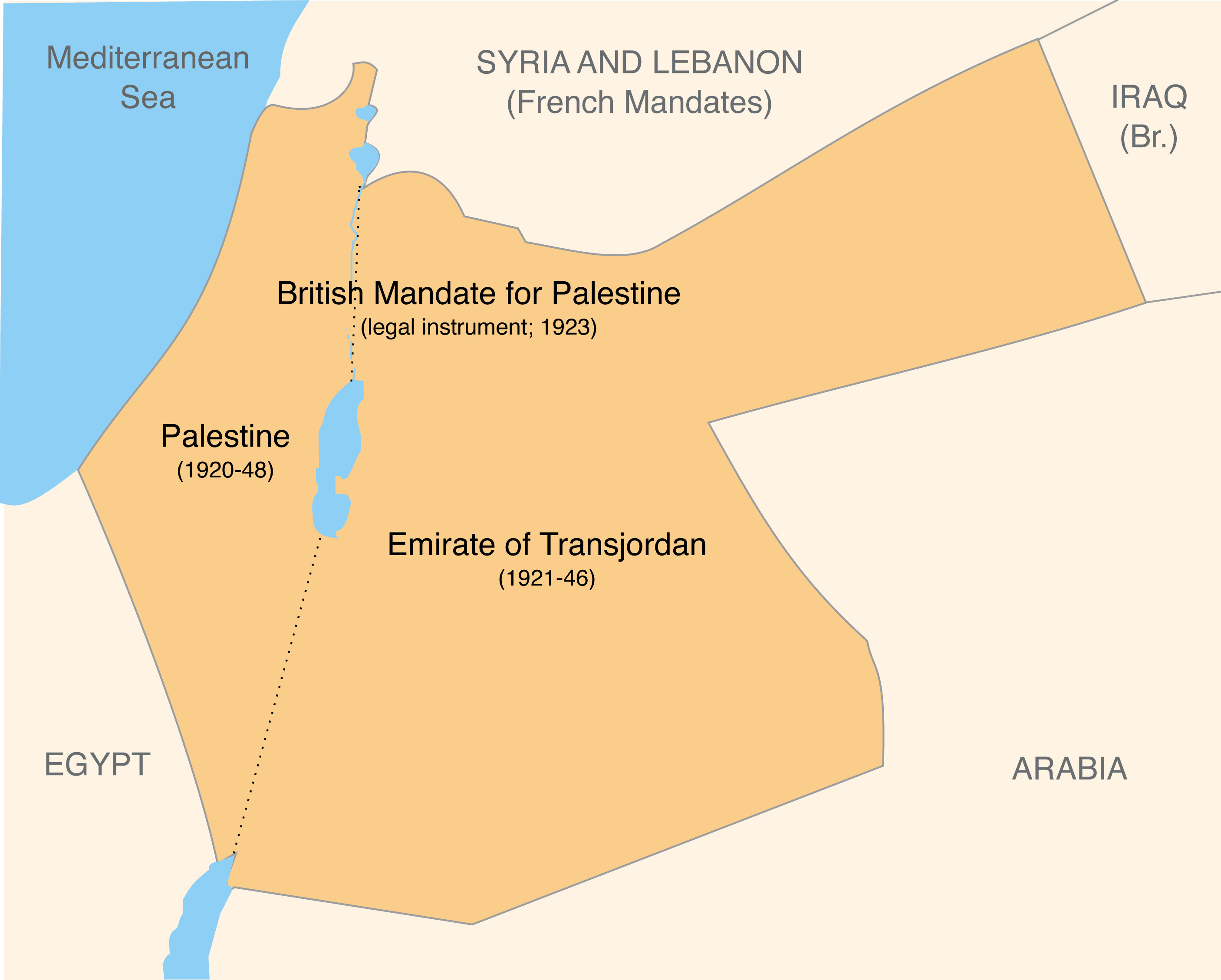
The Balfour Declaration did not apply to Transjordan, which is why you don’t see major conflict between Israel and the modern nation of Jordan today.
Zionist and Arab nationalism sprouted almost immediately after the Brits established their foothold there.
This led to the 1936–1939 Arab revolt and the 1944–1948 Jewish insurgency, which in turn led to the partition destruction of Palestine and the establishment of the Jewish state, as well as the most persistently intractable conflict in the world since World War Two.
Shortly after British Colonial Secretary Arthur Creech Jones announced that the British Mandate would end in May of 1948, Zionists declared independence through the Israeli Declaration of Independence. Palestinians have been getting forced out of their homes ever since, a process that continues to this day.
Ironically, the Ottomans were reasonably accommodating to different religions. The leadership was Muslim, but it wasn’t a fundamentalist strain of Islam. In an alternative world, there may have been a way for Jews wishing to pursue their ancestral heritage in their ancient lands that didn’t include bullying the Palestinians who lived there.
“The 1953 Coup D’Etat in Iran on JSTOR.” 2025. Jstor.org. https://doi.org/10.2307/163655.
Kinkead, Gwen. “Brief Life of Harvard CIA Agent Who Helped Install the Shah of Iran | Harvard Magazine.” Harvard Magazine, December 16, 2010. https://www.harvardmagazine.com/2010/12/kermit-roosevelt.
Contributors. “Shah of Iran from 1925 to 1941 and Founder of the Pahlavi Dynasty.” Wikipedia.org. Wikimedia Foundation, Inc., June 21, 2003. https://en.wikipedia.org/wiki/Reza_Shah.
A once top secret CIA document: https://www.cia.gov/readingroom/docs/the%20central%20intelligence%20%5B15369853%5D.pdf (PDF)
CIA, ibid
Wikipedia.org. “Mohammad Mosaddegh - Wikipedia,” 2023. https://en.wikipedia.org/wiki/Mohammad_Mosaddegh.
CIA, ibid
CIA, ibid
CIA, ibid
Sale, Richard T. “SAVAK: A Feared and Pervasive Force.” The Washington Post, May 9, 1977. https://www.washingtonpost.com/archive/politics/1977/05/09/savak-a-feared-and-pervasive-force/ad609959-d47b-4b7f-8c8d-b388116df90c/.
No, the Shah didn’t say that. It was a joke spread by political nerds in those days.
Engelbrecht, Cora, and Matt Huynh. “A Massacre in Mashhad.” The New Yorker, January 22, 2026. https://www.newyorker.com/news/as-told-to/a-massacre-in-mashhad.
Young Pioneer Tours. “Complete Guide to the Flag of Iran - 2024,” November 22, 2023. https://www.youngpioneertours.com/flag-of-iran/
Contributors. “Flag of the Islamic Republic of Iran.” Wikipedia.org. Wikimedia Foundation, Inc., December 24, 2003. https://en.wikipedia.org/wiki/Flag_of_Iran
Nikoghosyan, Ruben. “Persian Alphabet.” ASPIRANTUM, April 7, 2020. https://aspirantum.com/blog/persian-alphabet.
The US has bit of a habit installing 'friends' who due to being screw-ups eventually get overthrown or otherwise replaced by someone *decidedly* less accommodating, doesn't it?
Charles, the Mossadegh biography alone earned the read — and the Kermit Roosevelt thread pulls the whole architecture into clear, unsparing focus.
I grew up knowing the broad strokes of Iranian history — Persia, as the people themselves prefer — and watched the Shah’s unraveling in real time as a teenager in Germany. The granular detail of the Anglo-Persian Agreement, the constitutional trickery around Zahedi, the CIA’s own report calling the first coup attempt an abject collapse — those layers sharpened something I carried as vague outrage into actual documented fury.
Every convulsion since 1953 traces to one decision: Western powers decided Iranian oil belonged to them, hired someone to dismantle a functioning democracy, and handed the rubble to fundamentalists. The ayatollahs rose from the rubble, full stop.
130 years of Western meddling runs on one engine — money, power, control over natural resources. Dress it in anticommunism, counterterrorism, regional stability — the fuel stays the same. Persia paid. Its people keep paying.