

The other day, a reader urged me to stop doing business with Amazon.
I said no.
Doing that would end any hope of reaching more than a tiny percentage of potential readers, for one thing, but there are other reasons.
One reason is that I, a humble, broke author, should not have to pay the price for voters rejecting Lina Khan. More on that later.
Another reason is that a boycott is not just futile, but logistically impossible.
To understand what I mean, you need to look at some software code. Bear with me. I’ll make sure it’s not painful. Here’s the code:
img src=”https://substackcdn.com/image/fetch/$s_!hcCR!,w_1456,c_limit,f_auto,q_auto:good,fl_progressive:steep/https%3A%2F%2Fsubstack-post-media.s3.amazonaws.com%2Fpublic%2Fimages%2Febffef32-aea0-4a2f-ab7a-1c2dafb4f516_1200x675.jpeg”
This is part of the rendered HTML code used to display an image in the post where the comment was made. Do you see this part…
media.s3.amazonaws.com ?
That code references part of the web address where an image is stored on an Amazon server managed by Amazon Web Services (AWS).
My always vigilant readers might be wondering, “Why is Substack storing images on an Amazon server? Doesn’t Substack have its own servers?”
Nope, most likely not even one. Almost every moderately sized website in the Western Hemisphere rents space on a set of servers managed by AWS or one of its competitors, like Microsoft’s Azure or Google Cloud.
This one simple line…
media.s3.amazonaws.com
…provides a wealth of information to the technically curious. It says, “We here at Substack use AWS for our primary infrastructure needs.”
The reason for this is that AWS is incredibly efficient at something we in the web software biz refer to as “scalability.” To put it in the simplest terms, this means that when a website gets slammed with lots of traffic, it can spin up a new server at the push of a button to handle the increased load.
Nothing, of course, is ever that simple. The largest websites in the world have entire software teams responsible for rolling out production code after quality assurance tests are completed on new code or bug fixes. You can make some pretty nice coin as a software engineer who specializes in AWS.
The point of this is that when you tell me to stop doing business with Amazon’s bookselling biz as an author, you are asking me to abandon 90% of my potential readership. Or whatever Amazon’s book market share is. 90% is probably an exaggeration, but it’s so high that I’m not going to look it up.
If I’m asked to abandon most of my potential readership, I’ll need to ask for something in return.
I’ll need to ask anyone who urges me to stop doing business with Amazon if they’re going to stop using the internet, because AWS currently powers 58,902,751 active websites.1
Depending on your source, somewhere between 30% to 40% of cloud-based web services run on Amazon servers. The others mostly use Microsoft Azure or Google Cloud.
To truly boycott Amazon, here is what we’d all need to do:
Stop reading Substack.
Also? Stop using the internet.
Since you can’t do that, try to discover the 58 million sites that pay AWS and stop using those. These include Amazon-owned services such as Twitch (livestreaming), Audible (audiobooks), IMDb, and Wondery.
No more watching anything made by Amazon-owned MGM, a film and TV production studio with numerous affiliated companies. This means you are no longer allowed to watch “The Wizard of Oz” and many other old classics. You’re not in Kansas anymore.
No more Whole Foods Market, Woot!, or Zappos for you. Amazon owns them, too. That’s okay. The Whole Foods buffet ain’t what it used to be.
You can’t eat any food from companies that sell on Amazon. This is everyone. All companies. Everywhere. All the time. Even obscure stuff like this:

Screen capture from Amazon.com Don’t use any products that are sold on Amazon. This is all products. Everywhere. All of the time.
Since you can no longer engage with the modern economy, you will need to become a survivalist, but don’t buy any survivalist products from companies that sell their goods on Amazon. This is almost all of them. You’ll be left with an old knife and a tent from the 1950s.
Just in case that’s not enough, you can’t buy or use anything marketed through one of the 58 million websites that use AWS.

Wait. How did this happen? Why didn’t anybody tell us Amazon owned the world even though we kind of knew?
When I was a software engineer for big tech firms, the teams I worked on spent all day coding and programming. We didn’t worry about deployments much. That was someone else’s job. The only time I had to think about deployments was when I was asked to manage production rollouts, but that was mostly a process for merging different versions of the code base from (for example) a successful test environment into the production queue.
The process was arduous because it sometimes involved merging thirty or forty different code base versions (branches) into one.
Hot tip if you’re in the software biz with huge code bases: Don’t get a reputation as an expert at merging other people’s code. You’ll find yourself doing it a lot, often in the wee hours of the morning.
The process of managing things like server loads and other arcane (to most people) tasks related to software deployments was handled by teams of what we called “release engineers.”
For a long time, companies managed all of that internally, but as AWS built its cloud, it lured companies into outsourcing an ever-growing number of production release processes.
At first, this mostly meant server management. If a company encountered a spike in web traffic, all they had to do was click a button (I’m greatly simplifying this process to illustrate a point), and additional servers could be added to handle the load.
This process works well for startups, too. If you can focus on code development, and your release team can be whittled down to a couple of people who know how to work with and deploy to AWS, you can cut your costs significantly because you don’t need to worry about buying computers (which, compared to people, are almost free, but bean counters have their principles).
AWS makes it easy to start small, and if you’re lucky enough to hit the big time, it’s easy to scale up.
The number of your AWS servers might start at two, but quickly expand to thirty or even a hundred once your new business idea starts turning into a gold mine. You can see why AWS grew quickly. Everyone loved it. And it was done well. There were few glitches in the process.
As time marched on, a cottage industry was born. Technical specialists with expertise in AWS filled the skies, eager to help the next company that wanted to deploy via AWS. AWS grew in complexity. It became a behemoth that no single person could master.
One of the classic case studies of a company transitioning to AWS is Netflix, which in 2008 suffered catastrophic database failures. Yury Izrailevsky, who was Vice President of Cloud Computing and Platform Engineering when the eight-year transition to AWS was completed, explains what prompted the move:2
Our journey to the cloud at Netflix began in August of 2008, when we experienced a major database corruption and for three days could not ship DVDs to our members. That is when we realized that we had to move away from vertically scaled single points of failure, like relational databases in our datacenter, towards highly reliable, horizontally scalable, distributed systems in the cloud. We chose Amazon Web Services (AWS) as our cloud provider because it provided us with the greatest scale and the broadest set of services and features.
Are you old enough to remember web pages that took forever to load? A major reason you don’t see that anymore is because of AWS and supporting infrastructure software services firms like Cloudflare.
There’s that phrase again: “single point of failure.” There’s another phrase there that matters: “distributed systems.” That sounds like tech bro talk, but all it means is that Netflix’s databases are no longer hosted at a single Netflix data center in Campbell, California (its HQ city) or wherever they were before the transition to AWS.
When I worked at eBay a million years ago, we actually had a server room. It was a dark, scary place with a lot of blinking lights guarded by hooded dudes in sunglasses gripping a karambit.

Don’t tell anybody, but I even hosted a small public-facing test application from a single Linux box in a cube a few steps away from me. That doesn’t happen these days. Not without getting fired. Or smoked by a hooded dude with his karambit.
These days, everything for most companies, including Netflix, is hosted in several different locations within the AWS infrastructure. Data corruption is considerably less likely to ruin the company because several more sites, in multiple locations, host the data than before the transition.
Oh, did I mention that you need to stop watching Netflix if you want to boycott Amazon? I forgot, didn’t I?
Izrailevsky continues:
Leveraging multiple AWS cloud regions, spread all over the world, enables us to dynamically shift around and expand our global infrastructure capacity, creating a better and more enjoyable streaming experience for Netflix members wherever they are.
We rely on the cloud for all of our scalable computing and storage needs — our business logic, distributed databases and big data processing/analytics, recommendations, transcoding, and hundreds of other functions that make up the Netflix application. Video is delivered through Netflix Open Connect, our content delivery network that is distributed globally to efficiently deliver our bits to members’ devices.
Yay, another tech bro phrase: “multiple AWS cloud regions.” Another one he uses (not quoted) is “redundancy,” which simply refers to the fact that there are multiple instances of things like databases that duplicate the same information or functionality as other instances.
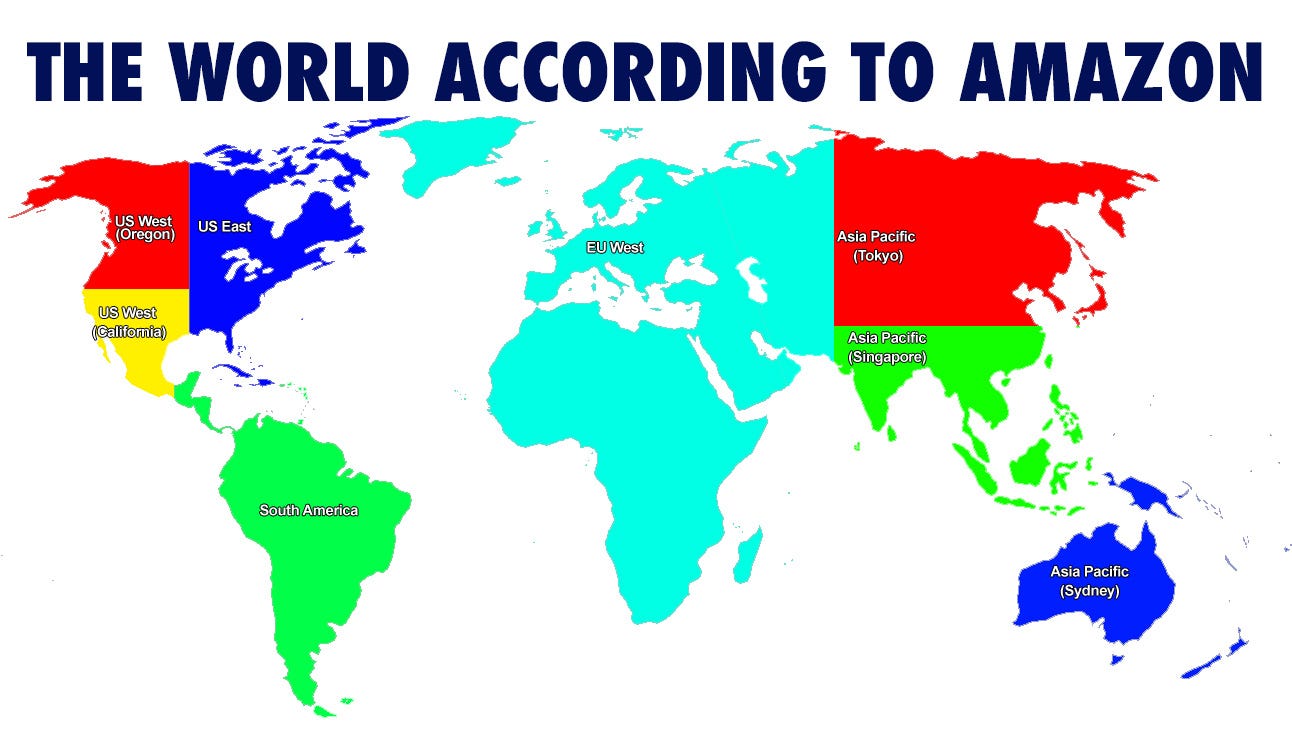
The AWS cloud is distributed at several different points throughout the globe (see map above). For years, as the AWS infrastructure grew, new Amazon data centers seemed to pop up at least every month around the U.S., then the globe.
AI, of course, has taken the concept of data centers and multiplied their reach and environmental impact exponentially in just a few years.
This brings me to another question for anyone asking authors to stop using Amazon to sell books: Do you use AI for anything? You do if you use Google, because Google now defaults to an AI query on everything you search for.
Lina Khan to the rescue
Back when we thought there was a chance the United States would not be menaced every day by a mobster with a sordid sexual assault history, an old fella named Joe Biden teamed up with a sharp gal named Lina Khan, who wrote a fantastic thesis called “Amazon’s Antitrust Paradox” while studying for her Juris Doctor degree. It was published in the Yale Law Journal in 2017 and was a big hit among the few anti-trusters still willing to speak up in the wake of the mad cow’s first election.3
When Biden won the presidency, he named Khan a commissioner of the United States Federal Trade Commission, where she evangelized breaking up Amazon. The idea, at least in some quarters, grew into the concept that one part of the company would become a bookstore, another a grocer, another a web services company (AWS). These would also be monstrous companies, but they’d at least be separate ones.
Unfortunately, 77 million Americans had another idea, and the dream ended, and so did Lina Khan’s influence on American government.
So, no. I’m going to keep trying to sell my books on Amazon. This isn’t a choice I am thrilled about, but it’s one I’m stuck with, just like you’re stuck with interacting every day with Amazon, no matter the grand pronouncements made by boycott enthusiasts.
In a perfect world, a new, independent bookstore would be created that offered the same self-publishing capabilities that Amazon does through its self-publishing services.
In another perfect, alternative world, Amazon would face regulation forcing it to stop cranking out AI slop from that same self-publishing arm.
In that alternative world, Donald Trump never took control of the Oval Office.
All change begins with his removal from not just the Oval Office, but the American political scene.
But even when/if he goes, Americans don’t seem particularly interested in combating oligarchy and/or breaking up monopolies.
The bigger problem
In all my many years on this planet, I've never seen an American electorate willing to vote for substantial change — the kind where society demonstrates a willingness to toss out the red meat of its routine to sacrifice together for the greater good. It has always voted to protect itself, whether from outside forces or enemies invented by screeching preachers posing as politicians.
Nothing is more sacred to Americans than the status quo. Almost all major change has been incremental and has arrived in the face of rugged resistance.
One might argue that the Trump cult is an exception. Didn't that change the country substantially? Didn’t his voters vote for change? It did change the country, in about as bad a way as possible. But that cult wasn't voting for change. It was voting to preserve an extinct society that never offered even its most animated adherents anything beyond bitter, luminescent grievance.
The predator-in-chief claimed to give them power, when, in fact, he took it away.
Meanwhile, over recent decades, the rest of us have done little more than tinker.
How slow is the pace of change in the U.S.? We can't even get consensus on a national healthcare program, something every other nation in the West has maintained as a core policy for decades.
Tell a European about the misery of bankruptcies at the hands of healthcare profiteers, and she'll just shake her head in bewilderment. “Such primitive creatures,” she'll mutter.
One of these days, maybe I’ll write a small communist manifesto explaining how I really feel about corporate America.
If I do, I’ll self-publish it on Amazon, because no modern publisher will want to touch it.
Notes
The map in this essay shows AWS regions. When one region goes down (it happens), a whole bunch of websites go down with it. As you can see, AWS has worldwide reach. The map is sourced from Wikipedia, which is one of the few huge websites that doesn’t use a cloud service. This is referred to as “Using our own metal.”
I’ve always provided a non-Amazon option as the first option for purchasing my new short story anthology.

You can purchase a PDF of all my Substack Fiction from a source that doesn’t involve Amazon or any other giant retailer. It’s only $4.99. That’s less than a Starbucks Venti Latte (you should probably be boycotting Starbucks for its resistance to unions). I haven’t checked under the hood to see if the site I’m using to sell it uses AWS.
The book, of course, is also now available on Amazon/Kindle in ebook, paperback, and hardcover formats (the Kindle version is free if you have Kindle Unlimited):
If you are a paid subscriber, it’s available free here on Substack as a Perk. Just go to the “Perks” page via the Ruminato web page menu to find it.
Thanks for reading!
You can help me reach more people by subscribing (paid or free), sharing, restacking, and commenting.

Footnotes
Give or take a few, since that number changes a bit each hour.
BuiltWith. “Amazon Web Technology Usage Trends,” 2026. https://trends.builtwith.com/hosting/Amazon.
“Completing the Netflix Cloud Migration - about Netflix.” 2016. About Netflix. 2016. https://about.netflix.com/en/news/completing-the-netflix-cloud-migration
I take your points, they're all made. However, I still refuse to give my money to Amazon directly. I've told a number of authors that is love to buy their books but won't do so from Amazon. One of them (Nicole) even granted me temporary free access to her book on SubStack so that I could read it, a gesture I found profoundly generous, touching and moving. I promised her that as soon as it's available elsewhere I would buy a copy, not just for her generosity, but because I loved her book and wanted to have a copy I could re-read.
I mean no criticism of you or any other author who publishes on Amazon, I just choose not to even if I may be giving them my custom indirectly. And I applaud you for giving us alternatives. It's a matter of principle for me. And I also try to urge people to find alternative sources, wherever they can. It may be a futile gesture, but if no one does anything things won't ever change. The Lone Skums, Bezarses and the rest of them will take over the world.