

I’ve published a few books over the years, so I was curious if any of them made the Anthropic download list.
In case the first sentence has no meaning for you, here’s some background
Anthropic, the AI company behind Claude AI, got hit with a class action lawsuit claiming that it infringed authors’ copyrights when it downloaded millions of entire copyrighted books in violation of U.S. copyright law. Anthropic responded to the lawsuit by claiming that its use of the downloaded “datasets” constituted fair use because it only wanted to train its models on the content for its LLM models.
The litigants, however, also accused the firm of piracy, partly because the sources of some of their downloads contained pirated works, in addition to works they legitimately purchased.
The lawsuit was filed on behalf of authors Charles Graeber (The Good Nurse), Kirk Wallace Johnson (The Feather Thief), and Andrea Bartz (We Were Never Here) by three legal firms: Susman Godfrey LLP, Ieff Cabraser Heimmann & Bernstein LLP, and Cowan Debaets Abraham and Sheppard LLP.1
Anthropic tried to get the case tossed into the legal garbage can by obtaining a summary judgment, but in June 2025, Judge William Alsup of the U.S. District Court for the Northern District of California said, “Nope.”
He said that, if the books had been obtained legally instead of pirated from various sources, Anthropic could claim fair use. However, he said Anthropic would have to prove it didn’t pirate the books. He then set a trial date for December 2025.
Rather than go through all that, Anthropic settled out of court. They didn’t admit to piracy, but they did agree to compensate authors for the pirated downloads anyway.
This means that if you published a book with a valid ISBN or ASIN (ASIN is, essentially, Amazon’s version of ISBN) that was downloaded by Anthropic, you could get part of the $1.5 billion cash settlement.
CAUTION: Nothing in this post should be considered legal advice. If you have questions, contact the claims administrator for the case directly at 877–206–2314, or by emailing info@AnthropicCopyrightSettlement.com
The New York Times reports that this amounts to $3,000 per work for 500,000 authors. The settlement site handling the claims states “at least $3,000 per work (not per copyright owner).”
There is also a bit of math involving how much you get based on contractual rights with your publisher.
If you’re self-published, there’s no math. It’s all yours.
You must file a claim to get your money
Some important dates for your consideration:
November 10, 2025: This is the date by which publishers must submit author contact information. Do not wait for them to do this. If you’re like me, they may not even have your contact information. My books were published twenty years ago.
November 24, 2025: This is the deadline for the Claims Administrator to send notices to authors who appear on the list of known class members, meaning people to whom Anthropic owes money.
March 23, 2026. The final date by which you must file a claim.
August 10, 2026: Expected payment date for most claims.
As court cases go, this one is moving quickly. You should take action now if you want to collect money, but you absolutely must by March 23, 2026.
The law firm handling the plaintiff’s case knows precisely which pirated books were downloaded because Anthropic downloaded them from two sites and maintained the downloads in specific datasets made available to the court.
These downloads came from either the Pirate Library Mirror (PiLiMi), which is a torrent-based digital library of books (downloadable as a massive zip file), or Library Genesis (libgen), a Russian project that contains 4 million ebooks. Each resource contains around 30 TB of books.2
The settlement claims are being handled by a company called JND Legal Administration.
How to find out if your book was downloaded by Anthropic
This is how I “met” Sheryl Crow.
JND established a website where you can search for your book by Title, ISBN or ASIN, publisher, or author name.
The search website is here:
Search for your Anthropic Settlement books here
Check it out (after you are finished reading this article, of course!)
I was disappointed to see the pirated downloads didn’t include my first novel, MagicLand. After all, it received good reviews, was a finalist for a 2023 Feathered Quill Award, and showed up in a lot of libraries through the distributor, Ingram. How insulting. A pox upon you, book pirates!
But, alas, “Charles Bastille” is a pen name. My publisher thought that my real name was too common to do well in SEO. Looking back, I don’t think it mattered, but that’s how the “Charles Bastille” pen name originated. Since then, it’s sort of become my “brand,” so I’ve stuck with it, for better or worse.
However, a long time ago, I wrote a bunch of computer books for Wiley, too, under my real name, which I published under the name “Chuck White.”
I was in luck! And guess who was there, too?
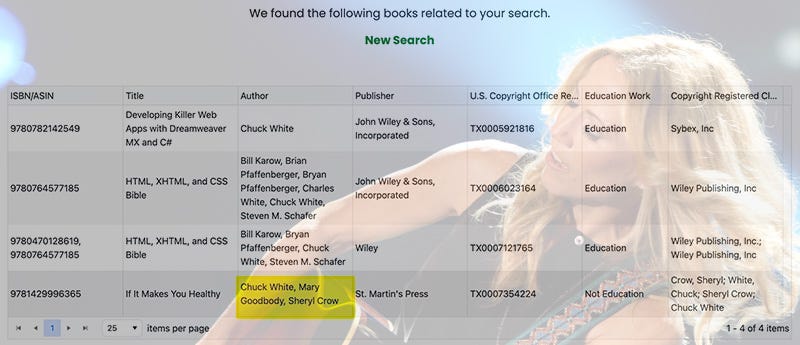
Wait, the sharp-eyed observer must be saying. How did Sheryl Crow show up as a background image on the JND search page? What kind of magic is this?
Well, before there was AI, there was Photoshop. So creating fakery is not a new thing. I added her to the screenshot because I was in a mood.
But check out the stuff in yellow, too. Who belongs to that name? Well, that stuff is for real, and it’s the kind of common name that I guess my publisher was worried about. “I’m” listed as a co-author on a book written by Sheryl Crow. Exciting times.
I loved the fact that Sheryl and I wrote a book together so much that I made a graphic for it. But that “Chuck White” isn’t me, so if I want money for it, I’d have to scam one of my favorite singers. Bummer.
I wrote about six or seven computer books, but only three showed up in the search, two of them under the same name (one is hardback, the other trade paperback, hence the different ISBNs).
Because the Bible books (shown in the listing graphic) have co-authors, I’ll need to share my winnings from Anthropic’s downloads with them. But one of the books in the search results is mine. All mine! Because it has no co-author.
I was hoping for more books to show up, but I guess book pirates are not impressed by my efforts. So I sighed and moved on to the next part: Filing a claim.
Note: You don’t have to accept the Anthropic Settlement if you’re part of the class in the downloaded dataset. Copyright law permits larger settlements than were obtained by the lawsuit, but that means hiring your own lawyers, etc.
For me, this is just the easiest thing to do. Many authors have objected to the settlement and have said they won’t participate in the settlement claims. If you’re one of those, I hope you’ll add your reasons in the comments to help others make sound decisions.
How to file a claim for the Anthropic Settlement
Filing a claim is easy. Just go to the menu item on the far right that says, “File a Claim” to start.
That page is here:
It should look like this:
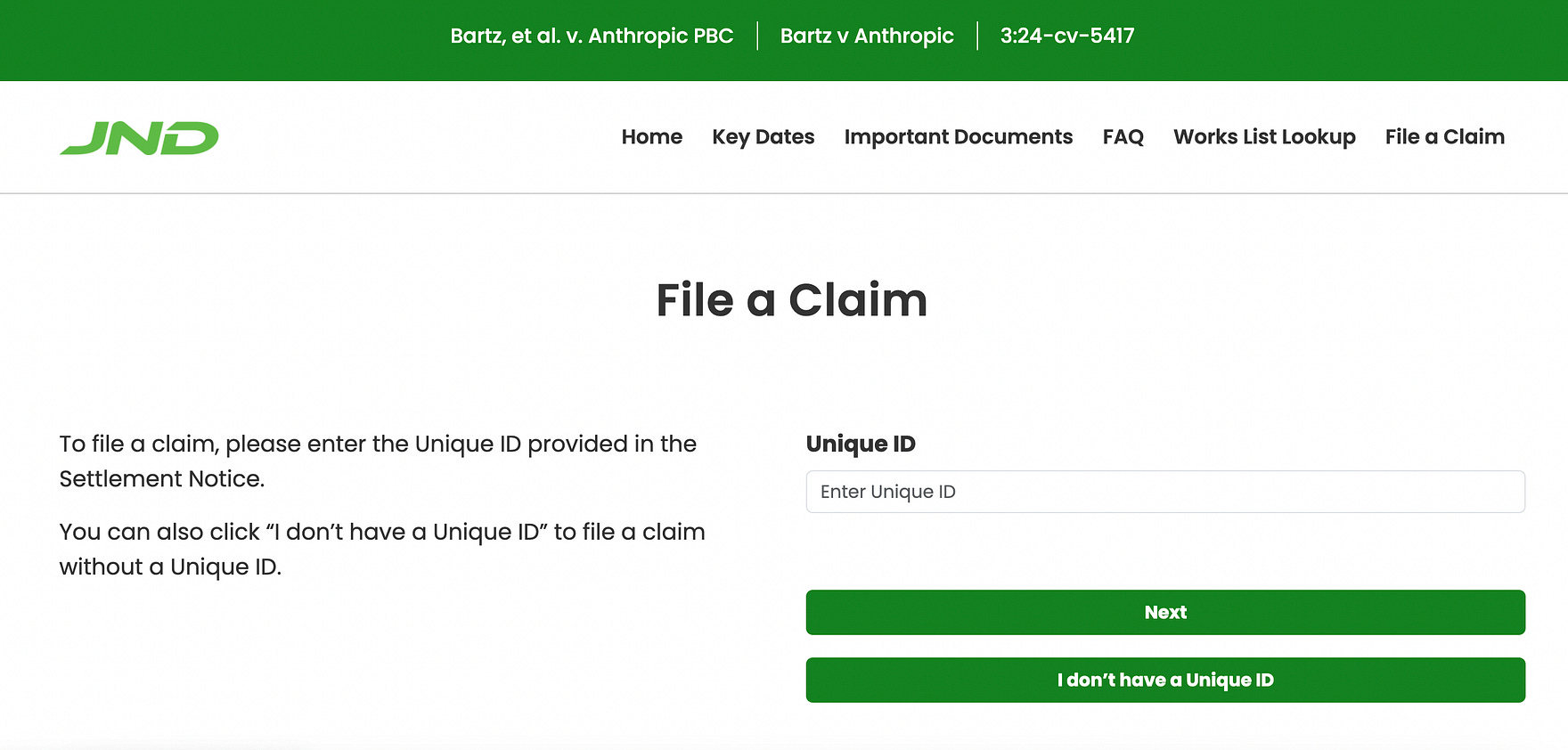
You’ll only have a Unique ID if the claims administrator, JND, has already contacted you and sent you one. This is unlikely given how frequently our meager income forces us writers to be evicted from our homes, but don’t worry, you can move on by clicking that second button, “I don’t have a Unique ID.”
If you do have it, hit “Next.” I didn’t, so I got this screen:
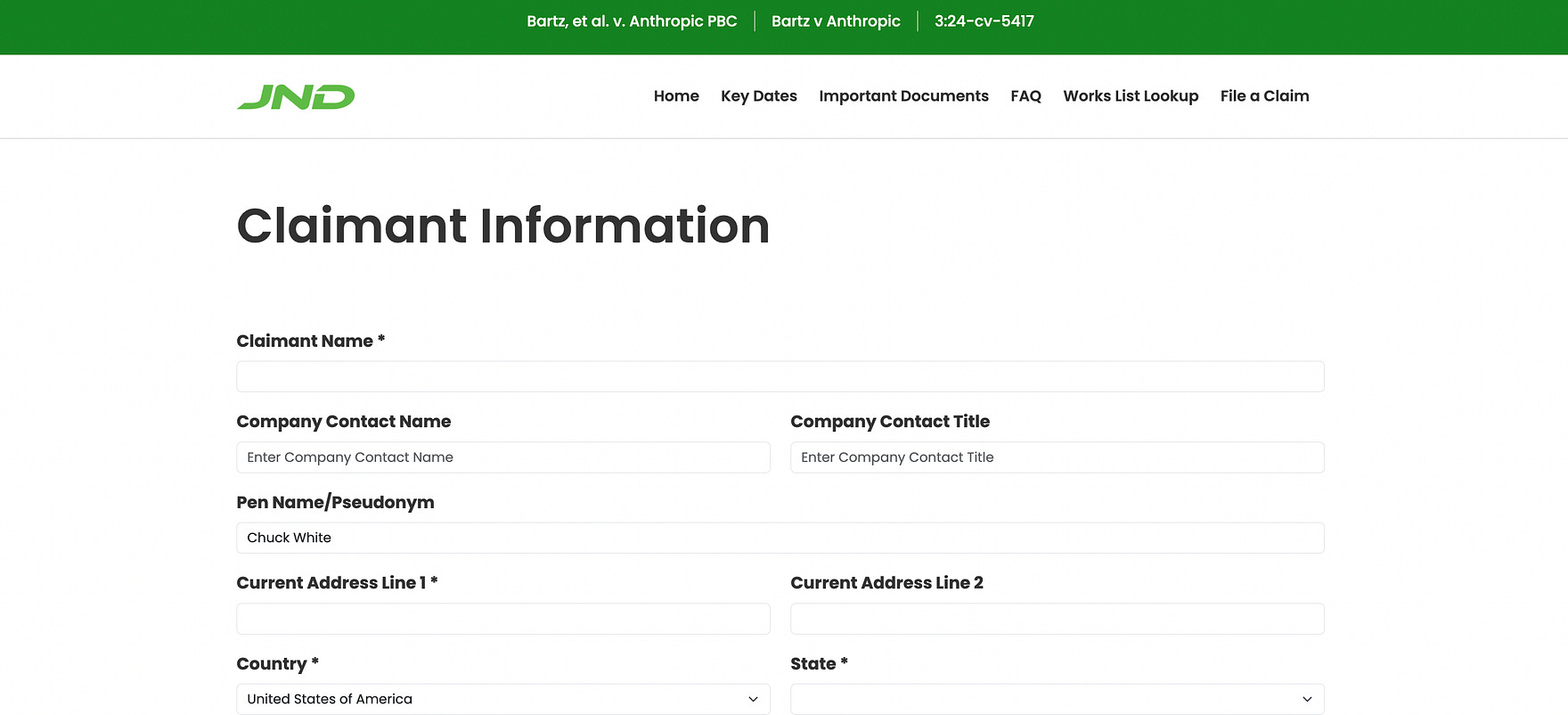
When I was done filling out that page, the website fired up this screen:
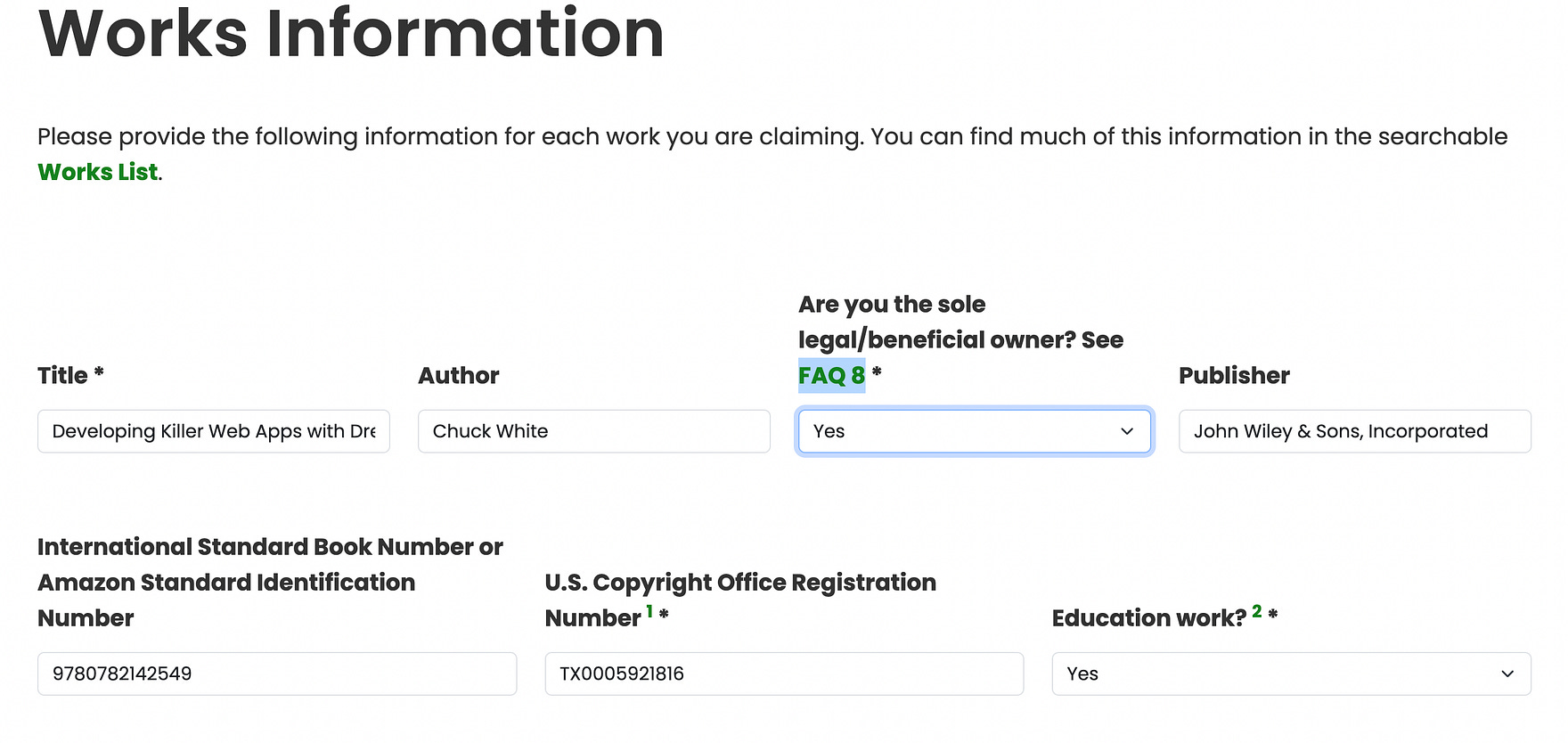
All the info you need is available on the search results page.
There is an emphasis on “Education work” because Anthropic downloaded a significant number of education-related titles, and copyright law is more complex with educational titles than, for example, fiction.
The trick question on the screen, “legal/beneficial owner?” is pretty much always going to be a “yes” if you’re an author (I can’t think of exceptions unless it was a work for hire).
The search results page will also let you know if it’s an educational work.
So, Sherl Crow recipes no, computer books yes. Sorry, Sheryl, that’s just how the world works. Love ya!
After you fill out that page, you are asked to stake a claim. I had no idea what I was doing here, so I just used common sense, assuming that this is what class action lawsuit claims administrators are paid to figure out.
But there is something you should know, so pay attention here. If your book is old like mine, and/or you had an agent, which I did, and you signed with a major publisher, which I did, there’s a good chance that there’s an applicable rights reversal clause in your contract.
Rights reversals are commonly triggered when fewer than a contractually stipulated number of books sell during a given period of time. I know nobody’s been buying my books for a long time.3 So I asked for the full percentage of the author’s cut for each book.
If rights have reverted to you, you might be able to claim the full percentage. I no longer have a copy of my contract, so I made the bold assumption that the rights reverted to me (I had a good agent).
Note that many book contracts, even if there’s a rights reversal clause, include another clause in tiny, tiny print that states you must submit a request for your rights reversal claim to the publisher. But the law is complex enough that I took the chance to assume that after twenty years, the rights have reverted, especially considering that I had an excellent agent at the time.
If I’m wrong, the publisher will dispute it, and that’ll be the end of it. I’ll still get something, just not as much as I’d hope.
Also, if the publisher challenges my claim, I can ask them to provide a copy of the contract so they can prove I’m wrong. But I’m not going to make a big fuss over it unless they get weird.
This is the screen for staking your claim:
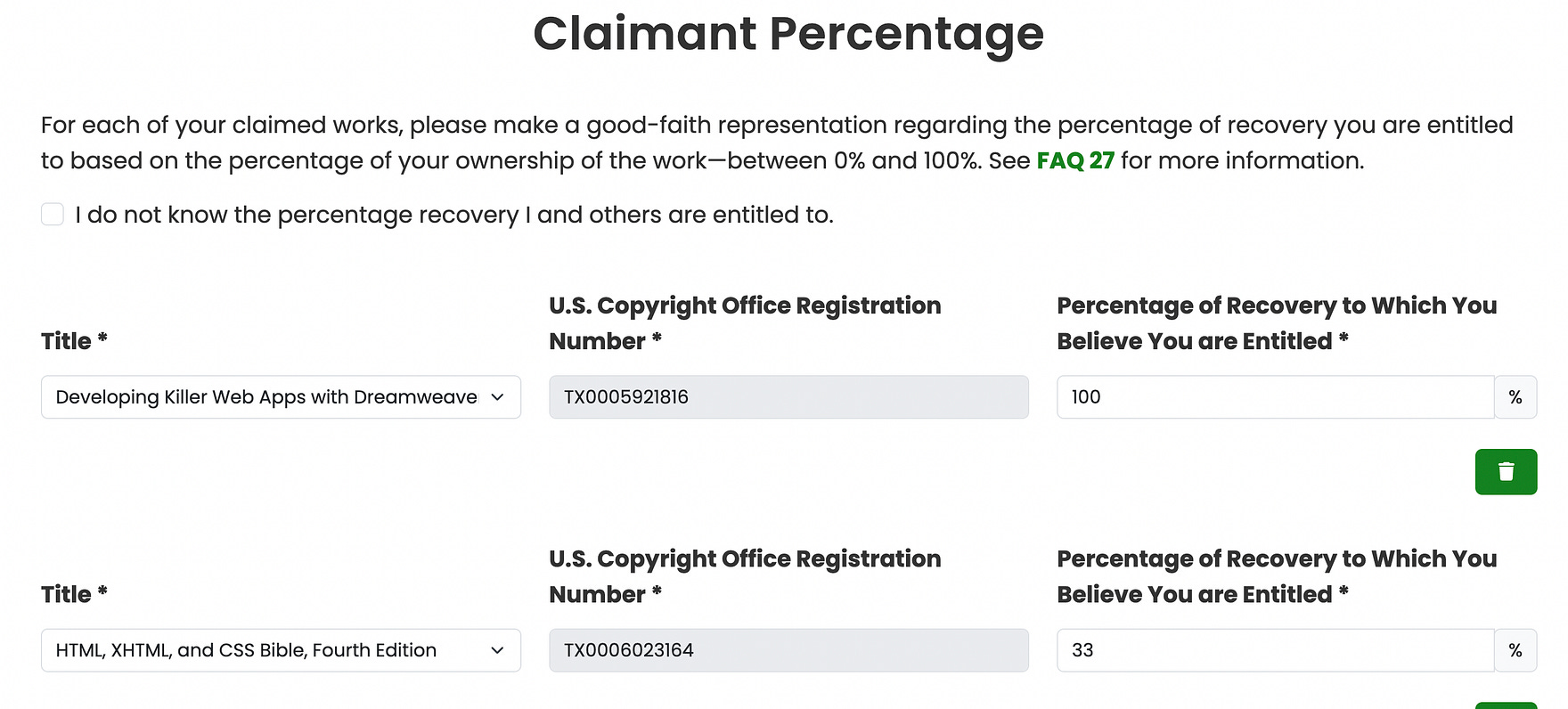
The first one was easy. I had no co-authors, so give it all to me, you monsters.
For the others, I claimed 33 percent, since I was one of three authors, but if I remember correctly, one of the other authors was the “primary” author. My best guess here is that the publisher, Wiley, which is a huge technical publisher, will also fill out the form, and the claims administrator will use their answer for this instead of mine.
That’s fine, as long as I get a chance to talk to Sheryl Crow. More on that soon, I promise.
In what I thought was a bizarre twist and mostly an opportunity for the lawyers to get a bigger cut because the next question might stop some people, you’re asked for co-author contact information. Just laugh that off. You don’t need to know. If you do, that’s great, I suppose. Just be sure to fill in their name correctly.
My books were published 20 years ago. I don’t even remember where I was living twenty years ago, much less where my co-authors are these days. After you fill that out, or not (you have to at least provide their name), you see this page:
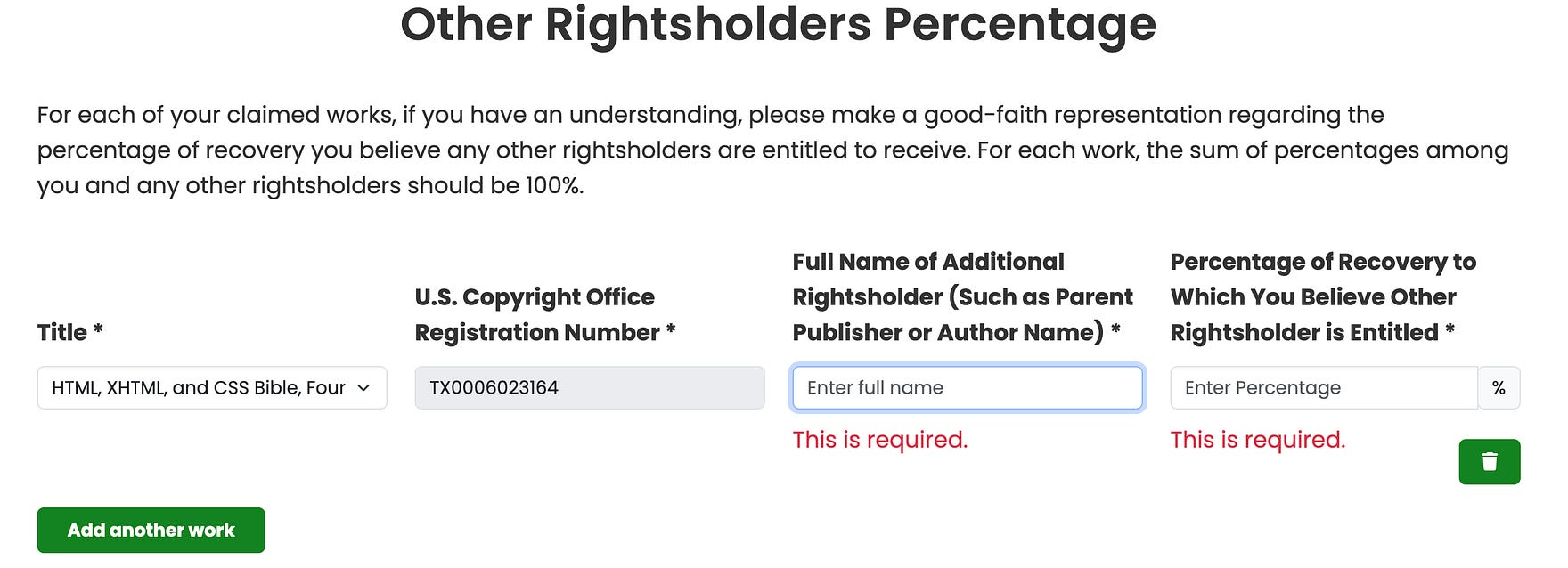
Here, you’re supposed to guess their compensation. I guessed that it should be the same as mine. What else could I do?
I acknowledged the likelihood of my cluelessness on the next screen presented to me:
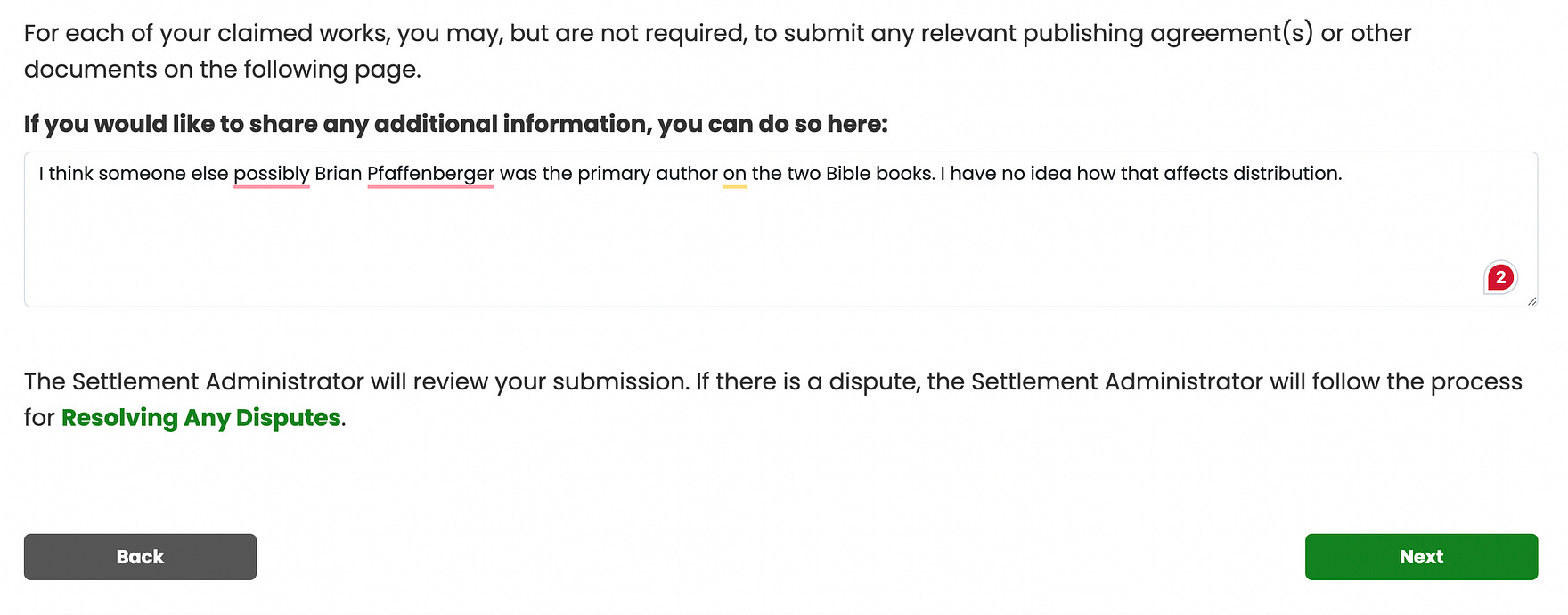
This is an opportunity to provide further statements regarding your claim. If you aren’t certain of some answers, it’s a place to say so.
This kind of thing is called good good-faith effort. If you’re not trying to rip off your co-authors, you’ll be fine. I sort of claimed cluelessness and moved on. I’m definitely not interested in ripping off a fellow author.
As with the screen where I addressed my claim percentage, I assume that publishers who fill out these forms will decide any “dispute” with their answers.
Next, you are asked to provide supporting documentation. After twenty years, I can confidently say I don’t have any aside from my social security and driver’s license numbers. They don’t ask for that kind of stuff, so I skipped this screen and landed here:
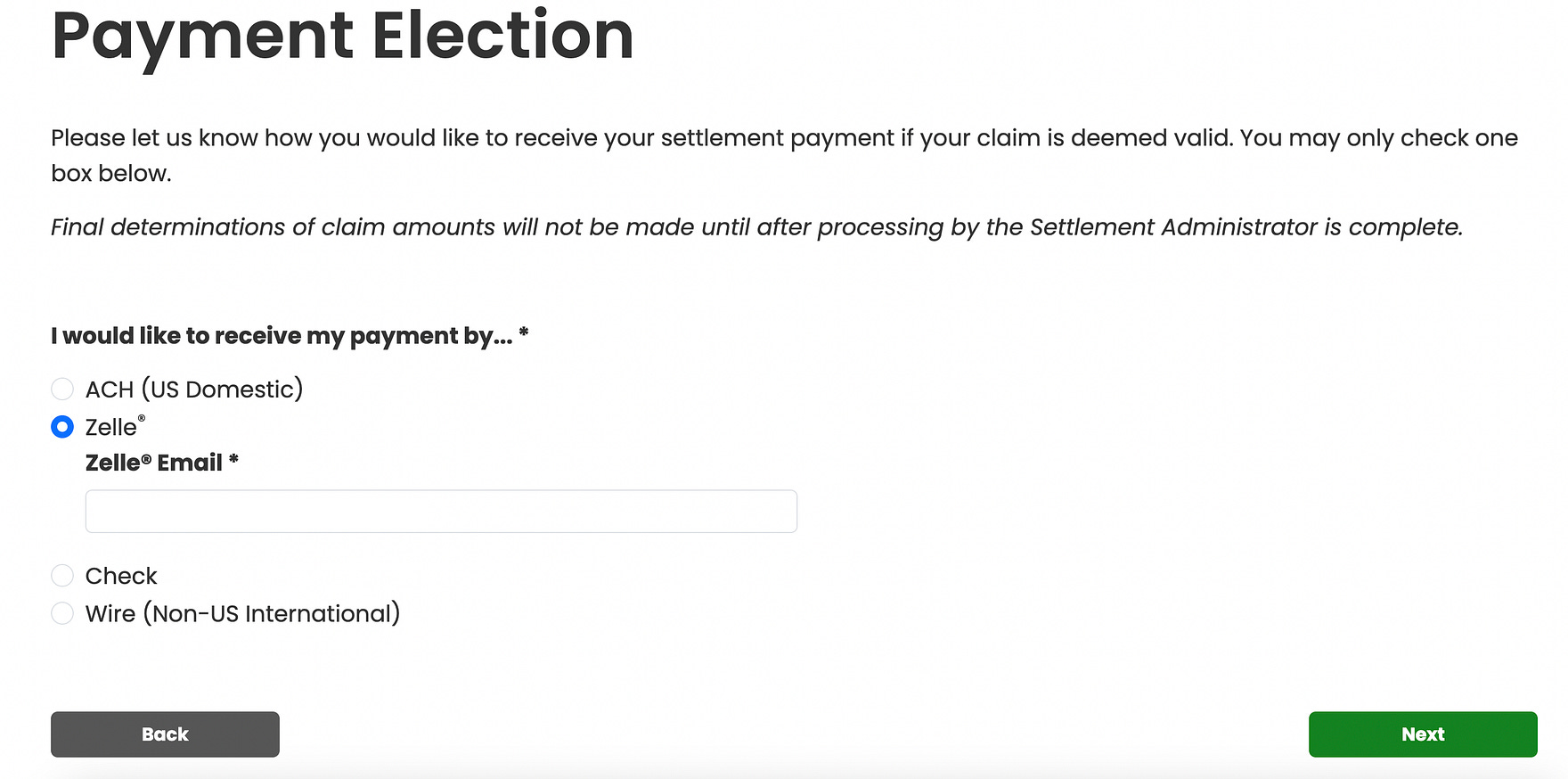
Yep. The good stuff.
I chose Zelle.
Funny story: The other day, I received thirty-eight dollars through Zelle from a Meta privacy settlement that I had forgotten about. So I guess this lawsuit stuff kind of works.
Thirty-eight dollars does not come close to approaching what the lawyers made, but that’s tort law for you.
I filled out that form and moved on to a summary page. I clicked Next, and found myself here:
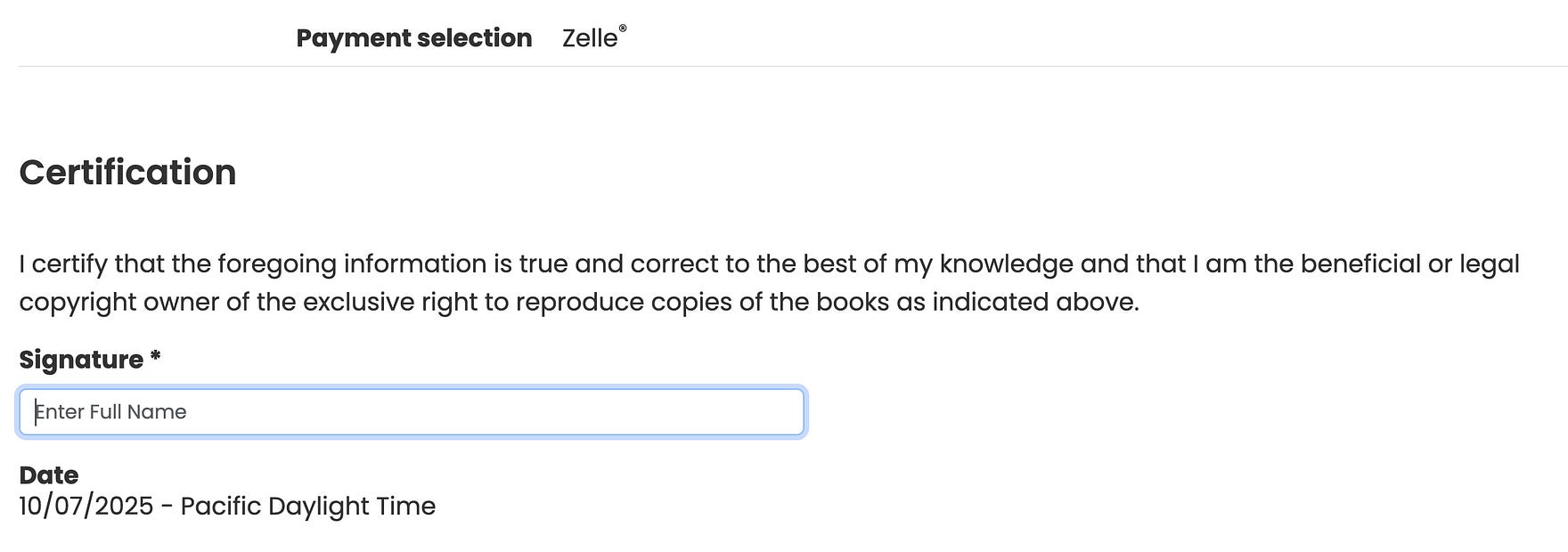
Whew! Almost done. These days, computer forms do signatures the right way by just asking you to fill out your full name, so I did that, then got the page I had been excited to see from the beginning:
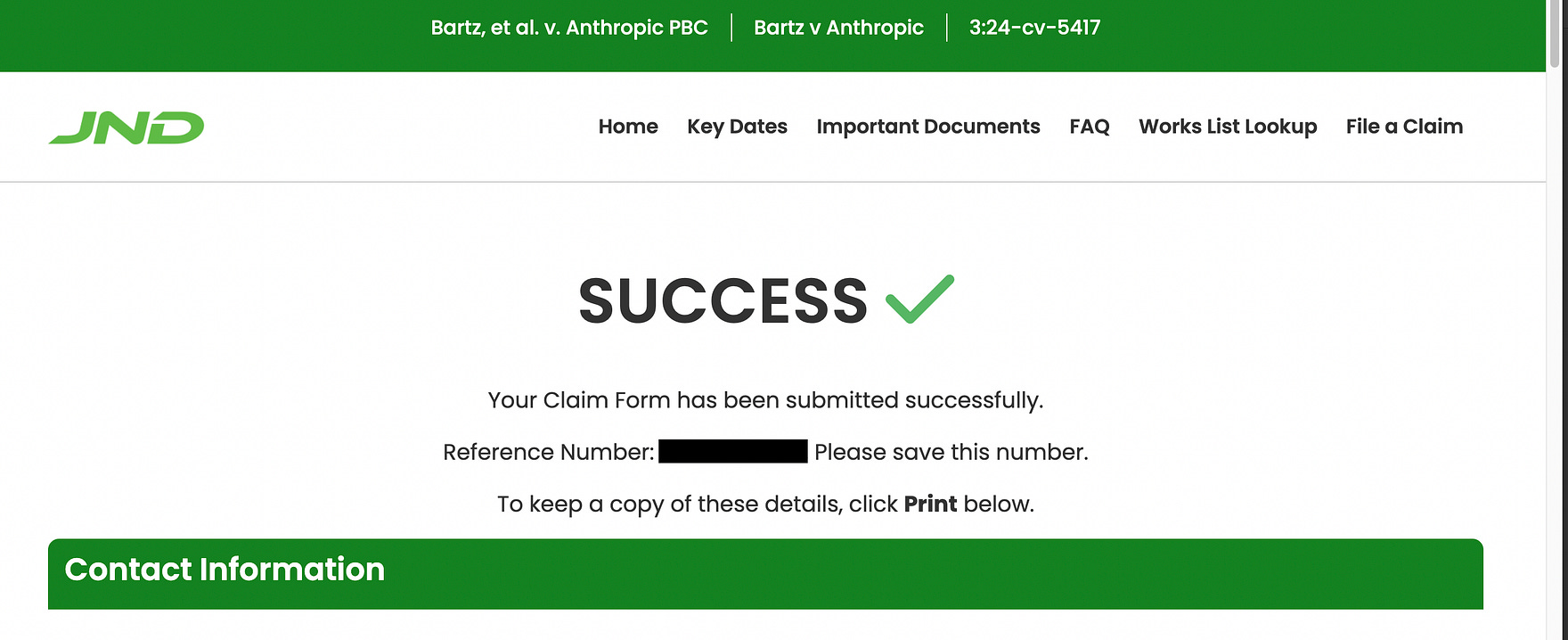
This might seem like a lot of effort, but we don’t know how much we’re getting, so it’s worth it. Besides, with dozens more similar lawsuits in the pipeline against various AI bubble4 firms, you might as well get used to the process.
The alternative is to decline participation in this class action suit, find my own lawyer, and try for more. For twenty-year-old instruction manuals? Nah.
The Scam
After finishing, I looked online for Sheryl Crow’s contact info because I thought it might be good to scam the other Chuck White out of his money. After all, we live in Trump’s world these days: Scamerica rules it, and I just live in it.
I also decided I should have a chat with Sheryl since I hadn’t spoken with her for a while (as in, never).
Okay, I confess. I didn’t speak with her for realz. And I didn’t try to scam anybody. This is fiction, because I write fiction that doesn’t sell now instead of computer books that don’t sell.
But I should have given her a call, I think, given that we are technically co-authors on a book.
First, I’d have to get through her phalanx of bodyguards. This is how I imagined it transpiring:
Bodyguard 1 (of several hundred, I am guessing, answering the phone): “Whaddya want?”
Me (in a tough mobster voice): “I’m looking for Crow. Tell her that I want to chat with her about the Anthropic settlement. Tell her I’m putting in a 100% claim.” This would snatch her claim away, too, in addition to robbing the other Chuck White, which isn’t very nice, but she’s rich and I’m not, so I don’t care.
Bodyguard 1: “Give me a minute, twerp… Okay, hold on, I’ll put her on.”
Sheryl: “Hello?”
Me: “Hey, Sheryl, ‘sup? It’s me, Chuck, your co-author on If It Makes You Healthy!”
This is where it gets dicey. In my experience, co-authors often never meet each other in person, and don’t even bother with video calls. In my case, we wrote, we edited, we commented, we said our goodbyes. All online.
So this is me taking a chance, hoping she never met the dude.
Sheryl: “Oh, hello, Chuck, nice to speak with you! You sound different. Do you have a bad cold? Polyps in your mouth, maybe? How’s the Nashville restaurant going?”
Me: “Oh, umm, great. Lots of good eatin’ goin’ on!”
It is then that I realize I should have done at least the most basic research. Maybe check out her book on Amazon. I furiously tap on my laptop keyboard as I search for something to say.
An image of their book pops up.
Ruh-roh…
Is that Chuck?

Abort!
Well, at least it was fun while it lasted. I hope she signed up for the claim. Anthropic snatched her book, too. And the other Chuck’s.
Maybe I should give the other co-author, Mary Goodbody, a call. She’s got a great, healthy name, so at the least, it might be an interesting conversation.
Notes
The first question you probably have, especially if you’re self-published, is, “Do I have a book that I can file a claim on?”
Search the claim administrator’s website here. Your definitive answer is there. If you don’t see your book there, it’s not in one of the datasets.
Here is the Frequently Asked Questions page from the lawsuit administrator’s website:
It’s a comprehensive FAQ that will probably answer most questions you have. If not, give the claims administrator a call. I think it’s always a good idea to make lawyers work for their money, especially if the money doesn’t come out of your pocket.
There are currently more than 50 other lawsuits against AI companies in various stages of litigation. For a full list, go here:
Master List of lawsuits v. AI, ChatGPT, OpenAI, Microsoft, Meta, Midjourney & other AI cos.
Look for more book-related and writing-related lawsuits on that site. Don’t leave money on the table. I don’t know much about the folks who put it together, so direct any questions you have to them.
For information on understanding publishing rights transfers, try this site:
Requesting Rights Reversion From Your Publisher
Good luck, Sheryl! Sorry we never connected!
And good luck to the rest of you. If you have a different experience or are refusing to participate, let me know in the comments. Thanks!
Footnotes
“What Authors Need to Know about the $1.5 Billion Anthropic Settlement.” 2025. The Authors Guild. October 8, 2025. https://authorsguild.org/advocacy/artificial-intelligence/what-authors-need-to-know-about-the-anthropic-settlement/.
If I’m honest, nobody buys my books unless I pose on a Substack Live with a neurotic vampire and Karen Marie Shelton, and even then it’s a tough sell.


I’m glad you’ll be receiving some compensation and that you don’t have polyps in your mouth, sad you didn’t meet Sheryl Crow.