

The mainstream media has unsurprisingly cast the Midterm Elections results, which left the Republican Party gasping for air, as the last gasp of identity politics.
However, the opposite is true. The Republican collapse was a triumph for identity politics.
What is identity politics?
Like many words and phrases in America these days, such as the words “patriot” and “socialist,” the term “identity politics” has seen its original meaning grossly deformed by the right-wing and its ever-growing representation in mainstream media.

These are the same institutions that soiled the concept of immigration to the point where a polling majority of Americans favored harsh anti-immigration policies leadiing into the 2024 presidential election, even though immigration is the only reason the United States exists in the first place.
These days, identity politics are defined by corporate media as a divisive culture of victimhood on the part of whatever group the right wants to vilify, whether it's Black women, Muslims, Asians, the LGBTQ+ community, or whoever is in Trump's crosshairs during any given late-night social media spree.
This kind of definition used to be the sole domain of the far right. Now, it’s the accepted mainstream definition, too. It’s also inaccurate.
The term “identity politics” has a start date. It has a birthplace. It has authorship. Its definition should never have been polluted or taken over by racists, but it wasn’t co-opted only by racists; the morphed and deformed meaning was adopted by the corporate press to the point that most people now think it means politics that focus too much on identity at the cost of more important things.
Identity politics defined
Black feminist Barbara Smith introduced the term back in 1977 through the Combahee River Collective, a Black feminist group that thrived in Boston, Massachusetts, between 1974 and 1980.
That group was started by Smith, her sister Beverly, Demita Frazier, Akasha Gloria Hull, Cheryl Clarke, and Audre Lorde, all of whom had previously been active in another Black feminist group, the National Black Feminist Organization (NBFO).
The Collective said that identity politics instructs us that before an individual considers the oppression of others, a person’s identity confers the right to shape one’s own political agendas because everyone’s lived experiences are different. That’s it. No secret agenda, no “us versus them.”
If you don’t believe me, here are the original words written by the Combahee River Collective, which say that identity politics is the understanding that…1
…the most profound and potentially most radical politics come directly out of our own identity, as opposed to working to end somebody else’s oppression.2
There was context to this. The early 1970s witnessed the tail end of the Civil Rights movement before Republicans began fighting in the 1980s against its victories. Feminism was on the rise. Then came the inevitable backlash.
But, according to the women who founded the Combahee River Collective, the experience of Black women, especially Black LGBTQ+ women, was unaccounted for by both movements.
Mainstream media is still dominated by the white perspective, so it never noticed that the far-right definition of identity politics was a designed malformation. The right wing often twists good philosophy upside down to reverse its meaning. Identity politics has become a case study.
Many people of color, the LGBTQ+ community, and people in various Latinx demographics, such as Texas Hispanics, are fully aware of these tactics, even if they don’t name them.
Identity politics became a rallying cry, a message that resonated across decades to the point where we can now say that Black women like Stacey Abrams and new Georgia Governor Keisha Lance Bottoms triggered the transformation of Georgia’s power center from its belligerent, stubborn racist past into something more suitable for the 21st century.
Bottoms became the first Black woman to be elected governor in any state. The election result in Georgia was a vote of historic proportions, but she didn’t focus on her past or her identity when she campaigned, nor did anyone else. Neither did most other traditionally marginalized people running for office in the nation. So the media, wide-eyed and happy, declared in unison that identity politics is dead.
In truth, identity politics changed the face of American politics on November 3, 2026.
In Georgia, Bottoms was among seven other women elected to statewide office. These included Black women who won critical races. The new Secretary of State (Penny Brown Reynolds), new Attorney General (Tanya Miller), and the new Georgia State School Superintendent (Lydia Powell) are all Black women.
Identity politics has shaken Georgia to its core. You can be sure that the good old boy backlash will be fierce after they’re done licking their wounds, but trust me, these ladies will be ready. They’ve been dealing with blind resentment all their lives.
What’s different about this election is that nobody that I can think of ran on race or gender. That doesn’t make identity politics dead, though. It means that the backlash against America’s first Black president, as vicious as it has been during the last ten years, ultimately failed. It means that voters are now, generally speaking, not thinking about color or gender when they’re making their decisions.
It probably even means that the nation is finally ready for a female president.
Identity Politics unleashed a flood of electoral wins
Another Black woman, Juliana Stratton, was elected as a Senator in Illinois, joining Tammy Duckworth, a woman of Thai heritage, as Illinois’ female U.S. Senate tandem.
Xavier Becerra became California’s first Latino governor. Nevada elected Aaron Ford as its first Black governor. David Crowley will soon be Wisconsin’s first Black governor.
Black Maryland Governor Wes Moore won re-election. So did New York’s Letitia James, who won her third term as New York State’s attorney general. James got her start in that office in 2018 by becoming the first Black woman to win a statewide office in New York. She’s been a pain in Trump’s hide ever since.
Nobody on the progressive side seems to like Hakeem Jeffries much, but he will probably become the first Black Speaker of the House anyway. Unlike Chuck Schumer, Jeffries seems smart enough to read the room, but we’ll find out soon enough.
Peggy Flanagan, who is now Minnesota’s lieutenant governor, will soon be the first Native American female U.S. Senator.
Deb Haaland, a member of the Laguna Pueblo nation, was elected the first female Native American governor.
Stacey Plaskett became the first woman elected governor of the U.S. Virgin Islands.
In New Hampshire, Chris Pappas became the first openly gay man elected to the U.S. Senate. Mark Pocan of Wisconsin and Jeremy Moss of Michigan will represent their districts and the LGBTQ+ community when Congress convenes in January 2027.3
JoAnna Mendoza, an openly gay LGBTQ+ Marine veteran, flipped Arizona’s 6th Congressional District by defeating incumbent Republican Juan Ciscomani.
Rep. Ritchie Torres, who gained fame as the first openly gay Afro-Latino Congress member in 2020, won a fourth term in New York. Eric Sorensen, Illinois’ first openly LGBTQ+ person elected to Congress, won a third congressional term. U.S. House Representative Emily Randall, the first LGBTQ+ Latina in Congress, won reelection in Washington State.
Massachusetts’ Democratic governor Maura Healey, who identifies as a lesbian, won a second term 63 percent to 33 percent. So did Tina Kotek, Oregon’s first lesbian Governor, who won 54 to 43 percent.
U.S Representative Robert Garcia, who enjoyed a viral moment immediately after the election by telling Republicans to “lawyer up,” is another member of the LGBTQ+ community to win re-election on election night.
Democrat Marni von Wilpert, who identifies as bisexual, flipped California’s 48th Congressional District by a nearly 20-point margin.
Another House seat was flipped in New York by combat veteran Cait Conley, who identifies as lesbian. She defeated Republican Mike Lawler, who was seeking a third term.
And, of course, a gay man, Pete Buttigieg, is a popular 2028 presidential contender.
Members of the LGBTQ+ community won seats in state houses across the country, including the South and even including the state of Montana.
Florida went against the grain a bit and elected a Republican, Byron Donald, as governor. He’s Black. A Black woman, Angie Nixon, barely lost a Senate race in Florida. She’s poised to do what Stacey Abrams did in Georgia after she lost in the governor’s race there: Change voting trends by focusing on organizing folks in her identity group.
Speaking of Republicans, 12 of the 15 districts redrawn in an effort to gerrymander Republicans into congressional seats went to Democrats. The Republican effort to gerrymander using their twisted version of identity politics was a spectacular failure.
And then there’s Abdul El-Sayed, who oligarchs and racists spent hundreds of millions of dollars denigrating and threatening. In January, he will represent the state of Michigan as the first Muslim U.S. Senator, thanks largely to a massive Black turnout and its 90% vote in favor of El-Sayed.
El-Sayeed’s election was a combination of an incredibly intelligent and vibrant candidate, and… identity politics. El-Sayeed remained mum about his background. Republicans did not. They hurled one insult after another. Voters raised their collective middle finger.
Let’s put a bow on this by alerting the mainstream media about who just became chief justice of the Supreme Court in Texas. Yes, in Texas, the chief justice of the Supreme Court is a member of the LGBTQ+ community. Here’s what she said after winning:4
“Texas, we made history. As a mom, I can’t help but think about what this means for the next generation of Texas kids,” Ellis said in a statement reported by KXAN. “I want every child growing up in this state to know that no door is closed to them because of who they are, where they come from, or who they love.”
When she won a seat on Texas’ Third Court of Appeals in November 2024, that entire appeals court became fully female.
Her Supreme Court victory was one of four Texas Supreme Court justice wins for Democrats on election night. Republicans still have a 5-4 majority, but the Supreme Court’s chief justice is an LGBTQ+ woman. This occurred in a state famous for Republican attacks on anyone who identifies as LGBTQ+.
Texans said “no” to that in a battle for the soul of Texas that the good guys decisively won.5
If Texans repeat those kinds of voting numbers in the 2028 presidential election, CNN’s John King will be able to shut his big map down at 8 pm and go home for the night.
The Texas blue wave started before this year. It just took some time to coalesce.
Voters are growing up by treating identity with respect
Initial exit polling by the New York Times suggests a new level of political maturity on the part of voters:6
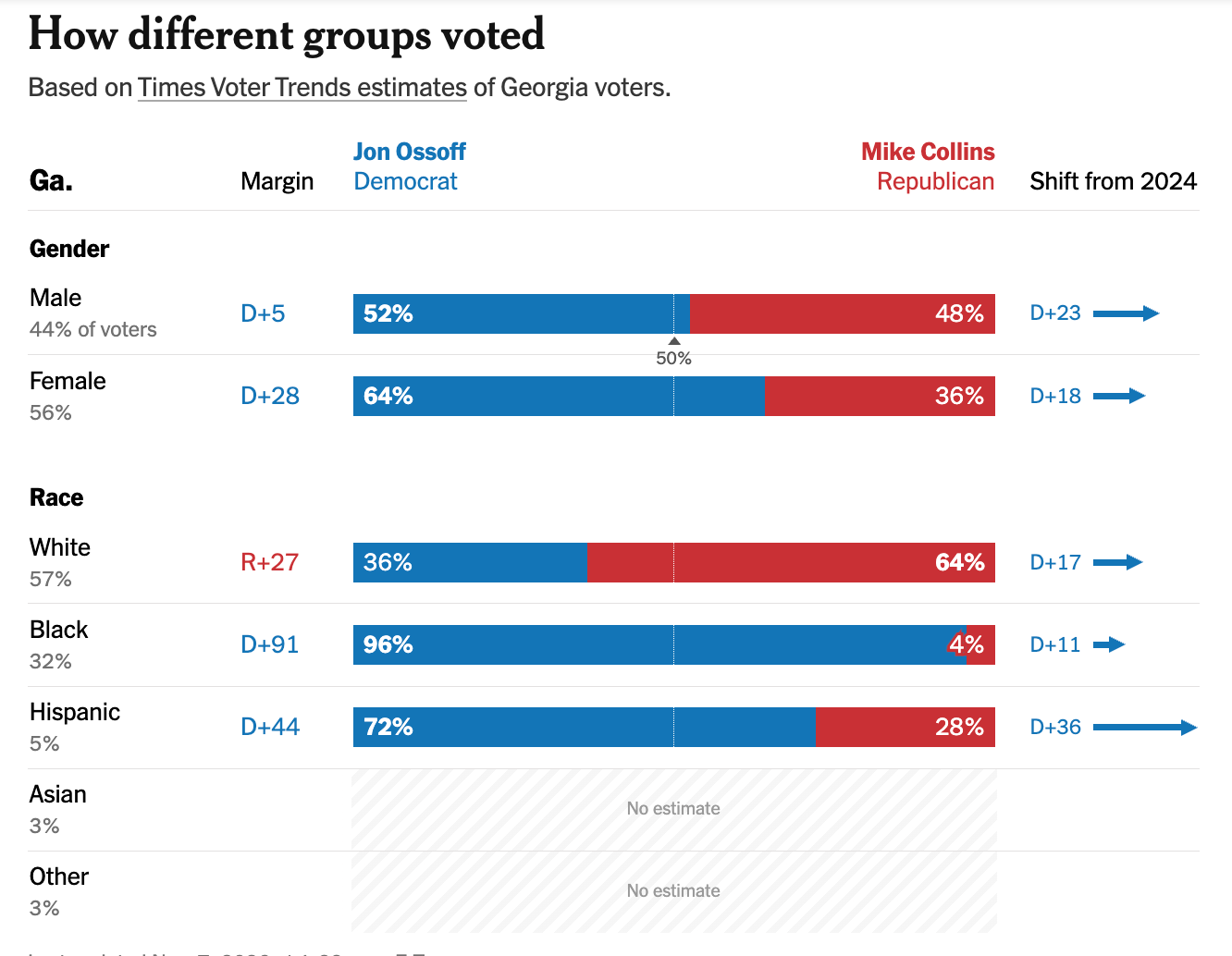
Those are still pretty abysmal numbers from white folks, but it’s still way up — 17 points from the previous election in 2024.
There is still too much support for the Confederate cause in Georgia among white voters, but a swing like that can’t be ignored.
But identity politics can’t be ignored, either. Let’s look at Texas to see the dangers of doing so, because Democrats have ignored the needs of Hispanic voters consistently there, and kept losing elections because of it.
When the racist-in-chief barrelled his oval flatulent orange self into the West Wing, everyone with a non-white identity suddenly became a target for a new ethnic cleansing program.
It didn’t take long for identity politics to kick in and raise alarms.
In Texas, Hispanics, especially those with Mexican heritage, which is most of them, especially near the border, have an identity focused on specific desires based on a combination of heritage, faith (especially Roman Catholic), and family.
Disclaimer: I can’t claim to know what motivates a Hispanic voter, because I’m not one. So consider these descriptions illustrative, but not necessarily accurate, for the sake of my argument that identity matters.
Centrist Democrats will tell you that those desires dictate that anything that runs counter to what the most rigid Roman Catholic pulpit will preach, such as resistance to the needs of the LGBTQ+ community or opposition to women's bodily autonomy, is a losing proposition. “They’re conservative,” goes the refrain. “We mustn’t speak of such things as abortion,” thereby pretending all Texas Hispanics universally follow the Roman Catholic conservative catechism.
In fairness to centrist Democrats, they read or heard these declarations from mainstream media, and assume them to be true, but Texas Hispanics voted 72% to 27% for a guy, James Talarico, who Elon Musk spent $200 million trying to brand as a gender thief.
This was a 46% swing from 2024. It was fueled by identity politics. Pope Leo would probably say that Jesus smiled.
They voted this way because their very identity was being threatened by a regime attacking them or their families on the streets, at Home Depots, at the courthouse. Republicans, like Democrats before them, also ignored one of the tenets of the original identity politics: It’s all personal, based on individual histories and the lives led by those who are most oppressed.
Pope note: Centrists couldn’t have anticipated a Chicago Pope who would loosen his robes enough for Roman Catholic parishioners to contemplate a less restrictive dogma. This change shook up identity, too.
One reason Democrats lost so much of the Hispanic vote in 2024 was that the Orange Deceiver was able to convince Hispanics that he understood kitchen table issues like the high cost of eggs. He also tricked them into believing the lie that his ethnic cleansing program wouldn’t attack their families and would only focus on criminals, to which they nodded their heads in agreement because many of them had long ago crossed the border “the right way” upon their arrival to the United States.
How identity politics really work
If we take a cue from identity politics as originally defined, it’s easy to see how almost all groups organically drift to it without thinking about it.
This generally means that everything we think about in terms of identity politics begins as a reaction against the white standard that tries to pave all the roads to social justice, even those that are seemingly benign.
But Hispanics living along the border of the Rio Grande know nothing about these standards. White standards are meaningless to them. Their only exposure to them is typically negative, often with a barrel of a gun pointed at them.
They probably don’t care about Pride marches in New York. They care about whether they can get to work without being shipped off to Uganda. They care about whether their kids can get an education or a fair shot at a job when they’re out of the public school system.
The mainstream press conflates a lack of interest in issues not always directly pertinent to an “outside” group like the LGBTQ+ community with hostility, when it’s nothing more than a setting of priorities. One of the key tenets of the original identity politics was that there should be no expectation of an oppressed group to fight against someone else’s oppression without fighting against their own first.
This often takes place organically. Sometimes it’s simply about voting. That’s what happened during the 2026 Midterm Elections in Texas, Georgia, and many other places across the nation.
But it wasn’t a rejection of identity politics. It was an embrace.
In Texas, identity politics means always being on the lookout for a smartass comment from a white person as soon as one appears on the road ahead. Hispanics and other nonwhites face prejudice at a level that no white person can understand.
If someone named Gina Hinojosa appears as a Democrat on the ballot for governor in Texas, nonwhite voters can know with confidence that she’s been vetted through grueling primaries because white politicians in Texas, even Democrats, set up roadblocks.
It’s unlikely that Hispanics will blindly vote for anyone who happens to have a Spanish surname. Qualifications are vetted, questions asked. Politicians of all races and creeds are met with cynicism and distrust, thanks in part to a Mexican government that has always struggled to piece together a government worthy of its people.
This, too, is identity politics.
But once vetted by a primary election process, identity politics then kicks into a different kind of gear. A comfort level emerges. The question: “Should I just vote a straight Democratic ticket so I can go home and get a little more sleep after my ten-hour day?” stirs Tejano voters into action. It’s all driven by identity politics.
One of the easiest things to do in Texas is vote a straight ticket. This has benefited Republicans for decades. This year, it benefited Democrats.
The hypocrisy of the identity politics lie
Unfortunately, the masters of identity politics as originally defined are the very people who necessitated the definition in the first place.
Except that they twisted it. They deformed it. They turned it into somethiing it is not.
There is no worse twist on the term “identity politics” than the one perpetrated by the far right, which has for years whined that somehow the white race is on the verge of extinction.
I’ve written about this before:
Destroying the Great White European Nation Might Be Our Only Hope

It’s well past time to ask hard questions about what I’ll refer to as the Genocidal White European Nation (GWEN), which is only “great” in the eyes of a twisted, but significant, minority of humans.
White “identity politics” (a misnomer) consistently manifests itself in voting patterns, a wall that is built into election results every election night that Democrats must overcome to win. It’s like automatically ceding the other side 20% of the vote before an election even begins. It gets old, and it’s a reflection of political immaturity and intellectual impoverishment.
These days, racists claim that they are the oppressed ones. Sometimes this results in the blatant, neo nazi stuff we’ve grown sadly accustomed to during these dark years of Trumpism.
Other times it’s more subtle, like when white writers (full disclosure: I’m a white writer) complain about the growing impact of different cultures on writing and an editor bias against white men (for example). A quick scan of bestseller lists refutes this complaint, but it prevails because social media is a powerful drug.
If a slight bias on the part of literary agents and acquisition editors towards what used to be called DEI really does exist, it’s probably beyond high time that it does. If it means white writers must push beyond mediocrity to break through, that’s a positive for literature, not a negative.
But that’s all an argument for another post. My point in bringing it up is that the complaint is an example of a deformed version of identity politics. Some white male authors are worried about losing agency, or never even getting a chance to have it, so they declare themselves an endangered species.
It’s as if they read the original identity politics declarations of the Combahee River Collective and applied them to their own affairs. I’d be curious to know how the original proponents of identity politics would feel about that. I'm guessing they'd say that such an application lacks an important causation: oppression.
White authors have not only never been subjected to oppression in America, they’ve also been part of the class of instigators. The same, of course, is true of all the politicians who yammer about the Great Replacement Theory.
My own identity politics are inconsequential, and I’m okay with that
My identity politics are born from the white side of things, too, but the focus for me was a lack of things, mostly a lack of money, which surrounded me growing up. I grew up with close and dear Black friends, which freed me from the racism that swarmed parts of my peer group.
My experiences informed me. Growing up around Chicago and spending my young adult years bouncing around different ethnic neighborhoods informed me, too. I grew to love the diversity, the smell of a street full of foods from around the world, the sound of foreign languages, the clothes, the turbans, the music.
Later, as I learned how to make money in spite of my experiences growing up, I travelled, learning more about different types of people.
But I think that the original inventors of the term would argue that I am disqualified from the conversation because I don’t come from an oppressed background. I can cheer on allies in the POC and LGBTQ+ community, but my motives will always remain suspect.
As such, I am incapable of engaging in true identity politics as originally defined, just like others from my demographic are. When someone like JFK comes along, or Bill Clinton, or Jon Ossoff, or Bernie Sanders, their help is surely appreciated, but those who have suffered centuries of oppression will always watch our actions with one eye searching for a hand behind the back or a dog whistle hidden under a stiff collar.
This shouldn’t lead those of us who consider ourselves allies into halting our support. On the contrary. We can’t relate, on a visceral level, to the lives lived by our brothers and sisters who have toiled under the weight of an oppression we could never fathom, much less experience. It’s simply impossible.
If white progressives are looked upon with a jaundiced eye, it’s because our ancestors made it so, and our contemporaries continue to throw out one roadblock after another on the road to equality and justice.
But we soldier on anyway, because it’s the only decent thing to do.
Thanks for reading!

You can now purchase a PDF of all my Substack Fiction. Only $4.99. That’s less than a Starbucks Venti Latte.
Enter SUBSCRIBER_SPECIAL to get a 20 percent discount.
It’s also now available on Amazon/Kindle in ebook, paperback, and hardcover formats (the Kindle version is free if you have Kindle Unlimited):
If you are a paid subscriber, it’s available free as a Perk. Just go to the “Perks” page via the web page menu to find it.
You can help me reach more people by subscribing (paid or free), sharing, restacking, and commenting.

Footnotes
Combahee River Collective, “The Combahee River Collective Statement,” reproduced in Barbara Smith, ed., Home Girls: A Black Feminist Anthology, Rutgers University Press, 1983.
You want radical politics defined this way? Attend a Turning Point USA meeting.
Ennis, Dawn. “Rainbow Wave: See All the LGBTQ+ Midterm Election Winners.” Advocate.com, November 4, 2026. https://www.advocate.com/politics/election/lgbtq-midterm-election-winners-2026.
Advocate.com, ibid
For more on the battle for the soul of Texas:
We Just Learned More About Ken Paxton’s “Biblical Grounds” Divorce

Remember the story about a very religious political couple in a very religious state named Texas, which is famous for stripping away the rights of women and urging its citizens to send each other to prison for attempting to preserve one’s bodily autonomy?
The New York Times. “Georgia 2026: Live Midterm Election Results.” nytimes. The New York Times, November 3, 2026.
Ruminato Gift Link 🎁
https://www.nytimes.com/interactive/2026/11/03/us/elections/results-georgia.html. 🎁