

The email was supposedly from the editor-in-chief at Kensington Publishing, a large independent that bills itself as the largest of the publishing houses that hasn’t been sucked into the Big 5 orbit through acquisition.
He was excited to have found me on the interwebs!
Let’s have a look at just how excited “he” was by reviewing “his” email. See how quickly you find the AI portion of it (hint: It’s easy):
Dear Mr. Bastille,
I hope this message finds you well.
My name is John Scognamiglio, and I am Editor-in-Chief at Kensington Publishing Corp.
(Yes, he’s the actual editor-in-chief)
I recently had the opportunity to review your work, particularly MagicLand, and was deeply impressed by its imaginative fusion of metaphysical fantasy, dystopian fiction, romance, and philosophical storytelling. The novel presents a richly conceived world where magic and technology have remained locked in conflict for millennia, resulting in a narrative that is both intellectually stimulating and emotionally compelling.
What especially stood out to me was your portrayal of Belex and Aurilena. Their relationship transcends the divisions between their respective civilizations, transforming a seemingly impossible romance into the emotional heart of the story. As Belex, a genetically enhanced young man from Gath, and Aurilena, a gifted priestess of Moria, struggle to reconcile duty with love, their journey becomes a powerful exploration of trust, compassion, and the courage to challenge generations of hatred.
I was equally impressed by the depth of your world-building. The long-standing conflict between the technologically advanced Gath and the magical society of Moria unfolds with remarkable complexity, while the mystery surrounding the true origins of their war continually raises the narrative stakes. The gradual revelation of hidden truths, combined with Aurilena’s search to understand the source of her extraordinary gifts, creates a story that balances epic adventure with deeply personal transformation.
Beyond its captivating fantasy and romance, MagicLand thoughtfully explores themes of peace, reconciliation, identity, destiny, sacrifice, evolution, prejudice, forgiveness, hope, and the transformative power of love. Your elegant storytelling, richly developed characters, and imaginative vision demonstrate both literary distinction and exceptional commercial appeal.
As part of our ongoing editorial review, I am always interested in identifying authors whose work demonstrates both literary distinction and strong commercial appeal. In that regard, I would be very interested in learning more about your current and forthcoming writing projects.
Could you kindly let me know whether you are currently represented by a literary agent? If so, I would be pleased to direct any future correspondence through your representative. If not, I would be happy to provide additional information regarding our editorial and acquisitions process.
Subject to the review of further material, I believe there may be opportunities for a broader discussion regarding the potential alignment of your work with our publishing interests.
Thank you for your time and consideration. I would be delighted to hear from you at your convenience.
Warm regards,
I’m a wary soul when it comes to unsolicited emails, so my radar for these things kicks in quickly. My first clue was simply the name of the supposed editor. An editor-in-chief of a large publisher isn’t going to reach out to me.
Full stop.
Not because I’m not America’s greatest unheralded living writer (I am, right? Right?). But because these folks really don’t have that kind of time on their hands, for one thing. And for another, it’s just not how they operate.
Fiction is a push operation, not a pull operation. Authors push, and push, and push their stuff out to potential publishers and agents. Publishers do not pull them in off the streets. It just doesn’t happen for the most part (a possible exception might be a writer’s conference or workshop, assisted, perhaps, by copious amounts of alcohol).
That said, for some reason I was awake at 5 am, so the first paragraph caught my eye anyway, and I let a glimmer of hope filter into my uncaffeinated brain. However, being a coffee addict, before I read past that first paragraph, I shuffled to my coffee pod machine and fired that baby up.
Slurp, slurp. The magnificent electrical charge of caffeine began to enter my brain. Slurp. Alert bombs began to go off in my head almost immediately. Slurp.
I read the first paragraph again, then the second:
I recently had the opportunity to review your work, particularly MagicLand, and was deeply impressed by its imaginative fusion of metaphysical fantasy, dystopian fiction, romance, and philosophical storytelling.
Okay, okay, John. Now we’re talking. You have excellent taste. Excellent. I bet you’ve won some editing awards, even. Perhaps you even discovered Chaucer. As Jon Stewart might say: Go on….

The novel presents a richly conceived world where magic and technology have remained locked in conflict for millennia, resulting in a narrative that is both intellectually stimulating and emotionally compelling.
Ruh-roh. Ding, ding, ding, ding!!! Sound the AI alarm! Call in the Pangram AI detector machine!
Actually, calling in the Pangram machine didn’t even occur to me. I didn’t need it. I read on anyway.
By the time I got to this part…
Your elegant storytelling, richly developed characters, and imaginative vision demonstrate both literary distinction and exceptional commercial appeal.
…I was asking: “Holy shit, dude, what kind of AI prompt did you use for this? And why the hell are you targeting me? Did I kill your cat while distributing rat poison in the neighborhood?”
The really stupid thing about this is that the scammer was fairly clever and sophisticated in his technique, up to a point. (I say “his” because, well, my gender bias is just built that way when it comes to scamsters and most other criminal types).
This was a very detailed and specific attempt to target me. It wasn’t sent as part of a broader effort. It makes sense to assume, I suppose, that someone has found a way to automate every aspect of this, which is the real reason for my post: to alert other fiction writers of this scam. If not, it sure feels personal.
Actually, you know what? Even if this is all part of some sophisticated automated AI turnkey fraud, it is personal.
Anyway, the final giveaway is in the footer of the email, which has two unmistakable tells.
The first is the return email address: johnscognjohnscognamiglio.kensingtonbooks@aol.com
Not
kensingtonbooks.com.
AOL.com.
Also: johnscognjohnscognamiglio
Huh?
Whoopsie doodle, Mr. Scammer. Also? You’re a dumb ass for getting that far in an effort that might have fooled some people, then adding that “AOL” part.
A good scammer would have left that off the footer and included it only in the actual return address of the email from whence it came.
The second is just plain dumb. Even if I had fallen for the scam, my old graphic design/art director/creative director eye would have caught the silliest, sloppiest mistake of them all: the lack of a space between the street address of the publisher’s zip code and “United States”

“United States” is also a tell. Almost all email footers sent domestically skip that part and end with the zip code.
It’s pretty offensive that scammers are targeting fiction writers like me. Most of us barely make enough money to keep our phones charged.
Maybe next time, Mr. Scammer, have AI check your work. Also? May the rest of your life feature lengthy bouts of explosive diarrhea on every romantic encounter, if you ever manage to have one.
I don’t know what the scammer’s endgame was. I originally intended to follow through on the email to find out. I suspect it was to lure me into a “reading fee,” but who knows?
Instead of jumping down that rabbit hole, I decided to write this post.
Seriously, I must ask this of scammers who do this kind of stuff: What the hell is wrong with you people?
Anyway, if you’re a writer, beware. Don’t fall for it. There may be variations. It’s very unlikely an editor or publisher is going to contact you out of the blue, but if you are absolutely convinced one has, double and triple-check the return email address by looking at the raw version of the email.
Google how to do that if you don’t know.
Don’t rely on the footer of the email. They can fix that easily enough for Scam 2.0.
My raw email looked like this (I redacted my email address, mostly because I’ve always wanted to redact something):
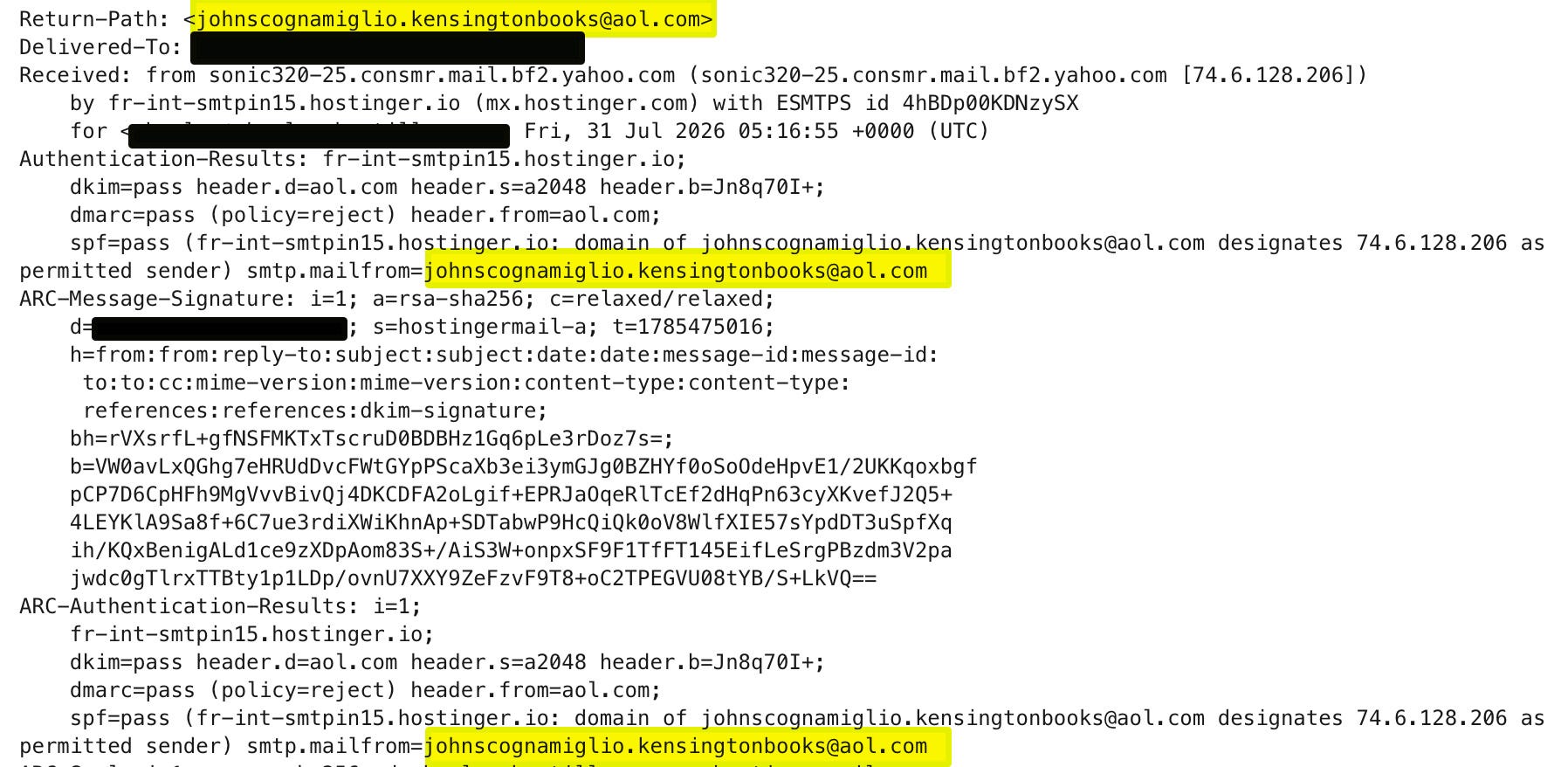
You should also be able to tell a spoofed email like this by simply hitting reply and carefully examining the sender email address. Looking at the raw version is a little more definitive for me, though.
As a sanity check, I looked at Kensington’s website to look for email address patterns.
I found this:
https://www.kensingtonbooks.com/fraud-alert/
One of the bullet points was this:
Pay close attention to the email domain, as scammers often spoof a legitimate email address. Our official email addresses all end in @kensingtonbooks.com.
I forwarded the company a copy of the email I received, since in my opinion, it’s also a personal attack against a guy who, upon a bit more research, has spent his life dedicated to the publishing business, and seems to be one of the good guys.
Stay safe out there, fellow writers. There are some real jerks out there.
Notes
I didn’t realize Kensington accepted unagented submissions until I checked them out, so I’ve decided to query them on my novel, Restive Souls. Wish me luck!
Thanks for reading!
You can help me reach more people by subscribing (paid or free), sharing, restacking, and commenting.
Please share this with any writers you know.

If you’re a paid subscriber, you can find my new 350-page anthology of short stories here for free:

If you’re not a paid subscriber, you can purchase it for $4.99. Enter the code SUBSCRIBER_SPECIAL for 20% off:
It costs less than a Taylor Farms pre-packaged salad, and, hopefully, is a little easier on the stomach, too, although, to be fair, there is a wee bit of gore in one of the stories.
Thanks for sharing this. The AI-generated praise felt convincing at first glance, which makes this a great reminder to always verify before getting excited.
Good luck! 😊