

Corporate publishers have created a new math for handling the recent Bartz v. Anthropic copyright theft settlement, in which the court ruled that authors and publishers should receive 50% in settlement fees for each pirated copy of their works.
In many cases, publishers are turning 50% into 85%, presumably trying to apply the royalty model to the Anthropic case. This is not what the court ruled.

When I first submitted my claim form for the case, which the plaintiffs won in an out-of-court settlement, I assumed a simple process for claiming my tiny piece of the pie.
By American class action tort standards, my piece is big. We authors have been told that the full claim settlement for each pirated book is about $3,000, with publishers getting half and writers getting the other half. But by the standards of fairness and the amount of work we put into writing, it’s a small amount of money.
It’s small enough that the chicanery by corporate publishers is forcing many authors to abandon the claims process. This is because, in addition to publishers overreaching on their claims, the settlement forms are poorly documented and difficult to use.
Most of us are familiar with class action settlements. Meta or some other big company gets sued in a class action case, and the “members of the class,” in other words, the thousands (or millions) of people affected by the damages that triggered the lawsuit, get a couple of bucks in a tiny check that most people never get around to depositing. I received one for ten cents for an identity theft hacking case not too long ago. The lawyers who bring these cases routinely collect millions.

That’s what I mean when I say that, by tort standards, the amount authors are supposed to receive in the Bartz v. Anthropic case is high.
The lawyers collected millions in this case, too, but at least our tiny share was bigger than we see in many class action suits. After the settlement ruling, the court assigned the money distribution process to a settlement firm, JND Legal Administration, that specializes in this kind of thing.
Background
If you’re not familiar with Bartz v. Anthropic, it’s the first big AI copyright case in the writing world. If you’re familiar with it, skip this box and read on!
Anthropic, the AI company behind Claude AI, got hit with a class action lawsuit claiming that it infringed authors’ copyrights when it downloaded millions of entire copyrighted books in violation of U.S. copyright law.
Anthropic responded to the lawsuit by claiming that its use of the downloaded “datasets” constituted fair use because it only wanted to train its models on the content for its LLM models.
The litigants, however, also accused Anthropic of piracy, partly because the sources of some of their downloads contained pirated works, in addition to works they legitimately purchased.
The lawsuit was filed on behalf of authors Charles Graeber (The Good Nurse), Kirk Wallace Johnson (The Feather Thief), and Andrea Bartz (We Were Never Here) by three legal firms: Susman Godfrey LLP, Ieff Cabraser Heimmann & Bernstein LLP, and Cowan Debaets Abraham and Sheppard LLP.
Anthropic tried to get the case tossed into the legal garbage can by obtaining a summary judgment, but in June 2025, Judge William Alsup of the U.S. District Court for the Northern District of California said, “Nope.”
He said that if the books had been obtained legally instead of pirated from various sources, Anthropic could claim fair use. It’s safe to assume that this ruling would have been challenged on appeal. Eventually, this fair use question will end up before the Supreme Court. Even the Roberts Court tends to be friendly to copyright holders, so that may not end up well for AI companies.
However, Judge Alsup said Anthropic would have to prove it didn’t pirate the books. He then set a trial date for December 2025.
Rather than go through all that, Anthropic settled out of court. They didn’t admit to piracy, but they did agree to compensate authors for the pirated downloads anyway.
This means that if you published a book with a valid ISBN or ASIN (ASIN is, essentially, Amazon’s version of ISBN) downloaded by Anthropic, you should get part of the $1.5 billion cash settlement.
Then, in October 2025, the judge overseeing the settlement, Araceli Martinez-Olguin, ordered that funds be disbursed to writers.
The settlement firm set up a website where authors could check if one of their works was pirated by Anthropic, and if so, file a claim for the funds. It should have been easy, right?
Not so fast. A few months after I made my 50% claim, I received a notification from the settlement firm that my share of the teeny, tiny pie was in a state of purgatory called “Disagreement.”
On one of the books, a web development book titled HTML, XHTML, and CSS Bible, which had four authors (we would split the 50% share), the publisher, Wiley, claimed 94%. I have no idea what part of the anatomy they pulled that percentage from, but I get the feeling it’s most active after six or seven bowls of chili.
My other books have also been assigned weird, arbitrary percentages by the publisher.
I filed a form that lets authors reset the percentages as part of a “Disagreement” process, and I guess someone from the settlement company will eventually try to arbitrate it. It shouldn’t be difficult. It’s very simple math, but who knows what happens behind the scenes when armies of overpaid lawyers are involved.1
Time has passed, and I still have not heard anything. Out of curiosity, and a burning desire to catch someone’s greedy hands in the till, I checked out the court docket to see what’s up. It turns out that publishers are routinely claiming at least 85% of the settlement on many titles in the huge trough of pirated works, enough that one author’s group has filed a motion with the court overseeing the settlement, with this type of letter a typical piece of evidence:2
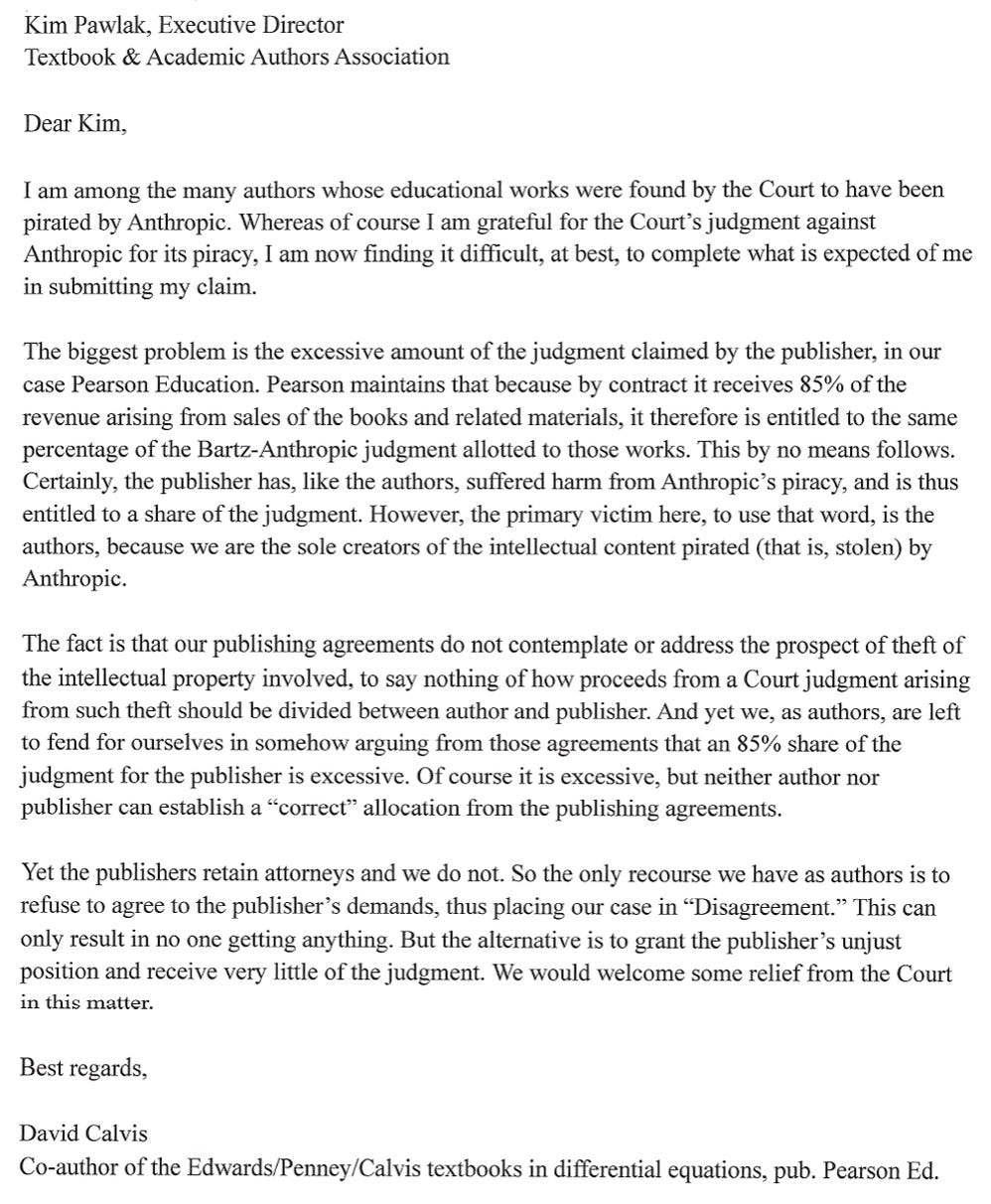
And this:
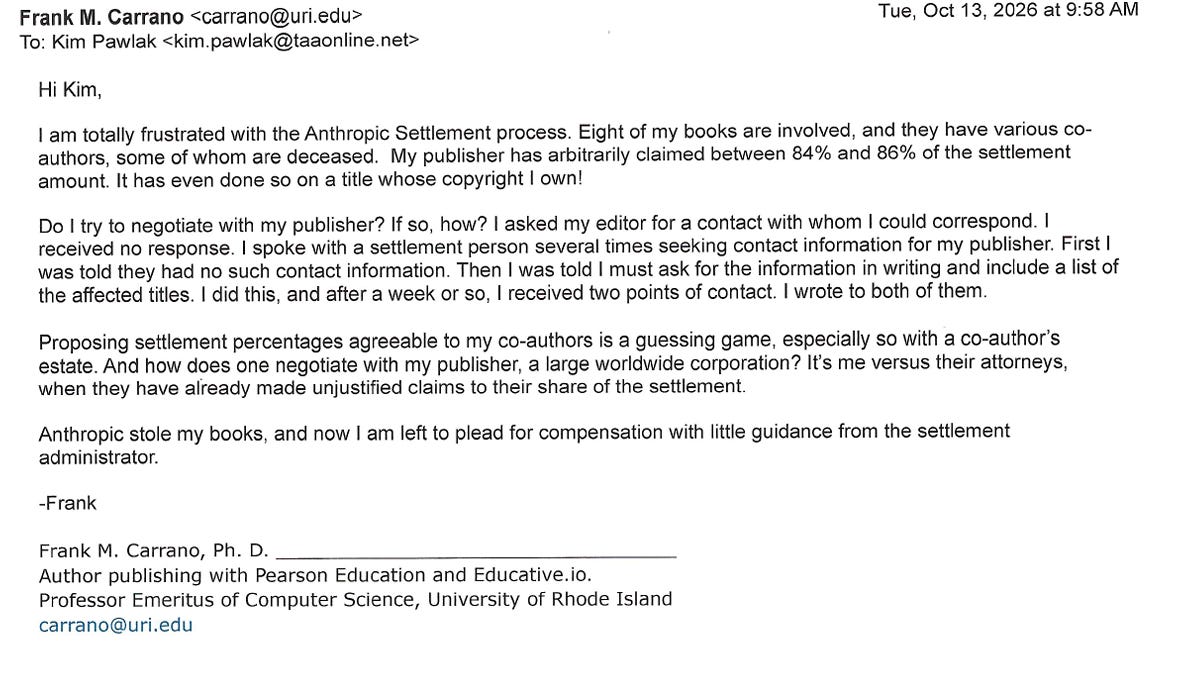
I suppose the 85% comes from the way publishers have traditionally maintained their standardized revenue scheme based on the formula where they keep 85% and authors get 15% in the form of royalties, but that isn’t what the court ruled. The court ruled a simple 50/50 split.
The Anthropic lawsuit was filed by authors. Not publishers. Publishers should consider themselves lucky to get anything, much less 50%. But greed is the corporate mantra of 21st-century America, especially during the Trump era.
In cases where all rights revert to authors, which occurs any time an author’s agent contractually stipulates that publishers only retain first rights on publication, as well as most times when a book is out of print (depending on the author’s contract with the publisher), publishers are still claiming 85%.
In other words, publishers are trying to steal authors’ money.
This is late-stage capitalism at its finest. Most writers struggle to earn a dime for any of their writing, no matter how it surfaces. But corporate publishers are trying to claw back even the mini-prize we get for Anthropic’s thievery.
It’s been a year since Anthropic was ordered to pay up. It’s not very much money, considering the scope of what should be perceived as a crime. Publishers are trying to snatch money out of authors’ hands in a typical corporate effort to stomp on the people who generate their income.
After receiving several letters from concerned authors, Kim Pawlak, Executive Director of the Textbook & Academic Authors Association, sprang into action, filing a letter to the court that reflected the concerns of authors.
Her appeal to the judge in the case, Araceli Martinez-Olguin, pointed to the complexity of the claims process, the 85% claims on the part of publishers, and the army of lawyers that publishers were recruiting to hammer away at authors’ small victory in their battle against corporate theft.3
In a best-case scenario, the judge will side with authors trying to fight back, but with so many authors throwing up their hands in frustration and giving up, publishers still win unless the settlement company does the right thing and automatically rejects any claims over 50%, which seems like an obvious answer to someone not highly educated in the black arts of lawyering.
I don’t know if this kind of stuff is happening to fiction writers. I don’t have any fiction books in Anthropic’s “stolen items” list. (Skip the “your fiction isn’t good enough to steal” jokes, thanks).
So far, Pearson and Wiley seem to be the biggest perps. The common thread is that they’re making claims on educational titles. If you’re a fiction author with books on the list, I’d love to know your experiences.
Notes
These are some samples included in the recent motion4 filed to fight back against corporate theft in the Anthropic case. I’ve included these mostly for the purpose of providing “alt text” for vision-impaired readers so they can know what the text in the documents I included as images says.
Document 695-4: Letter to Kim Pawlak, Executive Director Textbook & Academic Authors Association by David Calvis
Dear Kim, I am among the many authors whose educational works were found by the Court to have been pirated by Anthropic. Whereas of course I am grateful for the Court’s judgment against Anthropic for its piracy, I am now finding it difficult, at best, to complete what is expected of me in submitting my claim.
The biggest problem is the excessive amount of the judgment claimed by the publisher, in our case Pearson Education. Pearson maintains that because by contract it receives 85% of the revenue arising from sales of the books and related materials, it therefore is entitled to the same percentage of the Bartz-Anthropic judgment allotted to those works. This by no means follows. Certainly, the publisher has, like the authors, suffered harm from Anthropic’s piracy, and is thus entitled to a share of the judgment. However, the primary victim here, to use that word, is the authors, because we are the sole creators of the intellectual content pirated (that is, stolen) by Anthropic.
The fact is that our publishing agreements do not contemplate or address the prospect of theft of the intellectual property involved, to say nothing of how proceeds from a Court judgment arising from such theft should be divided between author and publisher. And yet we, as authors, are left to fend for ourselves in somehow arguing from those agreements that an 85% share of the judgment for the publisher is excessive. Of course it is excessive, but neither author nor publisher can establish a “correct” allocation from the publishing agreements.
Yet the publishers retain attorneys and we do not. So the only recourse we have as authors is to refuse to agree to the publisher’s demands, thus placing our case in “Disagreement.” This can only result in no one getting anything. But the alternative is to grant the publishers unjust position and receive very little of the judgment. We would welcome some relief from the Court in this matter. Best regards, David Calvis Co-author of the Edwards/Penney/Calvis textbooks in differential equations, pub. Pearson Ed.
Document 695-4: Letter to Kim Pawlak, Executive Director Textbook & Academic Authors Association by Frank M. Carrano, Ph. D.
Hi Kim, I am totally frustrated with the Anthropic Settlement process. Eight of my books are involved, and they have various co- authors, some of whom are deceased. My publisher has arbitrarily claimed between 84% and 86% of the settlement amount. It has even done so on a title whose copyright I own!
Do I try to negotiate with my publisher? If so, how? I asked my editor for a contact with whom I could correspond. I received no response. I spoke with a settlement person several times seeking contact information for my publisher. First I was told they had no such contact information. Then I was told I must ask for the information in writing and include a list of the affected titles. I did this, and after a week or so,I received two points of contact. I wrote to both of them. Proposing settlement percentages agreeable to my co-authors is a guessing game, especially so with a co-author’s estate. And how does one negotiate with my publisher, a large worldwide corporation? It’s me versus their attorneys, when they have already made unjustified claims to their share of the settlement. Anthropic stole my books, and now I am left to plead for compensation with little guidance from the settlement administrator.
I first wrote about my experiences with the settlement process here:
How I "Met" Sheryl Crow by Filling Out My Anthropic Settlement Claim

I’ve published a few books over the years, so I was curious if any of them made the Anthropic download list.

Footnotes
It’s not really a “motion” in the legal sense. It’s just a deposition supplied by Ms. Pawlak in support of authors. It’s up to the judge to decide what to do with it.