

What do you do if you’re Greg Abbott, the theocratic despot of the state nurturing America’s most recent backlash against American women, if the guy gunning for your job is closing in on you in the polls?1
Here’s what you do. You get your Korean corporate sponsors to invent a story that will help you get re-elected.
Just before the 2022 Texas Gubernatorial election, Samsung announced that it had proposed eleven new chip fabrication plants in the Austin area.
Not one or two. Eleven. In a drought zone. It’s almost like Republicans were punking their own voters, who collectively yelled out, “Yee-haw, gimme more of that!”
Abbott’s supporters believed this preposterous bit of political trickery and then bloviated about how Texas is a much better place to live than California. Thumping their chests in unison, his gun-toting cowboys hailed the Samsung announcement, then berated Gavin Newsom over homelessness.
Victory celebrations ensued as Abbott clobbered Beto O’Rourke in the 2022 election by nearly a million votes, 4,437,099 to 3,553,656.2
This September, the election safely pocketed away, Samsung sent most of the employees from their spanking new fab plant home, leaving a massive new facility in Taylor, Texas emptier than an auditorium anticipating a MAGA ethics conference.3
The Taylor, Texas, plant, along with an estimated $17 billion investment from Samsung, was announced in 2021 with much fanfare by Samsung officials, accompanied by a beaming, carnivorous Abbott during the heat and heart of election season.
The plant has been nothing but trouble since. It has faced one delay after another, with operations postponed from 2024 to 2026 and cost overruns that magically transformed $17 billion to $24 billion. But now, even that timeline is in jeopardy.
Reasons for the delay range from technical issues like “2nm GAA Yields Unable To Improve Beyond The 10-20 Percent Range”4 (whatever that means) to, and this part is unsaid, masked ICE goons chasing South Koreans out of Kia factories in Georgia.5
Qualcomm, one of the companies awaiting a new chip from the factory, has looked at early results and declined to make a purchase.
If you aren’t able to open your fabrication facility because you can’t achieve benchmarks, are you going to expose your mostly foreign-born technical staff to America’s militant and growing anti-immigration stormtrooper brigades?
The ironic thing about all this is that during the election, Abbott cynically tried to take advantage of Joe Biden’s heavy lifting through the U.S. Chips Act. Samsung was hoping to take advantage of subsidies through the act, but now can’t meet the requirements.
Naturally, the Samsung proposal of eleven fabs depended on piles of government handouts.6 Corporate welfare, some call it. Whatever you call it, it smells like that special grease that politicians have always cherished, but in Texas, it rolls around awhile in the thick manure of grim-looking conservative ranchers searching for water.
Nine of the expected eleven plants were forecast to be in Taylor, Texas, according to papers filed with the school district there. Construction on the first one ramped up in 2023 and is considered complete.7
The original plan called for nine more in Taylor.
Nine. In Taylor, Texas.
If you’ve ever been to Taylor, you’ll know it is not exactly spilling over with water or infrastructure. Why does this matter, the astute reader asks? It matters because each chip on your phone sucks up 2,200 gallons of water every day while it is being produced.8
Employees at the Taylor chip fab, if it ever goes online, will need to rinse the chips with ultrapure water so that those TikTok videos Americans love so much don’t stall out during the best part of a twerk. To make water that pure, you need 1,400 -1,600 gallons of municipal water to make 1,000 gallons of the super pure stuff:9
A fab may use between 2 to 4 million gallons of UPW every day, which is approximately equivalent to the water use of a city with a population of 40 to 50 thousand.
Where the hell was Taylor, Texas going to get that amount of water? Most of the people who currently live in Taylor can’t afford swimming pools, so it’s not like desperate municipal leaders were going to hire Elon Musk to create huge orbital water vacuums to steal the water from local citizens.
Maybe Elon will get the Boring Company to create a big tube to connect to the Gulf of America and send the water that way? They could call it the Tesla Gulf of America Pipeline. Although I can’t imagine salt water being easy to purify for chip-making. But hey, I’m not a silicon wafer engineer, so don’t listen to me.
In fact, truth be told, these are the only wafers I’m familiar with, and it’s been a bigly while:

Speaking of pipelines, according to Reuters and U.S. News and World Report:10
Samsung has also struck an agreement with Canadian EPCOR Utilities Inc to build a water pipeline to the plant from Alcoa, 25 miles (40 km) east of Taylor, Gravell said.
Oh.
Fair enough. I’m sure little Alcoa Lake can handle nine more chip plants:
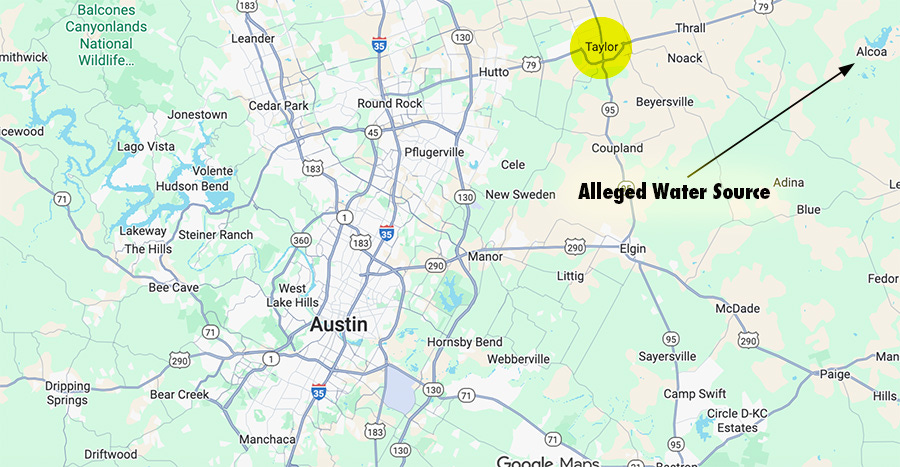
Somebody should have sent a quick DM to Samsung’s Dr. Jung-Bae Lee, the fella who worked with Texas politicians, to let him know that Texas aquifers are drying up so fast that by 2042, when the last screw of Samsung’s fab plants is turned, the compatriots he sends to mind the store will long to play a squid game to end their tortured new lives in Texas. That’s assuming ICE doesn’t hunt them all down and send them to prison camps in Cameroon first.
The presiding judge over Williamson County’s negotiations with Samsung, Bill Gravell, claimed at the time that the water would ultimately be recycled and that some of it would even end up in Taylor toilets, proving that Texas Republicans obsess over bathrooms even when they’re talking about wafers.
It is true that some companies11 specialize in helping facilitate this kind of thing.
But such recycling is hardly a mastered art, and besides, you still need a reliable source of water. Nine additional fab plants would have made things very interesting for anyone trying to master that dark art.
The attack of the data centers
Samsung faces a fearsome new enemy in its thirsty competition for water, now that data centers have entered the picture, especially those fueling the AI bubble:
This year, what Gov. Greg Abbott called “Texas-sized investments” were made with the passage of Senate Bill 7 and House Joint Resolution 7, which appropriated billions of dollars toward water infrastructure and conservation.
That snippet is from Texas Scorecard (“Real News for Real Texans”).12
In Texas, conservation means diverting water from citizens to corporate behemoths.
Almost overnight, 397 data centers have popped up all around Texas, from Amarillo to El Paso, with 193 of them in the Dallas-Fort Worth area.13
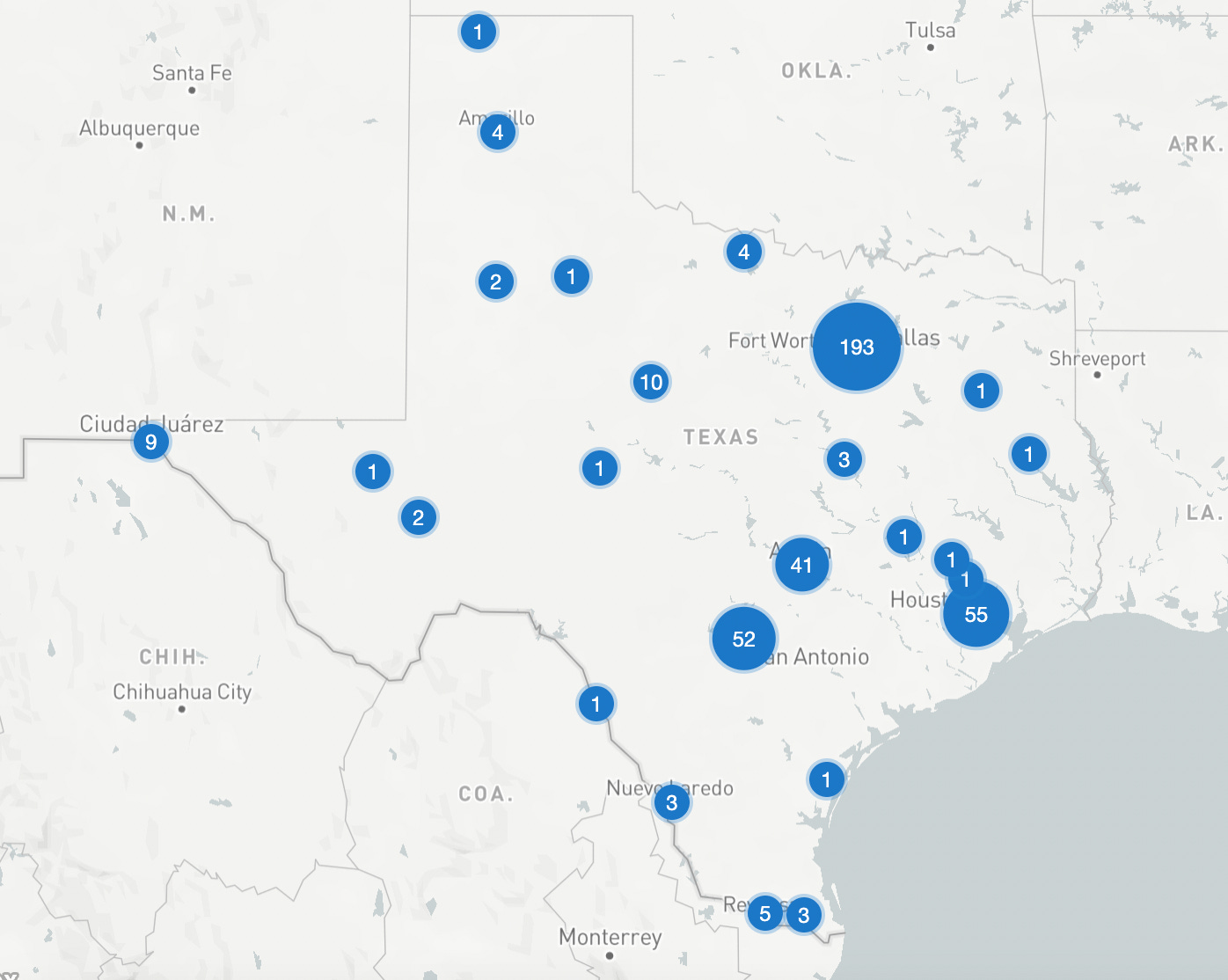
Let’s look at what these numbers mean to water shortages for Texans, who are already parched.
Back to the Texas Scorecard (“Real News for Real Texans”):
A white paper released by the Houston Advanced Research Center to the Austin Chronicle estimates that data centers are set to use 49 billion gallons of water by the end of 2025. That number is predicted to rise to 399 billion gallons by 2030, potentially accounting for 6.6 percent of Texas’ total water usage.
Texas being Texas, the state has no laws that insist that data centers report on their water usage. So nobody will be able to track how much water these monstrosities consume.
Texas is a mostly dry climate that gets most of its water from aquifers. As aquifers get sucked dry, local municipalities impose water restrictions.
Most data centers also occupy thousands of acres. From the Texas Tribune:14
“These new data centers are enormous,” said Robert Mace, executive director of the Meadows Center. “I don’t know where you get the water to do that in a state that’s already water-stressed, not only from drought, but also rapid population growth in both the population and industry.”
Some of these data centers are in parched landscapes like the Texas Panhandle and West Texas. In the Abilene area, the Ogallala Aquifer was already getting drained faster than it could get replenished without the help of data centers, but now that OpenAI has decided to say “howdy” there, things are about to get mighty damn dry.
A failed grid, and no water
Not only is there little water to speak of in Texas, but the electrical grid in Texas has had a few serious issues during Greg Abbott’s reign of deplorable governance.15
In 2021, the power grid pert near 16 collapsed.
Voters technically are supposed to have control over who manages Texas’ sprawling electrical grid, which is independent from the rest of the country. But they do so by electing three board members to something called the Texas Railroad Commission.
This is one of those ballot items where a voter looks at her choices and thinks, “Um, yes,” and just votes for the first names on the ballot, thinking, I assume, she’s voting for train conductors. The other governmental power center around energy is the Public Utility Commission, appointed by Abbott.
The result, aside from a fragile electrical grid that can kill people on those rare winter Texas days, is a commission structure that rubber stamps whatever the industry wants.
Texas also has a unique free market approach to energy. Sixty percent of its energy needs are assigned by consumers in a strange, helter-skelter market of choices that few people understand, but one which has been known to occasionally see people pay more for a daily zap of electricity than most Americans pay in a month.17
Before Samsung high-tailed it out of there, electricity was scheduled to be provided to Taylor’s first plant by Oncor Electric Delivery Co., Texas’s largest electric utility. Most energy observers believed that the utility would also provide the electricity for — I can’t even say it without laughing out loud — the nine additional fabrication facilities in Taylor.
Oncor was not affected by 2021’s nasty electrical outage caused by a deep freeze, but keep in mind it didn’t have a massive fab plant to deal with, much less eleven.
Austin Energy, which provides power to Samsung’s Austin fabrication plant, however, did. As a result, according to the Austin American-Statesman18:
Samsung lost at least $268 million due to damaged products after its semiconductor fabrication plant in Austin was shutdown during the February’s Texas freeze, according to the company.
Let’s hope it doesn’t ever get cold in Taylor. On second thought, it’s not producing any chips, so maybe Oncor dodged a Texas-sized bullet.
Furthermore, according to the Austin Business Journal19:
The incentives that Williamson County Commissioners and Taylor City Council approved earlier this month to lure the massive project to Taylor mentioned the water and wastewater agreements, though no specific details were included. Representatives of Epcor declined to comment for this article.
Did you notice that bit about “no specific details were included” with the proposal that locked up the deal? And that was just for the first fab plant. Which is now, essentially, closed for business until further notice.
No matter how well the first Taylor plant works out, if you multiply the needs of its upcoming plant by ten, you can sort of see how silly Samsung’s announced “proposal” was.
Oh, sorry. Not silly.
Political.
But none of that matters much now. More from the Texas Scorecard (“Real News for Real Texans”):
The Electric Reliability Council of Texas’ (ERCOT) long-term forecast anticipates a large uptick in the amount of power consumed by data centers over the next few years, stating that “[n]ew [d]ata [c]enters continue to be the major area of new growth.”
Though ERCOT did not quantify the data centers’ energy consumption for 2025, the forecast anticipates that over 12,700 megawatts will be consumed in 2026. That figure will more than double in the following year, according to the same report.
Additionally, HARC released a report revealing that for every megawatt per hour (MWh), 793 gallons of water are used on average. This number can rise to over 45,000 gallons in extreme cases for larger data centers.
Ruh-roh. Data centers. A lot of them. 397 of them and counting.
The Samsung travesty should be a warning, but it’s not
Many others are covering the AI bubble better than I can, starting with Will Lockett, who reports that OpenAI is expected to lose $27 billion by the end of this year.20 Also, pay attention to the originator of the phrase, “enshittification,” Cory Doctorow, whose seminal article21 on the AI bubble is a must-read for anyone wanting to prepare for the coming calamity.
Many of those 397 data centers may become empty monoliths of tech bro promises fueled by the AI bubble: Tombs of concrete and wires.
It’s almost like the entire country took a look at the Samsung project and decided to morph the original intent of Biden’s Chips Act from improving the nation’s semiconductor manufacturing to just building mega data centers based on very questionable promises.
If the Samsung debacle is a template for data centers, we’re in for a world of hurt.
According to the Austin American-Statesman,22 the proposal for the facility Samsung called the Taylor Fab 10 (the last of them) looked something like this:
Estimated total value of project: $23 billion
Proposed number of new jobs: 900
Proposed tax break over 10 years: $551.6 million
Proposed start of construction: 2029
Proposed start of operations: 2042
Proposed tax breaks begin: 2043
Average annual wage for 25 “qualifying” jobs, to meet Chapter 313 requirements: $158,944
Average annual wage of 875 additional jobs: $69,433
Forget the water question for a second, and take a look at the proposed start of operations: 2042. For one thing, we’ll all be dead by then because of climate change, but for another, 2042.
If you’re a corporate suit wanting to help out a governor, what date would you propose for a chip fabrication plant that will help create jobs and create a buzz if you really have no sincere intent to build one?
If you said 2042, you win a new Samsung Galaxy Folderama (release date 2042), which folds a hundred times, sort of along the same principles as a Russian Matryoshka doll.

_(2).jpg)
Oh, and about those “wages?” Can you imagine what that $69,433 will look like in 2042? Future Texan fab workers won’t be able to afford a rack of ribs on those salaries. Not even the cheap ones from Costco. (Hot tip for real estate tycoons: Get ready to grab yourself some empty data centers to sell to Costco.)
Of course, in 2042, the workers won’t be called Gen Z. They’ll be called Generation Dead, named after the climate apocalypse created by people like Abbott and the people who decided they couldn’t vote for Kamala.
I don’t know how well Abbott and the leaders of Samsung know each other, but it is pretty clear they know each other well.
And it sure was good of Samsung to give Abbott his latest election jolt, just in case Texans had somehow morphed into non-Texans before the gubernatorial election.
Isn’t it more than alarming how a governor who can’t keep the heat on while sticking his proverbial fingers into every female crevice in his state and who has extended those groping fingers to every other state through proxies like Clarence Thomas and Mitch McConnell keeps winning re-election?
This says a lot about the Texas voter. And the American condition.
At one time, Beto was said to be closing in.
Don’t be fooled. The stories of Beto closing in meant nothing. I lived in Texas not so long ago when they said the same thing about Beto’s attempts to unseat Ted Cruz, and what we found was that, quite simply, Texans are Texans. Even the new ones from California:

The rush of libertarian kilowatt-eating tech companies to suck every last drop of water out of Texas continues unabated. The wild dream of some Texas Democrats that the tech workers lured to Texas will move the political needle out of the red was wrong. The migrating tech workers from California were mostly libertarians, who have happily found a new home.
But if that new home comes with a swimming pool, they’re out of luck. No water to fill it with.
Thanks for reading!


More Ruminato ruminations about Texas:
Texas Attorney General Ken Paxton's Wife Reveals "Recent Discoveries"

This is the story about a very religious political couple in a very religious state named Texas, which is famous for stripping away the rights of women and urging its citizens to send each other to prison for attempting to preserve one’s bodily autonomy.
A Tour Through the Republic of Texas in 2032

Leave it to Texas to give us an avoidable measles outbreak thanks to strong demand for the disease from anti-vaxxers.,
Footnotes
Whitely, Jason. 2022. “Beto O’Rourke Outraising Gov. Greg Abbott Suggests Texas Governor’s Race Could Be Tightening.” Wfaa.com. WFAA. July 15, 2022. https://www.wfaa.com/article/news/local/texas/beto-orourke-outraising-greg-abbott-texas-governor-race-tightening/287-1716fa26-9c9d-42b2-ab6f-ad6282d84e0b.
“Texas Gubernatorial Election, 2022.” 2022. Ballotpedia. 2022. https://ballotpedia.org/Texas_gubernatorial_election,_2022.
Sohail, Omar. 2024. “Samsung Withdraws Its Personnel from Its Taylor Plant Located in Texas due to 2nm GAA Yields Unable to Improve beyond the 10-20 Percent Range.” Wccftech. September 12, 2024. https://wccftech.com/samsung-withdraws-personnel-from-taylor-texas-plant-due-to-low-2nm-gaa-yield/amp/.
Wccftech, ibid
Acevedo, Nicole, Laura Strickler, and Gary Grumbach. 2025. “Hundreds of South Korean Nationals Detained in Largest Single-Site Immigration Raid.” NBC News. September 5, 2025. https://www.nbcnews.com/news/us-news/hundreds-south-korean-nationals-detained-largest-single-site-immigrati-rcna229312.
staff, American-Statesman. 2022. “Details on Samsung’s 11 Proposed Fabs in the Austin, Taylor Area.” Austin American-Statesman. July 21, 2022. https://www.statesman.com/story/business/technology/2022/07/21/samsung-austin-taylor-tx-news-details-on-11-proposed-fabs/65379127007/.
Strupp, Julie. 2023. “Samsung’s Texas Chip Plant Price Tag Reportedly Surges to $25B.” Construction Dive. March 20, 2023. https://www.constructiondive.com/news/samsung-picks-builder-yates-construction-17b-chip-plant-taylor-texas/625884/.
“8 Things You Should Know about Water & Semiconductors - CWR.” 2025. CWR. March 11, 2025. https://cwrrr.org/resources/analysis-reviews/8-things-you-should-know-about-water-and-semiconductors/.
Engineered Environment. 2013. “Water Use in the Semiconductor Manufacturing Industry.” Tumblr. August 8, 2013. https://engineeredenvironment.tumblr.com/post/30464844411/water-use-in-the-semiconductor-manufacturing.
Reuters. 2021. “How a Little Texas Town Snagged a $17 Billion Samsung Chip Plant Deal.” US News & World Report. U.S. News & World Report. 2021. https://www.usnews.com/news/top-news/articles/2021-11-24/how-a-little-texas-town-snagged-a-17-billion-samsung-chip-plant-deal.
Nandu. 2022. “Gradiant.” Gradiant. January 25, 2022. https://www.gradiant.com/external-media/water-scarcity-concerns-drive-semiconductor-industry-to-adopt-new-technologies-ieee-spectrum-2/.
Kirwin, McKael. 2025. “Texas Data Centers Thirst for Water, Challenging State Infrastructure.” Texas Scorecard. August 6, 2025. https://texasscorecard.com/state/texas-data-centers-thirst-for-water-challenging-state-infrastructure/.
https://www.datacentermap.com/usa/texas/
You can look up how many data centers are in your state here, too.
Carver, Jayme Lozano. 2025. “Economic Boom or Environmental Disaster? Rural Texas Grapples with Pros, Cons of Data Centers.” The Texas Tribune. October 2, 2025. https://www.texastribune.org/2025/10/02/rural-texas-data-centers-water/.
Cai, Mandi, Erin Douglas, and Mitchell Ferman. 2022. “How Texas’ Power Grid Failed in 2021 — and Who’s Responsible for Preventing a Repeat.” The Texas Tribune. February 15, 2022. https://www.texastribune.org/2022/02/15/texas-power-grid-winter-storm-2021/
One of my fondest memories upon arriving in Texas was learning in a restaurant how the word “chair” is pronounced. As a Chicago boy, I had always thought “chair” rhymed with “hair.” I was wrong. It rhymes with “hire,” as in “chire.” A young mother commanded her youngster to sit in the “chire” or face a whooping. It took me a moment to understand her meaning.
Buchele, Mose. 2024. “Texas Supreme Court Hears Arguments on the High Price of Electricity during the 2021 Blackouts.” KUT Radio, Austin’s NPR Station. KUT. January 30, 2024. https://www.kut.org/energy-environment/2024-01-30/texas-supreme-court-hears-arguments-on-the-high-price-of-electricity-during-the-2021-blackouts.
Carlson, Kara. 2021. “Shutdown of Austin Fab during Freeze Cost Samsung at Least $268 Million.” Austin American-Statesman. April 30, 2021. https://www.statesman.com/story/business/2021/04/30/austin-fab-shutdown-during-texas-freeze-cost-samsung-millions/4891405001/.
2021. Bizjournals.com. September 24, 2021. https://www.bizjournals.com/austin/news/2021/09/24/samsung-utilities-are-key-to-17b-decision.html.
Lockett, Will. 2025. “You Have No Idea How Screwed OpenAI Actually Is.” Medium. October 23, 2025. https://medium.com/@wlockett/you-have-no-idea-how-screwed-openai-actually-is-8358dccfca1c. (Gift 🎁 link)
“Cory Doctorow: What Kind of Bubble Is AI?” 2023. Locus Online. December 18, 2023. https://locusmag.com/feature/commentary-cory-doctorow-what-kind-of-bubble-is-ai/.
staff, American-Statesman. 2022. “Details on Samsung’s 11 Proposed Fabs in the Austin, Taylor Area.” Austin American-Statesman. July 21, 2022. https://www.statesman.com/story/business/technology/2022/07/21/samsung-austin-taylor-tx-news-details-on-11-proposed-fabs/65379127007/.
Thanks for this Texas AI chip fabrication centers information. Everything I have read about such centers emphasizes the huge amount of water to keep the chips and centers functioning. Draining aquifers, lowering the water table for residents' water needs, pushing for water delivery systems from afar if local sources aren't enough, or dry up. Is water in the area going to be saved for the hard data centers first, and not for human consumption? The whole AI data center boom sounds extremely risky for humans. Also, I appreciate your comments about climate change - they made me laugh and cringe at the same time.