

Chapter Ten
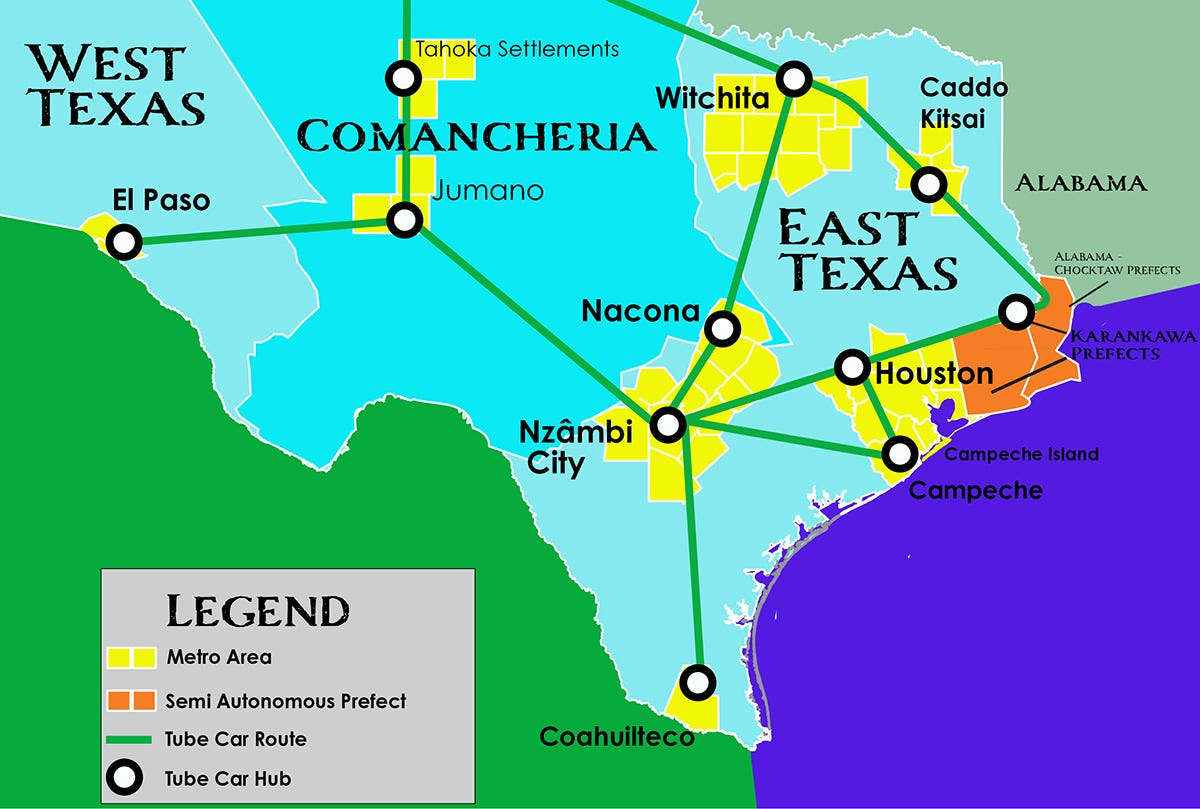
I took a tube car to Nzâmbi City and met Trace at his super-secret hideaway at the back of a city transit building that served as a passenger tube hub, which made my total travel time a little over two hours. The transit building was a surprising choice, I had always thought, for stuffing a bunch of computer and networking communications equipment that you didn’t want people to find.
This part of Nzâmbi City was a bustling commercial hub. Within the radius of about three miles were at least fifty congregations, all plying a variety of services and goods and theologies.
There were Comanche-based Christian houses blending First Settler and Christian traditions. There were African traditionalists, European protestants, Mexican Catholics, even Hasidic Jews. Navajo, Pueblo, and Iroquois were represented. There were Buddhists masquerading as Christians so that they could get registered with the Union Synod, and there was a Shinto temple that avoided all pretexts of Christianity that somehow managed to get official recognition from the feds.
This was all in the space of a few miles. The neighborhoods, storefronts, and restaurants reflected this diversity. Maybe that was the idea, I thought, as Trace opened a door that resembled the entrance to a fort. Build your command center in the middle of commercial chaos.
I had only been here once before. It wasn’t as richly fortified back then, but it still looked like armored barracks. “It looks like you’re expecting company,” I said to him as I walked in, approaching a line of monitors displaying a variety of camera angles aimed at nearby buildings, alleys, and spaces in between.
“I’m always expecting company,” he said.
He motioned to a small square table that didn’t look much sturdier than a card table. It was stacked with more heavy books than it should have been able to support. I sat down on the small chair at the table. “The chairs at the Seminole congregation were much cooler than this,” I said.
“I can replicate that whole setup for you if you want,” Trace taunted. He looked at his phone. “You said one of the dudes was wearing a vest?” he asked with a crooked smile.
I ignored the offer and took the baseball card out of my pocket.
“Yeah, you really hit a home run with this baby,” he said as he took it from me and looked it over. “These kinds of things aren’t easy to come by. I’m still a little surprised he gave you access to this. This is a sophisticated gambling operation. A smart criminal enterprise would never expose deltas so wantonly.”
“I’ve thought about that,” I said. “I think Richland Price is naïve. I think he stumbled into the source for this and doesn’t know what he got himself into.”
“So he’s in danger, ultimately.”
“He won’t last a month with these people.”
“Especially if they find out he’s handing these things out like candy to every dude with a bit of crypto in his wallet.”
“Which is everybody these days.”
“So now what? You wanna help this guy, don’t you?”
I nodded. “He’s a sweet kid.”
Trace shook his head. “Why do I even?” he said.
I shrugged innocently.
“Alright, well, let’s have a look.” The card had a series of tiny chips embedded within what appeared to be a titanium base. “I’ve never seen one like this,” Trace said. He slid it into a small black machine that was fronted with a slot. Trace stepped over to a shelf, pulled off a roll-up, and unrolled it onto the flimsy table. The surface of the roll-up lit up like a neon party on Svembe Street. When I mentioned that comparison to Trace, he snickered as he said, “Svembe’s got a lot more red lights than this.”
It took about half an hour for Trace to finish processing stuff. “The server that this thing routes its data through is in Campeche,” he said. He found a cluster of encrypted data associated with each potential transaction associated with the card.
“Have you made your bet yet?” he asked. I shook my head. “Make one now.” After he handed the card back to me, I bet on Mawlings’s .249 batting average at season’s end. Trace slid the card back into his little spy box. “The money goes to a bank in the Colombia Republic. Panama, it looks like, hold on. Yep, Caja de Ahorros in Panama City.”
“Gets the cash flow away from the congregational banks.”
“Uh-huh. Through a very circuitous crypto route. I can explain it to you if you’d like.”
“I’d rather chew on razor blades. So what’s the Campeche connection?”
“It’s where the nodes are. By nodes, I mean sort of like routing hubs for the system that handles the cryptocurrency, the data from the transactions, and the messaging apparatus that goes with the card’s transactions.”
“Why Campeche? Why not Seminole City? It’s where Alon is. Or is he not the mastermind of all this?”
“I don’t know what he is yet. But there’s a name that keeps coming up in all the encrypted data I’m seeing so far. Baldestero.”
“What’s that?”
“I don’t know. The name doesn’t start that way, but my encryption software is translating it from an SHA key that is showing up with each transaction.”
“Sounds like a dude.”
Trace nodded. “Uh-huh.”
When Trace reached towards a keyboard, Sonata Holmes appeared on a video. I was somewhat alarmed. “Now what?” she said to the video cam facing her. “Oh, hi, Longman!” She smiled and waved.
I tried to smile back, but was annoyed that Trace could pull her up on video so easily. How long had he known her well enough for this? And why? I imagined him calling her up like that while wearing a towel after taking a shower. Trace looked like he’d be good with the ladies, with a chiseled body and face that comic book artists used as their template. His hair was a blackened set of small waves with dark blue highlights that seemed to always catch the light. “Hey,” I said weakly.
“Sonata, do you know anything about a dude named Baldestero at Campeche?” asked Trace.
“Yeah,” she said quickly. “Baldestero Tanning. He’s the Keeper of the Campeche Internment Housing Program. You know. He runs the programs for the internment population.”
“Shazam!” said Trace.
“That’s kind of a big deal,” I said, looking at him.
“What’s going on?” asked Sonata. Instead of explaining the significance of Baldestero Tanning, I gave her a rundown of the case so far, including Tanning’s potential role in it.
“So let’s see,” she said upon hearing it all. “You’ve got some scoundrels misbehaving themselves under cover of what appears to be a legit congregation in Seminole City. They’re selling baseball cards and probably a lot more, and the money gets routed to a bank in Panama City. Through servers in Campeche. Every transaction has this guy’s name attached. That seems sloppy.”
“Not as sloppy as it sounds,” said Trace. “I had to bust a few encryption algorithms to find it. And they need to authenticate somehow. His name is just one piece of the authentication scheme they’re using. It was probably the idea of some hacker. Like choosing the month of your birthday, that kind of thing.”
“Still seems sloppy to me.”
“These are guys who don’t tie the feet of Tae Kwon Do black belts to chairs when they’re trying to imprison them, Sonata. Not exactly the sharpest knives in the butcher shop,” I said.
“Point taken, and thank God for that.” I was beginning to think she really did like me.
“And then,” she continued, “We have Horse Luemba, who is one of Alon’s goons, but we don’t know yet what his role in all this is, do we? But he’s the one you saw kill Williams, so we know he’s linked. And then we have, also, the goods that are manufactured in Seminole City and the Caribbean that, for some reason, get routed to the port here in Campeche instead of leaving the port in Seminole City.”
“That’s an unknown piece,” said Trace. “Let’s consider the baseball bats, the equestrian stuff, anything that looks like it should go to a domestic market. There’s no reason to send any of it to the port in Campeche, but the evidence says that is what is happening.”
“Houston is more of a distribution hub than Seminole City, which is an international port but not so much a rail or trucking hub or anything like that,” I said.
“Yeah, but it’s not like Seminole City industries need to route through Houston. The city is a big commercial center. If you looked it up, you’d see plenty of Seminole congregations specializing in distribution and almost nothing else. Plus, Houston’s more of a regional distribution hub, aside from its seaport. If you’re going to move stuff around the country, you’d go through Point DuSable.”
“A lot of the routes go dark after Campeche,” said Sonata. “That’s one of the clues Sherlock over there had for understanding that this all might be drug-related.”
I sniffed and acted like a dog. “What’s that smell?” I asked.
They both looked at me wide-eyed as if I’d lost my mind.
“Vanti,” I said. “I smell vanti. I don’t know how, yet, but I know the internment house is involved. What’s this guy Tanning like, Sonata? You ever meet the dude?” Vanti was currently the raging synthetic drug of the day. It was easy to make, but hard to distribute because there wasn’t a big market for it in North America.
“He’s a glad-hander in public, but supposedly fierce as a manager. He’s really, at least in my opinion, one reason the Freedom Alliance protests every time there’s a conviction that sends someone to the internment houses.”
“What do the protesters know that nobody else knows?” asked Trace.
“Nothing. He just has a reputation as an autocrat.”
“More and more of that these days,” I complained. “We need a way into that place.”
“The internment housing?” Trace asked. “What are you gonna do, Jones, try to impersonate a convict? Your last impersonation act was a bit of a bust.”
I shrugged. But I knew that finding out what was going on there was the key to everything.
“Maybe…” Trace was thinking out loud.
I scooted a little closer with my chair, because when Trace thought, crazy good ideas bounced around.
“Are you willing to forego your usual rescue operation to take a chance on some good old-fashioned high-tech snooping?”
“Explain,” I said.
“Instead of giving the dude polio,” he laughed a little at that, “Why not inject Summary James with some nanobots that can do a little spying?”
“I’m listening,” I said.
“This removes the possibility of the authorities finding out about the synthesized poliovirus, benign though it may be. And we use James as our eyes and ears for what is going on in that place.”
“Nanobots can do that kind of thing?” I asked.
“No. But they can grow something that can.”
“That’s weird,” said Sonata over the video.
“We inject the bots instead of the virus. They’ll grow a transparent layer over James’ eyes that will relay everything he sees. It’s like a cataract, but a sweet one. And it’s easy tech. I can get everything I need online.”
“You’re kidding,” I said.
“I guess you haven’t been keeping up on the advances medicine has made over the past decade on blindness?”
“I have, but this is different.”
“It uses the same fundamental principles. The only difference is that instead of relaying what the film over his eyes records to his brain, it relays it to us. It’s existing tech, mostly.”
I didn’t need to think about this long if Trace was serious about the science. The DNA stuff had always freaked me out. There was also the matter of getting James out of the hospital once the authorities were alerted to his wildly improvised medical condition. Of course, the cool cataracts solved the core issue we now had, which was finding out what was going on in the internment housing.
“Alright,” I said. “Makes my life a little easier.”
“Makes your life a lot easier,” said Sonata with a smile.
Trace tapped around more on his roll-up. “This Baldestero guy has a whole lot of software in his background. That’s probably why his name is all over everything. Ego. It’s like a signature.”
“What kind of software?” I asked.
“He was with several congregations in San Francisco and various Ohlone prefects. Worked on…” Trace leaned into his roll-up and read some info. “…enterprise and networking software, mostly. Set up networks for most of the congregations on the West Coast, according to this bio. Now I know why detectives in TV shows use a magic marker to draw a bunch of clues on a big plate glass window.”
“You don’t have any windows, Trace,” I said.
“Just a lot of clues,” said Sonata.
End of Chapter Ten
NOTES
You can find Chapters One and Two and the current table of contents here:

Thanks for reading!

“the Freedom Alliance protests every time there’s a conviction that sends someone to the internment houses.”
I’m beginning to think you can write the future.