Chapter Twelve
I was exhausted, but I had to get back to Trace to snag another phone and let him view my small bounty. It was a good thing that he was near the central city because I was again without basic services and payments. He was a little cranky about having to fetch me another phone, but he mellowed after I told him my climbing story and showed him my goodies.
“I’m happy to report that my contact at the health clinic was able to inject the nanobot sequences into James,” said Trace after handing me a shiny new device. This one was an upgrade, which made me happy.
“So instead of giving our man polio, we’re giving him cataracts,” I said. “Somehow I feel like I’m growing.”
“That’s what hitting the congregations hard will do for you,” replied Trace.
“How long does it take for these films to develop over his eyes?”
“Should only be a few hours. I haven’t received any data yet.”
Trace took the baseball cards and the man’s wallet from me. There was a digital ID card in his wallet, but when Trace ran it through his systems, all he got was a dead end. He had been pretty sure that would be the case. “The original data he’s using belongs to some dead guy in Florida,” he said. “The baseball cards should be useful, though. The more data I can play with, the more I can find out, and maybe unlock a few more pieces of the puzzle. Although I do think James and his new eyes are the key to that now.”
Trace also told me that Sonata was urging me to come to Campeche Island. “She thinks you should be there when things go down with James.”
“Problem is, I don’t have any authority.”
“No, but she does, through her congregation and her position there.”
“I’ve been wanting to go there, but for the wrong reasons.”
“I know, bro. Stop sweating that stuff. If you two are going to dance, you’ll dance. If not, you’ll at least nail a crook or two. It’s all good. I don’t need you here. When the data starts coming, I’ll strongly prefer you to be in Campeche ready to react. Dig?”
I nodded. He didn’t need to talk me into getting closer to Sonata Holmes.
“Before you go.” He handed me a flat device smaller than a matchbook with a tiny LED screen. “Network sniffer. Your friend Sonata says she traced some data to servers on Campeche Island, correct? That aligns with the baseball card info. I’ll bet you every bit of data on your Mawlings baseball card that the servers are housed at the internment housing.” He gave me a quick demo on how to use it. The plan was to sniff out their networks so that the device could isolate IP addresses. Then, the device would send the info to Trace for him to sort out.
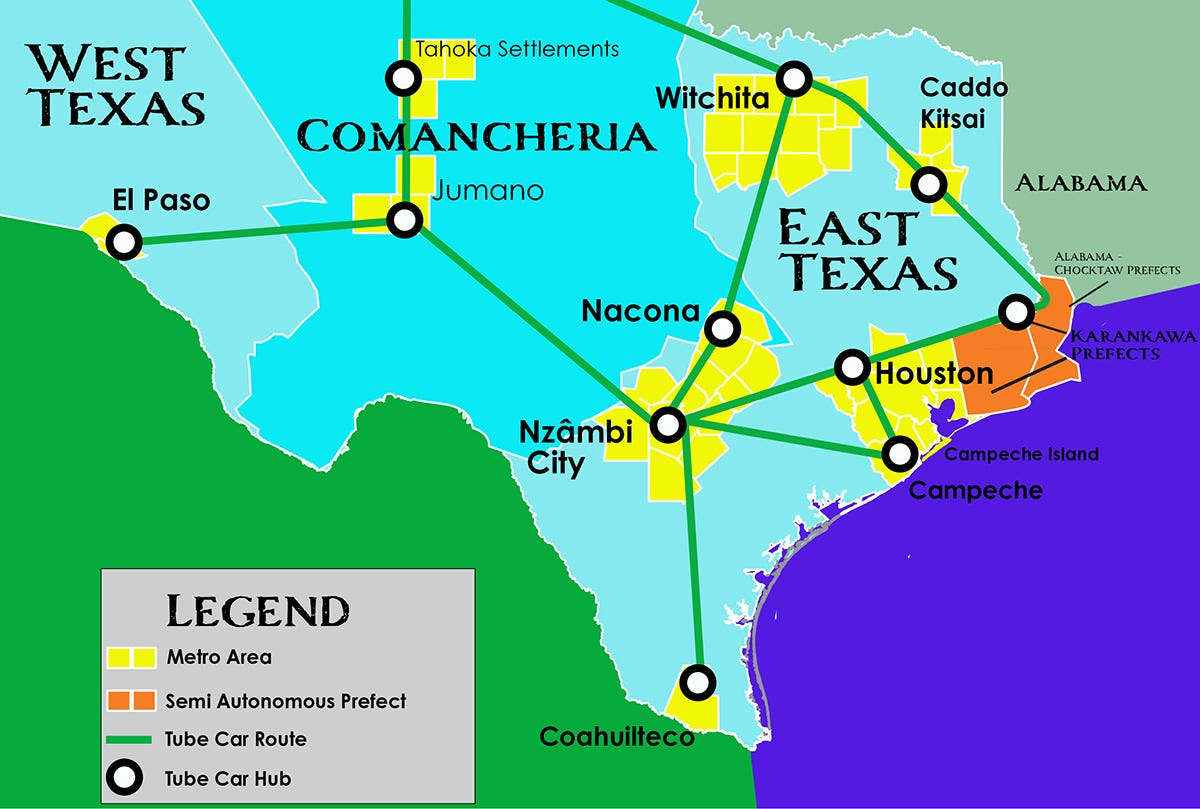
I took a tube from Nzâmbi City to Campeche, which would have gotten me there almost instantly if not for a long wait for tube cars, which were backed up for some reason. I never liked the things, but they were fast. The little cars shot through tubes at eight hundred miles per hour but made a sound I hated. Worse, it always felt like my face was going to explode, and naysayers were always talking about how the tiniest tunnel breach could blast the entire infrastructure straight up into heaven’s gate.
From Campeche, I took a rideshare over to Campeche Island and searched for a hotel on the waterfront, trying to think in terms of what women like. I found a small one nestled in a cove away from the line of sight of the ugly internment houses. There was a small Ethiopian-style restaurant next to it, so I ordered a plate of beyainatu, a nice vegetable dish surrounded by soft gray breads, and ate outside in the cloying Campeche air.
I had nerves of steel on the ladder of the Indigo Pyramid, but those same nerves were shaky reeds in a base of putty when I decided to call Sonata. “Hey,” she said enthusiastically, “Are you in town?”
“Yeah, on the island having some beach food.”
“Should I stop by? I’m probably not far away.”
“I’d like that.” I told her where I was.
“I already ate,” she said when she arrived, “But I could use some caffeine.” She was looking somewhat understated compared to her usual refinements. Her hair was wrapped in a colorful scarf, called a gele by many. She wore a wraparound skirt with matching blue, orange, and red colors, and a simple billowing white blouse. Her wooden loop earrings frolicked in a breeze blown by a large, loud fan that misted fine water from behind her on this humid Campeche day.
We ordered iced coffee. Before I could say much beyond a polite greeting, Trace called with some news. “Mind if I put you on speaker?” I asked him.
He didn’t mind. “So at first I thought, well, he’s not working the docks,” he said, surprised they were putting Summary James to work so quickly after he visited the medical people. But I thought, why not? What other plans did he have? “Because they sent him to this set of wooden tables in a room I’d say is, how to put it? Below deck?”
“In other words, the extremely tall windowless area, which I think everybody assumed is used only for HVAC and other things you’d use a basement for.”
“That, and I think most people assume that there is no flooring until the residential area two hundred and fifty feet or so up. For security. I can imagine other things to use it for, but I wouldn’t expect any residents to be there.”
“You mean prisoners, right?” asked Sonata, confirming where her politics lay on this subject.
“Right,” I answered for Trace.
“I think that, as it turns out, he was just not there in time for the first shift,” Trace continued. “So he’s sitting at this table with a bunch of other guys. Turns out these guys all get up to leave when a buzzer goes off. But he stays. Then a group of more guys come in and sit where the other guys were.”
“Shift change,” I said. “No sense trying to get him acclimated to the docks within the space of an hour or so.”
“Either of you got a roll-up with you?” asked Trace. I looked at Sonata, who had come to the restaurant with a tube case slung over her shoulder, and she nodded. Trace sent her a video. “Look what they’re doing.” She laid the roll-up flat on the table, then tapped a few icons to launch the video, which appeared in a hologram format to reveal several men sitting at the table doing piecework. Each man was filling a flexible, opaque grey vial shaped like a long, thin cone. When he was done, he sealed it with something and dropped it into a container at his side, which filled up quickly if the man was working fast.
“The vanti smell I detected earlier?” I said. “It’s filling up that room with its malignant odor.”
“Does vanti even have a smell?” asked Trace.
“Probably not,” I said.
“So get this,” said Sonata looking at me. “Did you know there’s a huge collectibles market in Europe for all things baseball?”
“They don’t even play the game. Why would there be a market for baseball collectibles?”
“I don’t know. But Euromarket, the big European online garage sale-like place, has a jillion listings. Check it out.” She showed me.
“Can you go back to the video of the prisoners?” I asked her.
She nodded with a smile, probably glad that I called them prisoners.
“Trace, this is a live feed, correct?” I asked.
“Yes, sir.”
“These guys are working the docks, then coming in to do this stuff?”
“It looks that way. We’ll know for sure tomorrow when James has a full schedule.”
The cones were piling up in many of the bins. A man who looked like a security guard walked around while encouraging the workers, but not harshly. He seemed friendly with a few of them, slapping their shoulders, laughing at the occasional joke.
“That’s 14 hours on the docks, then this?”
“I don’t know. We’ll find out tomorrow. These guys don’t look tired enough for that. Do those cones look like they could fit inside a baseball bat if you drilled it?” asked Trace.
“Very possibly,” I said.
“The street price for Vanti in Europe is wicked high because it’s highly concentrated and it lasts most of a day,” said Sonata. “If one of those cones is inserted into a baseball bat, that makes each bat worth a couple of hundred thousand dollars.”
“That’s one helluva collectible,” I said, watching Sonata’s fingers dart around the roll-up as she dug up more information. I hadn’t noticed how many rings and bracelets she wore until now. Four rings on the hand she was moving around the roll-up, and at least ten bracelets on the wrist. I began to think she could single-handedly sustain the business of a congregation’s small boutique shop. I didn’t ask her what else she was hunting for. I figured she’d let me know about any good hits.
Sonata was a true data miner. She next found out that Gibraltar, in the Iberian Peninsula, was a hotbed of collectible sellers looking for all kinds of baseball paraphernalia. A strong guy like Luemba could probably hurl a baseball bat from Tangier to Gibraltar — the two Mediterranean cities were that close. Although I doubted Luemba had ever heard of either place, much less visited one of them.
“And those baseball cards you got from the guy chasing you?” Trace said. “The data from those seem to trace to the servers at the prison, too. The network sniffer should confirm…”
Suddenly, the video feed, which Sonata had kept streaming from one corner of her roll-up, fizzled out as we heard Trace yell out a raunchy curse word before his connection was lost. I looked at Sonata, who gave me a look that said she had no inkling of what was going on. Empaths are funny that way. They sense things from some people, and not from others. I selfishly realized that the reason she may not have sensed anything about Trace was that she didn’t have as big of an emotional investment in Trace as she did in me. I felt terrible for even thinking that.
It didn’t take an empath’s skills to suspect that something was wrong. I said, “I could hop a tube car back to Nzâmbi City, but it won’t get me there soon enough to help Trace if something has gone wrong.”
“Could Alon’s people have found him?”
“I’m thinkin’ yes.”
“With you, we were lucky. You were conked out for a while after I sensed you were in trouble, but before they started trying to…” She paused, knowing this would not be a celebratory moment within my recent past, “…extract information from you. That gave the Mikasuki folks time to gather their resources and make a move to help you out. But I don’t have those kinds of connections in Nzâmbi City.”
I thought that was weird because it was so much closer than Seminole City. But this was no time to try to dig into her past. “Okay,” I said. “I might know a guy. But he’s never talked militia to me before.”
“You were a journalist. You’d be the last to hear about it.”
I nodded and tapped into my phone.
The city of Nocona, my hometown, is still sometimes referred to as The Wildlands by some. It’s a gritty, wild place in many ways, with many of its residents seemingly unaware that the 21st century arrived 20 years ago. Nocona is also the capital city of Comancheria, and the home of my favorite congregation, the Native American Church Congregation, because they consider peyote an important part of their sacrament. It’s not even that I have tried peyote; I just think it’s cool that they’ve established it as part of their religious traditions.
And I did know a guy. His name was Hiawatha Longfellow Smith, in honor of the famous poem, I guess. He held a steadfast belief that the fastest way to evangelize the grace and mercy of Christ was with his fist. I figured he’d have a long and happy career in the security business, and I was right. He became chief of the security detail for the Tribune of the Native American Church Congregation. No matter who it happened to be. He’d had the job for twenty years. I sometimes wondered if he was a shadow tribune for that congregation. And now, knowing what I knew after Sonoma’s recent acknowledgment that militias were as common as Texas pecans, I tapped him up on my phone. I got his voicemail, so I asked him to call me back.
When he did, I told him that I realized there could not possibly be such a thing as militias in his or any other congregation, but in a fictional world where such a thing was possible, it would sure be cool if he could connect with the Navasota militia in Nzâmbi City. In this fictional world, I informed him, there was a very non-fiction event involving an important Navasota barrister named Summary James, who had been wrongly convicted of murdering a tribune for another congregation.
Also in this fictional world, I wondered if it would be possible to check on an individual who had a one-man data center currently dedicated to exonerating Mr. James, and who may himself now be dead. Hiawatha responded that in this fictional world, the full weight of the Comanche warrior spirit would be brought to bear on the problem.
I ended the phone call with a satisfied smile as I gazed at the lovely Sonata Holmes.
“Well, don’t you look pleased with yourself,” she said.
“My world has expanded so since you alerted me to the ways of the congregational security apparatus across our fine land.”
She smiled at that, a jewel of a smile that could have carried me across seas. “Now what?” she asked.
“Wait, I guess. I don’t know what else we can do from here.”
“Let’s take a walk along the beach,” she suggested.
“You mean the gravel?” Campeche Island didn’t have beaches. Its waterfront was rocky and coarse. But anything along the sea was good for me. Especially if Sonata was part of it.
“Cynic,” she said as she stood up before curling her roll-up, sliding it into its case, and slinging it over her shoulder.
We talked about a lot of things as we walked and waited. Some of it was awkward. Most was not. We shared our pasts, our hopes for the future. I even allowed myself to offer a political opinion or two, even though I considered politics a game played exclusively by cheaters and swindlers.
I told her that my hatred of politics was a gift from my years with the Christ’s Union Summons. “Ten years of political reporting in the nation’s capital would wear down the biggest politics nerd,” I said. “But it was more than that. It seemed like half the reporting I did was crime reporting, not politics.”
She nodded. “It didn’t used to be like that. Congregational and government Synod leaders were people to look up to. It’s sad. The legacy of people like Shyllandrus Zulu used to be sacrosanct, and leaders tried their best to honor their legacy.”
“In fairness, I think most still do. But when you’re a reporter in Christ’s Union, you get a chance to look under every rock. The bad people, they have the largest footprints.”
“And there’s no punishment to speak of. For the general population, spiritual rehabilitation has proven to be far superior to the imprisonment other nations impose on criminals. But these people are already leaders in their congregation. They’re supposed to already be spiritual. What do you do with those people?”
“They’re typically financial crimes. You just kick the chairs from under them so they aren’t in power anymore. Seems to work okay.”
“What about now? Alon is not a financial criminal.”
“No. He’s a killer. And he belongs in Campeche.”
She laughed at that. “Making his own drugs?”
We continued talking like this for some time. I enjoyed every minute of it.
At one point she stopped walking and turned to face me. Swells of water separated by passing container ships were splashing across large sea rocks along the shore. “I don’t think I can just go back to my place to wait this out,” she said.
I looked down at her, nodding my head as I was about to take her chin between my fingers, when my cell phone played the uninvited role of chaperone. I reluctantly answered. I breathed an audible sigh of relief upon hearing Trace’s voice. “I don’t know how, but they found my place and ransacked it. I barely got out alive, Longman.”
“Who?”
“I don’t know. Three big dudes. None of them Luemba. Alon has a long reach. Anyway, everything’s gone. Equipment smashed to pieces. I couldn’t stick around to try and save anything. Not even my phone. I’m using a burner phone right now. They’d have got me, too. They tried to, but I was able to get away. They didn’t chase me down. Too focused on vandalism, I guess.”
“I understand. You know, I was pretty sure I wasn’t tailed when I came to see you.”
“You had to be tailed, my friend. It’s not your fault. These people are good. As good as it gets. Pros. Anyway, it was bound to happen someday. I have backups of all the data, but it’ll take some time to get it wired up. How are you two doing out there? Everything okay?”
I looked at Sonata. Under any other circumstances, I would have told him that it was about to be amazing until his call ruined it. “We’re okay.” I put him on speaker, then I told him about my discussion with Hiawatha Smith.
“If your man sent somebody, they came too late. And they didn’t leave a note saying, ‘Hey, we stopped by. You weren’t in.’”
“They wouldn’t, but if Alon’s goons left a trail, the Navasota folks may hunt it down.”
“I doubt it, man. I don’t think these militias operate that way. It’s in and out. Mission success or failure. Really simple stuff. Nothing complicated, ever. But Alon’s people will be on the Navasota’s radar now. That’s a good thing.”
I looked at Sonata for confirmation. She shrugged with her hands. “Alright, Trace. Sorry for all this.”
“Goes with the territory. Just watch yourself. Don’t even buy a coffee without looking behind you to see who might be following.”
When I was done talking with Trace, I remembered the network sniffer he gave me. I told Sonata about it. “I need to do this today. Things are moving too fast. They’re forcing my hand. But do you mind if I accompany you home?”
“Ever the gentleman.” She tried to kiss my cheek but couldn’t reach it. I obliged by bending down, and we took a ride share to her house on the mainland.
End of Chapter Twelve
Thanks for reading!
You can find Chapters One and Two and the current table of contents here: