


Trigger warnings: Violence
Chapter Thirteen
After saying goodbye to Sonata, I headed back to the island. While sitting in the back seat of the rideshare, I felt for the network sniffer by patting the zippered pocket in my canvas shorts.
After I told the rideshare to make sure it wasn’t being followed, I heard a buzzing sound. I guessed it was a compartment opening. This was confirmed when I looked over my shoulder through the rear window.
A small drone flew out of the vehicle, which then went off course, I thought. The car made several turns before I realized it was taking a purposefully circuitous route to the bridge.
The rideshare arrived at a location about a half-mile from the internment housing. I’d walk the rest of the way. When I exited the vehicle, the drone buzzed back toward the car and reentered its compartment. The rideshare left me on the north side of the island, but south of the internment housing.
I instructed it to drive about a half-mile north of the internments and wait for me. It gave me a price, which I paid. The car drove off. I realized it would be well past dark before I’d have a chance to crash in my hotel room.
The walk was pleasant enough. I crossed the busy highway to walk along the shore before veering back across the highway toward what Sonata had started to refer to as the prisoner tenements.
I had reminded her during our walk along the shoreline that these people were convicted of killing other people. Of course, she reminded me that Summary James was one of those people. “The Bible is clear about who the ultimate judge is,” she said. So were, she reminded me, the earliest congregational clerics when the criminal justice system in the Union was in its infancy.
The practice of rehabilitation over punishment was still a radical idea to most of the world more than 200 years after its successful adoption in the Carolina Union.
On a certain level, this made sense. The Union was uniquely capable of practicing this type of jurisprudence. The church was central to every aspect of Union life — political, economic, and legal. There were no intense logistical issues behind rehabilitating convicted criminals because every congregation had rehab houses, some more than others.
Every congregation also had the requisite number of spiritual gurus necessary to restore order to the wayward mind. The focus of the efforts was on spiritual re-enlightenment.
If drugs or alcohol were involved, which was often the case, the offender was told to quit. If he was unable, he was given help to do so. That alone resolved about 85% of criminal cases.
The other 15% produced a wrestling match between society and those who could not be successfully rehabilitated. Out of that 15%, at least half, it was found after a century of learning, were mentally handicapped. They were typically enrolled in special schools, where the recidivism rate was eventually whittled down to less than ten percent.
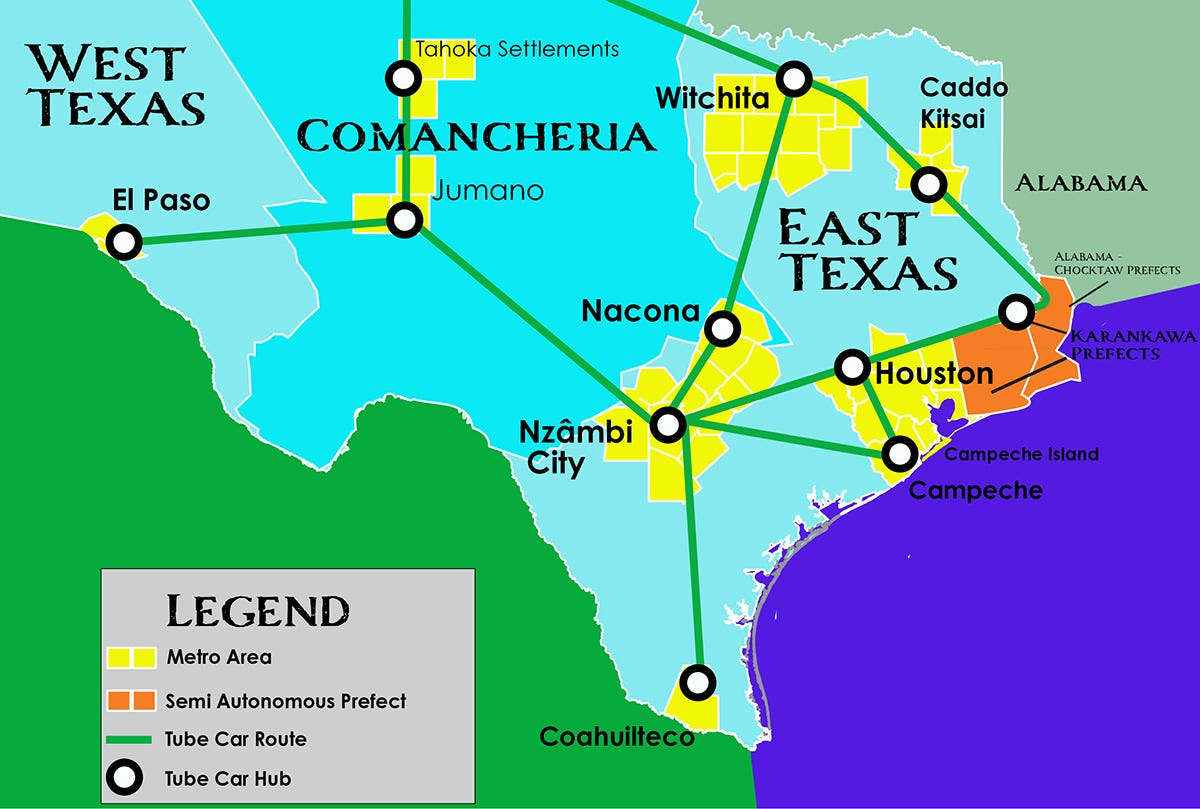
I thought about this during my brief walk. I also considered how each congregation had its own methodology for dealing with murder before Campeche became the arbiter of homicide.
The result was a maze of largely unsatisfying solutions. Now, it looked like the one solution that had made everyone happy was under siege. In concept, I didn’t think Campeche Island was a bad idea. But if it had turned into a lair for drug czars and criminals hiding behind congregational pulpits, something had to change.
I reached into my pocket as I approached the tall buildings housing the prisoners. I pushed the button on the back of the network sniffer while walking as close to the buildings as possible without getting hassled by guards.
The sniffer worked silently. I saw a stream of tiny numbers and letters scrolling quickly down its screen. I couldn’t read any of it because they were moving too fast, but I was pretty sure none of it would make sense to me if I could.
Trace had informed me that the only reason he had included a screen when he designed the device was so that the user would know the device was working. There was something about moving text that made people feel comfortable, he explained. He could have just included a green light or nothing at all. Instead, he wanted to broadcast to the device’s user — me — that everything was functional.
The device went dark for an instant, then flashed the words, “scan complete” before turning off. He had instructed me to dispose of the device when I was done, so I set it on one of the large boulders that ringed the buildings and smashed it with a large rock. Then I walked across the street and threw the scanner into the bay.
The process didn’t take as long as I thought it might, for which I was relieved. The rideshare was where I expected it to be. When I signaled it with my phone, its backseat passenger door opened as I approached. Then it took me to my hotel, where I had the feeling I’d sleep very soundly if somebody didn’t wake me up and kill me.
Chapter Fourteen
Sonata Holmes lives in a comfortable Comanche-style ranch home. Four halls form a square building with a kitchen and living room jutting into its small open-air center.
Each corner of the home consists of a large hexagonal room that encroaches deeply into its adjoining hallway section, extending considerably outward from its natural corner.
She keeps a grill in the open-air square, where she also maintains a small patio garden.
She is sitting in the garden reading some news items on a newspaper roll-up, enjoying the salt air of a quiet gulf evening.
While she’s sipping a cup of English breakfast tea, she hears a buzz. She looks up to see a small black object hovering high overhead. As she stares at it, she reaches for her phone, but the drone buzzes downwards quickly before she can punch in any numbers.
“Don’t be alarmed,” says a voice from the drone. She doesn’t express any such alarm, presumably because the voice belongs to Trace, who then follows up with, “I just wanted to make sure you are okay.”
“You’re back in business already?”
The voice from the drone says, “Stay safe,” as it spins away.
She stands up from her patio table, shaking her head, smiling a little at the antics of my nerdy, gruff friend.
She walks into her immaculately clean kitchen and prepares a small salad with artichoke and palm hearts, some romaine lettuce, radishes, a bit of lemon, and a cherry wine dressing infused with rosemary.
She carries that back to the patio, sitting down to eat while watching two cardinals argue over a perch on a tree in the center of her home square, just as the day is ending with a surprisingly quick dark drop of eventide.
That’s when it happens. Five helmeted men burst into the square with military-grade automatic weapons. Not the kind of weapons you’d find in even the most remote rural part of the country.
The men are dressed in black top to bottom, as if they need to, even though they are obviously here to take out a civilian. Which they do, without as much as one word, without any kind of explanation, without any kind of concern with leaving behind evidence, or even cleaning up the mess.
They riddle Sonata Holmes with at least a hundred bullets, the vibrations of her body nearly dancing in concert with the fusillade moments longer than it should before it crumples to the ground in a nearly unrecognizable, catastrophic heap of riven flesh.
This is what I see.
End of Chapter Fourteen
Thanks for reading!
You can find Chapters One and Two and the current table of contents here:


Brutal.
Horrific.
I feel bereft.