


Chapter Sixteen
We took a rideshare to the central plaza of Campeche. It was full of nightlife. When we walked past a large drum circle, a young boy gave Sonata a rose and a small beaded bracelet before blending back into a large crowd of dancing youth. The scent of food made me hungry. We grabbed some tent food, charred buffalo on a stick, and a couple of ears of corn, then sat at a table to listen to drumming and wind instruments striking the air.

“Now I know where you get all those bracelets,” I smiled as I powered through my ear of corn.
When we were done eating, I tapped up Hiawatha. “We’re here. Central plaza. Bring your goons.”
He laughed. “We need a plan. I’ll be there in a half-hour. Keep your phone on, send me your location.”
“You trust this guy, right?” asked Sonata after I finished talking to him.
“If I can’t trust him, life isn’t worth living,” I said.
“Interesting,” she replied.
Hiawatha arrived alone, as I knew he would.
I stood up to introduce him to Sonata, who smiled warmly. He bowed and placed a tiny flower he had pulled out from his deerskin sleeveless jacket into her hair.
We all sat down.
His hair was still long, set back in a ponytail, highlighted by a few bright blue streaks in otherwise ebony waves. He had thick, stony cheekbones, each graced with the tattoos I remembered seeing every day in my youth. His forehead was painted with three stripes. He was bigger than I remembered, more muscular. His strong arms were etched with inked drawings. One arm bore a hawk with skulls in its talons. The other arm bore what looked like a dove carrying a flower. I didn’t remember that body art, so I assumed it had been acquired since I last saw him.
“You look good, Longman.”
“You too. You’ve bulked up a bit.”
“Free weights, five times a week.”
I nodded.
We tried to discuss a plan, but found ourselves reminiscing more than we should have. Sonata had to finally speak up before we got down to a serious search for a solution. He explained that he brought about twenty men, which I found astonishing. Anything they did would have to be done discreetly. “Especially given that we are Comanche in Campeche. If the authorities here sense that a small Comanche army has arrived, they won’t take to it kindly,” he smiled.
I was genuinely disturbed about this whole militia thing, especially since I thought they had been done away with, truly, via an amendment to the Christian Bill of Rights. But for now, I was going to do what a lot of people were probably doing. I was going to be a part of the problem. Quite willingly.
“Of course, I can tell you don’t approve,” he said to me. “I’ve always been able to read you.”
“Some things never change. But this is no time for me to make judgments. I’ll sort through my feelings about it later.”
He gave me a stern look. “As a former journalist who worked at the most prestigious newspaper in the Union, I trust that you won’t sort your feelings through a news story.”
“I’m a part of this.” I looked at Sonata. “I was this close to losing someone I care about as deeply as anyone I ever have.”
With that, Sonata stared at me. I hadn’t meant to say it, but it was the truth. In truth, I also still barely knew Sonata Holmes. I had known many women much more intimately than I now knew her, yet not with such an arc of emotional gravity.
“It is interesting how we must occasionally adjust for necessities,” replied Hiawatha.
“Between you and me, and Sonata here, one of the reasons I got out of the newspaper business was because I knew someday I’d have to bust someone I like for doing something that could win me a journalism award.”
“You’ve won your share,” he said.
I shook my head. “It’s too judgmental a business for me. That got to me. Some people can play holier than thou a lot better than I can.”
“Besides,” said Sonata. “He kidnaps people.”
That brought a smile of deep appreciation from Hiawatha. I wanted to ask him if he understood why I liked this woman so much, but I didn’t need to, and I didn’t want to embarrass her any more than I already had with my previous statement.
Hiawatha folded his hands on the table. One of his wrists had a dark metal band around it with detailed art that I desperately wanted to look at. “You won’t like my proposal,” he said, looking directly into my eyes without blinking. “We need to go on the offensive. You’ve been on your heels the whole time.” He remembered my love of baseball as a youth when he said, “Batter up, slugger. Time to cap these guys with a line drive right to the mouth.”
“Okay, well, that part I like. What’s the part I won’t?”
“We need to slide you onto the tip of a fishhook.”
I liked that a lot more than I liked the idea of using Sonata as bait. “I’m still waiting for the part I don’t like.”
“And her,” he said.
“What? No. No, absolutely not.”
“Longman,” said Sonata. “I had a father who beat the crap out of his family for years before whiskey killed him. If I got through that, I can get through this, especially with a militia backup.”
“They want you, but they want her, too,” said Hiawatha. “Somehow, they know what you know. Can you get hold of your friend Trace? He sounds very useful.”
“I haven’t heard from him since his place got ransacked. Well, right after. He called using a burner phone. I sent some data through this network sniffer he gave me because he thinks they’re running their servers out of the internment housing.”
“Let me see the number he’s using,” said Hiawatha. I gave him my phone and he texted the number to someone. “Maybe something will turn up.”
“If Trace doesn’t want to be found, he won’t be found.”
“Unless he wants to be found by only you. I know how these guys think. Let’s see what my guy comes up with. Trace sounds like a special breed, but my guys are pretty good. May get a hit.”
I nodded.
I didn’t like involving Sonata, but since she was in danger anyway, I decided there was not that big a difference. “Okay,” I said. “How do we bait up, and where?”
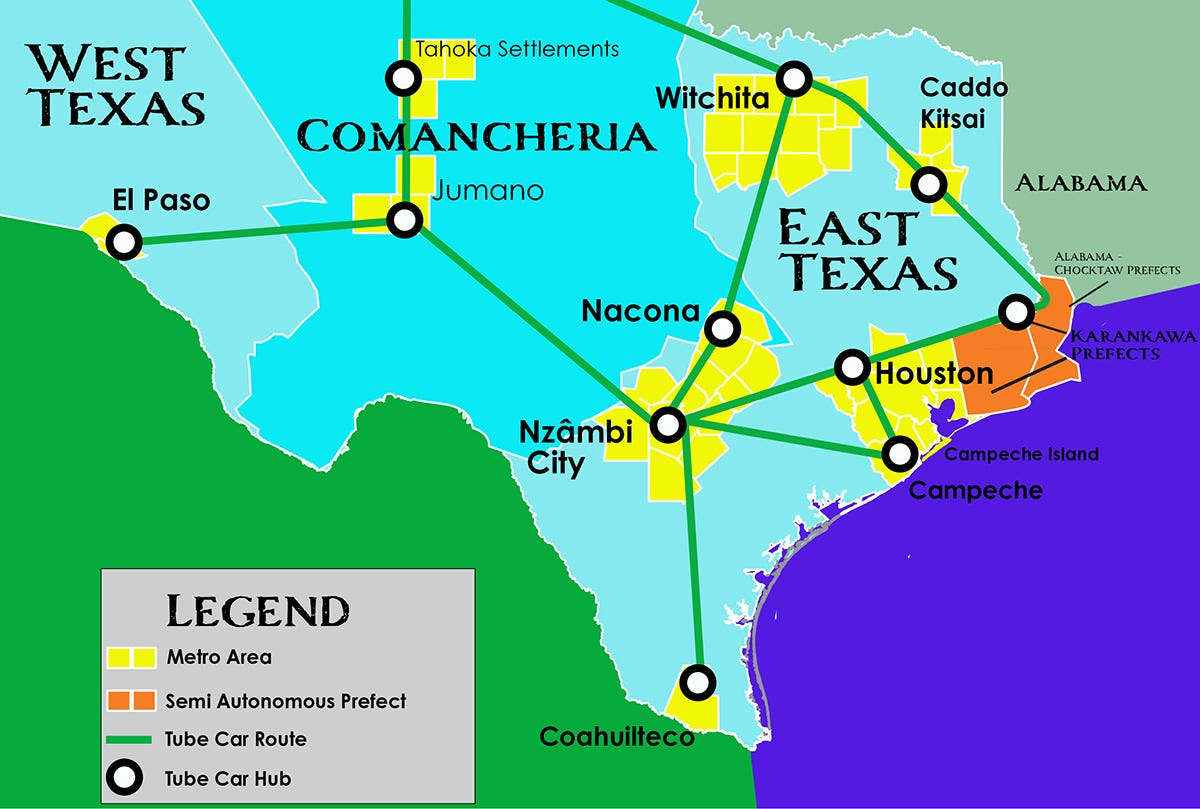
Sonata pulled out her trusty roll-up and plotted out all the pieces for Hiawatha to examine more closely; the routes used by the Drunken Dance Congregation between Seminole City and Campeche, the parts of the internment housing used to work with vanti, the shipping container routes to the Mediterranean, and even the baseball cards sold by the Seminole Caribbean Protestants. She told me to show Hiawatha my baseball card.
After he was sufficiently filled in, Hiawatha asked me, “And you like this kid, right?” in reference to Richland Price.
“Well, yeah. He’s just a young guy, playing around, really.”
“I’m going to pay him a visit,” said Hiawatha.
“Be nice,” I said.
“I will. But he needs to know what kind of fools he’s gaming with.”
If Hiawatha was able to contribute to his welfare without giving the kid details, I was all for it.
The discussion, which Trace joined about halfway through thanks to some detective work by Hiawatha’s tech people, lasted forever, it seemed. By the time we were done working out details, the plaza had been reduced to mostly loiterers. The food tents had all folded up, the drum circle was gone, the dancing ended.
A lot can be accomplished with an extremely smart group of people and a roll-up or two. We decided on a plan of attack on two fronts. Trace said that the data his network sniffer sent was not successfully scarfed up, because all he had outside of his main operational room when I tried sending the data from the sniffer were backup servers. The receiving unit that was supposed to process the data was destroyed by Alon’s men when they ransacked the place.
But we still had enough to work out a decent plan. Both teams would wear ear implants devised by Trace to work on a 10.7 GHz frequency so that everyone could remain in communication in case something happened to somebody’s smartphone.
Sonata had determined that nobody had yet reserved this frequency with the federal government, so Trace said he’d monitor it for the rest of the evening to be sure nobody had covertly hitched a ride on it. I asked Trace how we’d speak into it.
He said it would work within the ear, but that the voice would sound a little weird, maybe muffled. Unfortunately, there was one small detail that would need to be ironed out. Not only would Trace need to ready the ear implants in less than a day, but he’d need to hack a satellite to make the relays work. It wasn’t ideal, but it was a fallback anyway. The main communication link was still our phones.
Hiawatha would drop into Seminole City for a visit, hopefully with Alon himself if he could find a way into the gambling infrastructure. If not, he said, he’d force his way in. He’d bring a team of about ten men.
Meanwhile, Sonata and I would try to work our way into the internment housing. Sonata would ask for a tour or something like that, and I’d come along almost as a dare to our adversaries to come after us. If they did, Hiawatha had another team of ten or so who he was confident could make a sufficient assault on the buildings to get us out.
The hope, of course, was that they’d politely accommodate Sonata, grumble to themselves that I was there since all the important players in that operation probably knew who I was, and we’d maybe record some damning evidence with our earpieces.
I had initially proposed that we just provide a live feed of the vanti operation to the authorities from the guy we already had in there, but Sonata was concerned about legal issues, so we decided to try a more personal approach. The reality was that Hiawatha would be doing the heavy lifting in Seminole City.
We all decided to hole up at some guest houses at Sonata’s Campeche Apostolic Congregation.
Congregations typically consisted of two types of property — those that belonged to the congregation itself, meaning the individual members, and those that belonged to the congregation as an entity, which usually meant headquarters properties, various churches, schools, administrative offices, and whatever businesses were associated with the congregation.
Most headquarters were sprawling campuses containing dozens, even hundreds of buildings, depending on the size of the congregation. Campeche Apostolic was a rather modest affair, but it still had several guesthouses where we could stay the night. A direct attack on a congregation's property was extremely unlikely, even from the likes of Alon. Such an attack would guarantee a swift and decisive response from the federal government since congregation property was considered sacrosanct.
There had not been an attack on a congregation since the Savannah Wars of the 1820s, when the Seminole Nation attacked the Southern White Baptist Congregation, an attack that history applauds but one that still led to a constitutional amendment banning the militias, which now seemed so despairingly prevalent.
We each took a room upstairs in a massive Victorian home with two large spires wrapped by long curving balconies. I could picture myself lounging on one of those balconies enjoying an iced tea, but it was late, and I was exhausted.
Hiawatha and I took each other’s forearms and embraced before he went into his room. That left Sonata and me alone in the hallway. I walked her to her room. She put the key in her door and turned around to face me. “I’ll be glad when this is over,” she said. “I’d love to hang out with you without thinking about guns and fists.”
I nodded. “Soon,” I promised. She reached up with her toes and I bent down, and we kissed each other gently on the lips.
She took my hand in both of hers and kissed it. “Soon,” she said, smiling, before turning around and entering her room. She peeked through the door as she was closing it. “Good night,” she added with her smile.
End of Chapter Sixteen
Thanks for reading!
You can find Chapters One and Two and the current table of contents here:


Truly, you've created a different world with your words. History and all.
It reminds me of those recurring dreams that seem to be waiting for one to get back to sleep in order to continue from where they left off - that world exists only when your mind is free of your day to day focus on this one.
Fascinating.