

Trigger warning: Christianity! Possible blaspheme, too! Hide the children. Hide the pastors! But not in the same room, please.
Note: Footnotes now work in the Substack app (Substack fixed a bug)
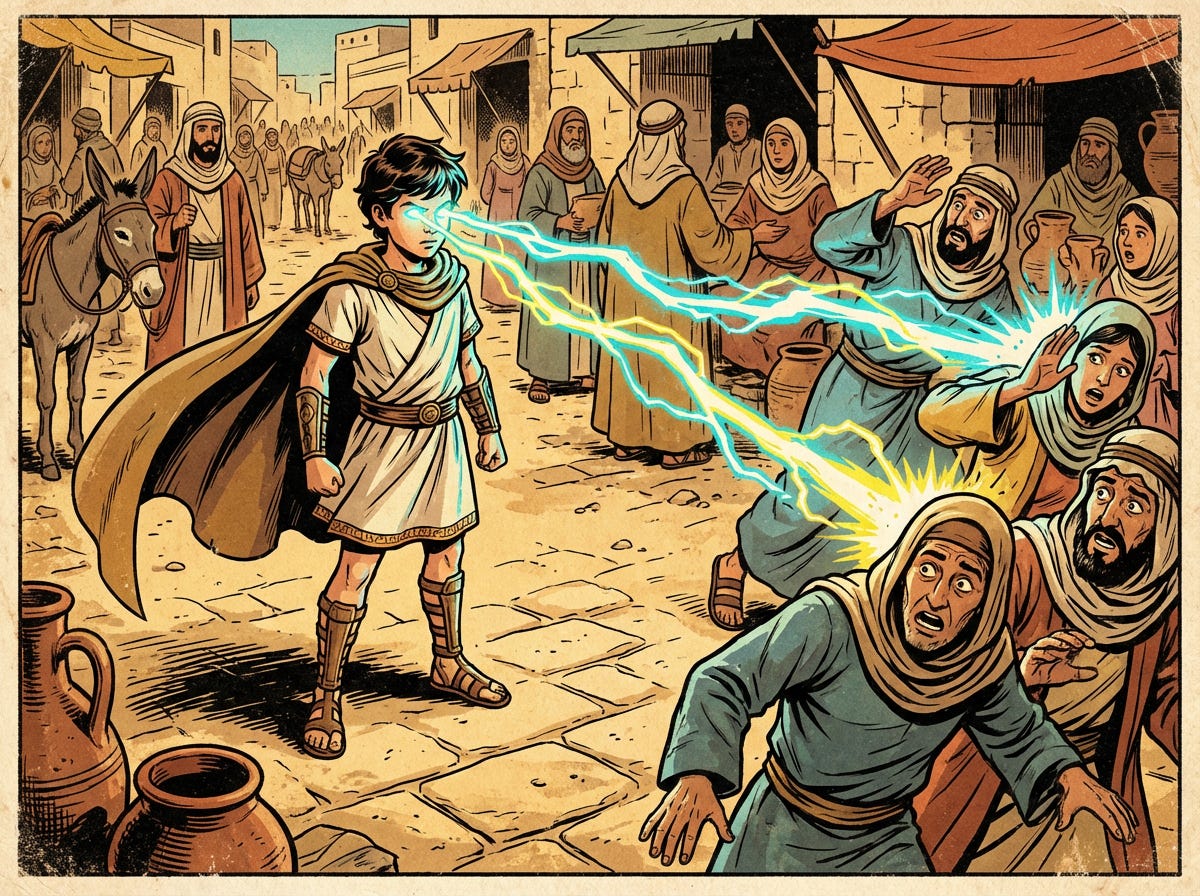
It’s possible that the first major disinformation campaign occurred 2,000 years ago. Or, maybe this stuff really happened.
Most people are unaware of an unusual group of stories about Jesus Christ that appeared in a gospel but never made it into the New Testament. We’ll take a closer look at that in a bit. For now, let’s check out the stories.
A wayward boy Jesus? Say it ain’t so
When he was five, so the story goes, the boy Jesus gathered water from a stream of non-potable water and purified it into a series of pools.1
The son of a scribe saw this and, being something of a brat, wielded a willow branch to destroy the purified pools and the waters that the five-year-old Jesus had gathered.
Most of us can imagine the kid in our schoolyard who would have done the same thing, as well as the reaction of a kid who might have a wickedly decisive advantage in the schoolyard brawl that followed.
Sure enough, boy Jesus did what a lot of five-year-old boy-gods would do. He admonished the kid, saying, “Wicked, impious, and foolish! What harm did the waters and pools do to you? Now, you, too, shall dry up like a tree, and you shall never produce leaves nor roots nor fruit.”
The obnoxious kid then withered and died.2
Before that, Jesus created twelve sparrows from clay just because he could. After his father chastised him for violating the Prime Directive,3 Jesus sent the birds aloft, saying, “Go, take flight and remember me, living ones.”
Why the other kid cleared out Jesus’s nice little water system after seeing the boy create living beings out of clay and giving Dad the finger is anyone’s guess. Darwinism, I suppose.
You would think these kinds of stories would have slowed the roll of other kids, but no. As Jesus was walking through Nazareth, apparently unaccompanied by mom or dad (helicopter parents were not a thing those days), another not-so-bright kid bounded towards him from the opposite direction and banged into his shoulder.
I’m pretty sure the kid did it on purpose because he thought he was being tough.
Big mistake. Jesus did his best imitation of Gandalf’s famous, “You shall not pass!”4 by saying, “You shall not go your way!” Little tough guy keeled over and died right there on the spot. Someone from a small crowd of onlookers freaked out and said of Jesus, “Where was this boy born, that his every word is a deed accomplished?”
Krypton, fool.
Furious, the dead kids’ parents, who should have been watching over the kid better anyway, knowing there’s a rampaging superhero who hasn’t yet figured out how to do good with his powers, visited Joseph and complained. “You, having such a boy, cannot be with us nor live in this village unless you teach him to bless and not to curse; for he is killing our children,” they said.
I kind of love that boy Jesus cursed, by the way. I mean, this kid was like Homelander, not the gentle and polite Clark Kent discovered by two quiet Kansas farmers centuries later. 5

Joseph, realizing things might be getting out of hand with his unruly fledgling Superman, pulled Jesus aside and said, "Why do you do such things? Those people suffer and hate us and drive us away.”
Jesus wasn’t finished, however. He said to Dad, “I know that your words are not mine but yours; nevertheless, I shall be silent on account of you. But those people shall bear their punishment.”
And bear the punishment they did. Jesus’s accusers went blind. Dad, like a U.S. Democratic Senator issuing a strongly worded memo, yanked on Jesus’s ear a bit. Jesus then issued forth a warning: “Do not irritate me.”
Yeah, sorry, son. Won’t happen again. Have at it. I bet all these dumb rural voters vote Republican anyway.
A nosy local teacher named Zacchaeus paid a visit to Joseph a few days later and told Joseph he was willing to try to teach Jesus the Greek alphabet. Maybe, Zacchaeus must have thought, that will help tame the child.
Joseph was probably thrilled to get that kid out of the house for a spell, so, after some cajoling on the part of Zacchaeus, Dad said “F*ck it,”6 or whatever the Hebrew equivalent of that was in those days.
But when Zacchaeus tried to teach Jesus letters, Jesus mocked him by pointing out that he knew a lot more than just letters, and, by extension, a lot more than Zacchaeus. I mean, he wasn’t wrong, right?
The conversation must have taken place outside, because people quickly gathered and began talking fearfully about the super boy in their midst. Jesus, who hadn’t quite yet developed the empathy he was known for later, said to the gathered crowd in his little five-year old voice:
“Why are you so amazed? Moreover, do you not believe what I said to you—that I know when you were born and your fathers and your fathers’ fathers? I say this wonder to you: I know when the world was created, and the one who sent me to you knows.”
“Yikes!” gasped the crowd.
Sensing the kill, little Jesus then said, “I played with you because I know you are amazed by trifles, and you are small-minded.”
Even though that’s a Monday for some modern parents, in those days, kids just didn’t talk smack like that unless they could back it up. Jesus could and then some.
Luckily, he didn’t smote anyone, and eventually Zacchaeus dragged him into school. They can’t really say this in Bible stories, but, well, things quickly went to hell. As I mentioned, Zacchaeus tried to teach Jesus letters, but Jesus responded thusly:
“Listen, master, and understand the order of the first element. Pay close attention here how it has lines and middle strokes which you see; sharp, standing with legs apart, meeting, spreading, elevated, dancing in chorus, in triple rhythm, of the same thickness, of the same family, holding the measuring cord, in charge of the balance, of equal measure—these are the lines of the alpha.”
If a five-year-old talks like that to me, I’m either high-tailing it out of there or am calling the dean of the nearest Ivy League school. Or an exorcist.
That was pretty much Zacchaeus’s take on it, too. He said in response, for all the class to hear:
“Woe is me! I am puzzled, wretch that I am, bringing shame to myself, attracting to me this boy.
“Take him away I beg you, brother Joseph. I cannot bear the severity of his look nor his lucid speech.
“This boy is not of this earth; he can even tame fire. Perhaps he was born before the creation of the world. What kind of womb bore him? What kind of mother’s belly nourished him? I do not know. Woe is me, brother! He stupefies me. I cannot follow along in my mind. I have deceived myself, thrice unhappy as I am. I strove to gain a student and I am found to have a master.
“I think, friends, about the shame because I am an old man and I was defeated by a boy. I must be cast out and die on account of this boy.
Let me interrupt you for just a moment, Zacchaeus. You’re being a little hard on yourself here. Besides, regarding the “die” part, I am getting the sense that boy Jesus might take care of that part for you.
Zacchaeus continued:
For I can no longer be seen in his presence, especially after everyone said that I was defeated by a small boy. What can I say and tell anyone concerning the lines of the first element which he told me? O friends, I do not know. For I do not know the beginning or the end of it.
“Therefore, I ask you, brother Joseph, take him away into your house. What great thing this one is—either a god or an angel or whatever else I might say—I do not know”.
I’m thinking “demon,” Zach, but let’s see how Jesus responds to your minor cardiac arrest.
By this time, school administrators had joined the fracas, so there was yet another crowd. While Zacchaeus was getting advice and, presumably, sympathy from all quarters, Jesus laughed loudly and said, “Now let the barren bear fruit and let the blind in heart see, because I am here from on high so that I may deliver those below and call them to the heights just as the one who sent me to you instructed.”
Then, the people he had blinded earlier suddenly regained their sight, and others he had maimed recovered, too.
A short time later, Jesus was playing on a roof with other kids, who must have had a death wish. When one of them fell and died, the parents accused Jesus of killing him. Jesus approached the dead child and said to him, “Zeno, rise and say to me: did I knock you down?”
Zeno jumped up and said, “No dude, you rose me from the dead,” and the parents and others worshipped the boy Jesus, thrilled at his spiritual growth, which was notable, since just a short period ago those same parents would have been on the receiving end of some serious Old Testament retribution.
The boy Jesus was transforming before the villagers’ eyes.
The growth continued. A short time later, a young boy accidentally chopped his foot in half with an axe, then died from blood loss. The boy Jesus pushed his way through a gathered crowd and touched the boy’s foot, saying, “Rise, split your wood, and remember me.”
Sentiments around town began to change: “Truly, perhaps God dwells in him,” some town folk began to say.
As boy Jesus grew, so did his patience for us mere mortals. When he was seven, his mother, Mary, gave him a jar to draw water from a local well. When a crowd jostled him, he fumbled the jar onto the ground, breaking it. Instead of striking down those who got in his way, he shrugged his shoulders, took off the cloak he was wearing, filled it with water, and brought it to his mother. His mother kissed her wondrous child, but didn’t tell the neighbors about the neat trick.
Where do these stories come from?
These and other stories are extracted from the non-canonical ( not in the Bible) Infancy Gospel of Thomas, a late, non-apostolic text outside of traditional Christian literature.7
The early bishop and Biblical scholar Eusebius rejected this book as heretical “fiction” in his fourth century history of the church. Pope Gelasius I declared the book a heresy in the fifth century. St. Irenaeus, who hated anything associated with Gnostics, which was a group that promoted the book, also lambasted it while making the first known reference to it in 180 AD.8
But here’s the weird thing. The famous story of the 12-year old boy Jesus in Luke 2:41–52, where Jesus mockingly tells his parents not to worry about where he’s been after having gone missing for a wee bit, is aligned with the same story in the Infancy gospel at 19:1–12. (see Footnotes)9
The Infancy Gospel focused on the early life of Jesus as a superhero-type character struggling with how to control his superpowers. The boy Jesus made live birds out of clay and struck people down when they offended him. It almost seemed as if the child’s spoken words came to life. Rather than being overwhelmed by such power, he seemed to relish it.
Nobody knows for sure who wrote this gospel. In the version I quote from, the Infancy Gospel opens with “Thomas the Israelite,” which suggests that it originated with Judas Thomas (Thomas the Apostle), who is thought by many Christian sects to be one of Jesus’s brothers. He would have been privy to Jesus’s earliest antics.10
Family dynamics being what they are, he might have also had an incentive for spreading some disinformation, even if he loved his brother.
The early church rejected the book’s verses for inclusion in the Bible because traditionalists and orthodox clerics claimed that, unlike the rest of the New Testament, it wasn’t written close enough to the time of Christ’s lifespan, which means much of it relied on oral history (even though there is evidence it was written around the time the Gospel of Luke was written).
Nevertheless, the concept of a boy with godlike powers is a fascinating one. It has drawn enough interest to have launched a million or so TV series and streaming franchises.
The temptations of the boy Jesus
One consistent thread throughout this gospel was a vibe of insolence. This isn’t as out of character as you might think. Jesus became the symbol of empathy, love, kindness, and forgiveness, but he sometimes got a bit testy when his apostles seemed dense. He could become impatient when his apostles did stupid things.
But he loved them desperately anyway.
What was he like during those hidden years before he emerged out of one of human history’s black holes as an adult in his thirties? Were his early years redacted by a concerned clergy?
One clue that there may be at least some truth to these events occurs in a canonical Biblical story, where Jesus returns to his hometown of Nazareth and is all but turned away. In fact, in Luke Chapter 4, verses 14-30, the locals try to throw him off a cliff.11 Now, maybe we know why.
The Bible reports such rejection as a common occurrence, but whoa, tough crowd. Native sons, the argument goes, often find rude welcomes when they make a return visit after many years. But that tough? Throwing off the cliff tough?
Sure, I guess so, although it’s not something I’ve heard much of beyond the relevant Bible verse. If boy Jesus was a whirlwind of destruction, even for a short time, it isn’t a stretch that the villagers would view his return with trepidation.
They might not have looked upon him as a Son of God, but instead a powerful demon.
Hollywood director Martin Scorsese addressed the issue of Jesus’s temptations in his movie, “The Last Temptation of Christ,” where, sadly, Scorsese helped promote the defamation that Mary Magdalene was a prostitute (she was not).
The last temptation in the movie was the resistance of death itself at the hands of his executioners.
The temptations described in the Infancy Gospel are presented to Jesus when he’s much more vulnerable, a child, unable yet to block out the easy answers to challenges from people he considers inferior.
It’s the ultimate superboy story: Loving, kind parents offering guidance to a child born with impossible powers.
The question for Christians is fairly simple: Was Jesus born with his sinless ways, or did he require training? Was the training a necessary part of his adoption of human form?
It’s possible that Thomas, if he was the author, exaggerated Jesus’s behavior. Jesus may have been no more than an insolent child, and Thomas, jealous of his brother, wrote the book as a disinformation campaign. Either way, the feisty, impatient personality part of the story fits.
As a Christian, I never understood the whole sacrificing one’s son thing.12 This explains it for me. It wasn’t a sacrifice. It was Jesus himself atoning for his own sins, big or small, and ours.
The kid was pretty rowdy. It’s no surprise that tales of his early years are not canonical. The powers that be didn’t want an alternative to their message that he was born without sin to escape into the wild.
But if he was born human, to be a reflection of us, and as a god who must experience human humility, how could he possibly become the wise teacher he became without losing some of his battles against himself? It’s easy for someone to just tell us to be pure of thought and full of love, but even a god needs some street cred.13
A story like this also lends more power to the story of those days Jesus spent in the desert fending off Satan’s charms. There is nothing in the biblical narratives of that story that suggests it was anything less than a struggle. Why would that be if he was born without sin in the absolute sense the Christian patriarchy has taught us? He would have laughed his way to victory.
Instead, angels aided him during his difficult trial, “ministering to him,” while he resisted the devil.
God could have come to us in another form. Like a kind-hearted Thanos with immutable power.
To me, the ultimate story of forgiveness is given added credence by the sweet possibility that he was tortured as much by what haunts us mere mortals in our daily lives as he was when his tormentors nailed him to the cross.
NOTES
My spiritual gut says, “No way.” If I, a very much less than perfect human, have never been able to imagine killing someone, it’s reasonable to assume Jesus never did either. But the temptation? I suspect that existed. He may have even threatened to after burning down a tree or something.
If you think this is all a bunch of hooey, I understand. It’s a thought exercise.
I always lose a few subscribers when I talk about God anyway. Given our current political environment, I can understand why. At the end of the day, none of us knows what happened 2000 years ago. With apologies to Gil Scott-Heron, the revolution was most definitely not televised.
The concept of messiahs has long fascinated me. I’ve written some fiction about it…
Messiah short stories
Jesus can’t be the messiah for other sentient beings. That makes no sense.
This short story is about a dolphin Messiah:
A messiah’s last breath in the oceans of Europa

This is a more whimsical look at a cat messiah:

And this short story will make people think I take too many drugs (I can’t say I didn’t dabble when I was young):

Thanks for reading!

Footnotes
The Infancy Gospel of Thomas can be found here (among other places):
Gnosis.org. “The Infancy Gospel of Thomas,” 2025. http://www.gnosis.org/library/inftoma.htm.
and here, where there are multiple translations:
Tonyburke.ca. “Infancy Gospel of Thomas | Tony Burke,” 2025. https://www.tonyburke.ca/infancy-gospel-of-thomas/.
Most of this storyline comes from this version of the Infancy Gospel of Thomas:
Tonyburke.ca. “Infancy Gospel of Thomas: Greek a | Tony Burke,” 2025. https://www.tonyburke.ca/infancy-gospel-of-thomas/infancy-gospel-of-thomas-greek-a/.
In the television series Star Trek, the Prime Directive is a rule directing starships not to interfere with alien civilizations that have not acquired warp technology.
This is a scene from the Lord of the Rings movies. I don’t remember if he says it in the books or not.
Homelander is an evil super villain who originally poses as a Superhero in the TV streamer “The Boys.” It took a long time for maga types to understand that he was representing the maga phenomenon, which is kind of beautiful.
This is a biblical tale, so, no, I’m not spelling out an F bomb.
Biblical scholars also call non-canonical books apocryphal. There are many, such as the Gospel of Mary, which covers the life of Mary Magdalene, and might have made it into the Bible had it not been broken up and redacted by male scribes from Christianity’s earliest years.
Contributors. “2nd-Century Greek Bishop and Doctor of the Church.” Wikipedia.org. Wikimedia Foundation, Inc., December 19, 2001. https://en.wikipedia.org/wiki/Irenaeus.
From the Infancy Gospel of Thomas (Tony Burke, Greek A)
19 1 And when he was twelve years old his parents went as usual to Jerusalem for the festival of the Passover with their group of travelers. And after the Passover, they returned to their home. But as they stared to return home, the boy Jesus went to Jerusalem. And they assumed he was in the crowd of the travelers.
2 After traveling a day’s journey, they looked for him among their relatives. When they did not find him, they were distressed and returned to the city to search for him. After the third day they found him in the temple, sitting among the teachers and asking them about the law and asking them questions. And all paid attention to him and were amazed how, being a child, he questioned even the elders and teachers of the people <and> explained the main points of the law and the parables of the prophets.
3 And his mother Mary approached and said to him, “Why have you done this to us, child? Look, in great anxiety and distress we have been searching for you”. Jesus said to them, “Why were you searching for me? Did you not know that I must be in my Father’s house?”
4 And the scribes and the Pharisees said, “Are you the mother of this child?” And she said, “I am”. And they said to her, “Blessed are you among women, because God has blessed the fruit of your womb. For such glory and such virtue and wisdom we have never seen nor heard”.
5 And Jesus rose and followed his mother and was obedient to his parents. And his mother treasured the things that concerned him, all that Jesus had done. And Jesus increased in wisdom and in years and in grace. And he was praised by God Almighty. To him be glory forever, amen.
Ehrman, Bart (2003). Lost Scriptures: Books that did not make it into the New Testament. Oxford University Press. pp. 64–66. ISBN 0195141822.
It’s complicated. He was God’s “son,” but as part of the Holy Trinity (according to most Christian denominations), he was also God.
Also of note: The Bible is full of stories of spiritual heroes with human failings. Moses killed an Egyptian, David snatched a wife from a general, and then killed him.
I concur with your research findings on Mary Magdalene and the Gospel that was dropped from the final text as published. As for your historical fiction account of young child Jesus, I started visualizing something here along the same lines, but with a different modern twist - I see this small child Jesus as an early version of a smarta$$, but better well spoken biblical B*rt S!mpson [legal staff told me to be careful of copyright infringement and big lawsuit] with M*rv@l Comic superpowers [again that damn legal staff]. But maybe I just missed that Christmas episode.
Slightly off topic, but regarding Jesus and Joseph, the artistic depiction of both men vary widely amongst the great painters of the 15th through 17th centuries, whose paintings adorn the walls of Catholic churches throughout Europe and American museums. Joseph, as depicted in scenes with the infant Jesus varies from a teenager (as likely the Virgin Mary was) to an older middle age man with a long brown beard and in some cases balding with a grey beard. Jesus as an adult is shown as any where from thin to muscle man Jesus, totally ripped hitting the gym daily. I suspect the former based on the nutrition of the day.
Thank you for this. It all makes perfect senses.
Of course, being in a child's body would having him behaving like a child and relishing - with abandon - the powers he came in with.
Of course, he'd need to learn humility and empathy as part of being in a human body.
I read that he eventually studied with Masters in India. That would explain the years he went missing and his philosophical growth.
“This boy is not of this earth; he can even tame fire. Perhaps he was born before the creation of the world."
That's it in a nutshell.
An intriguing read, Charles.