

All they wanted was bread.
On October 5, 1789, a large contingent of exasperated women marched eighteen kilometers from their Paris marketplaces to Versailles, then stormed the palace of King Louis XVI and escorted him at swordpoint out of his gilded palace to Paris.
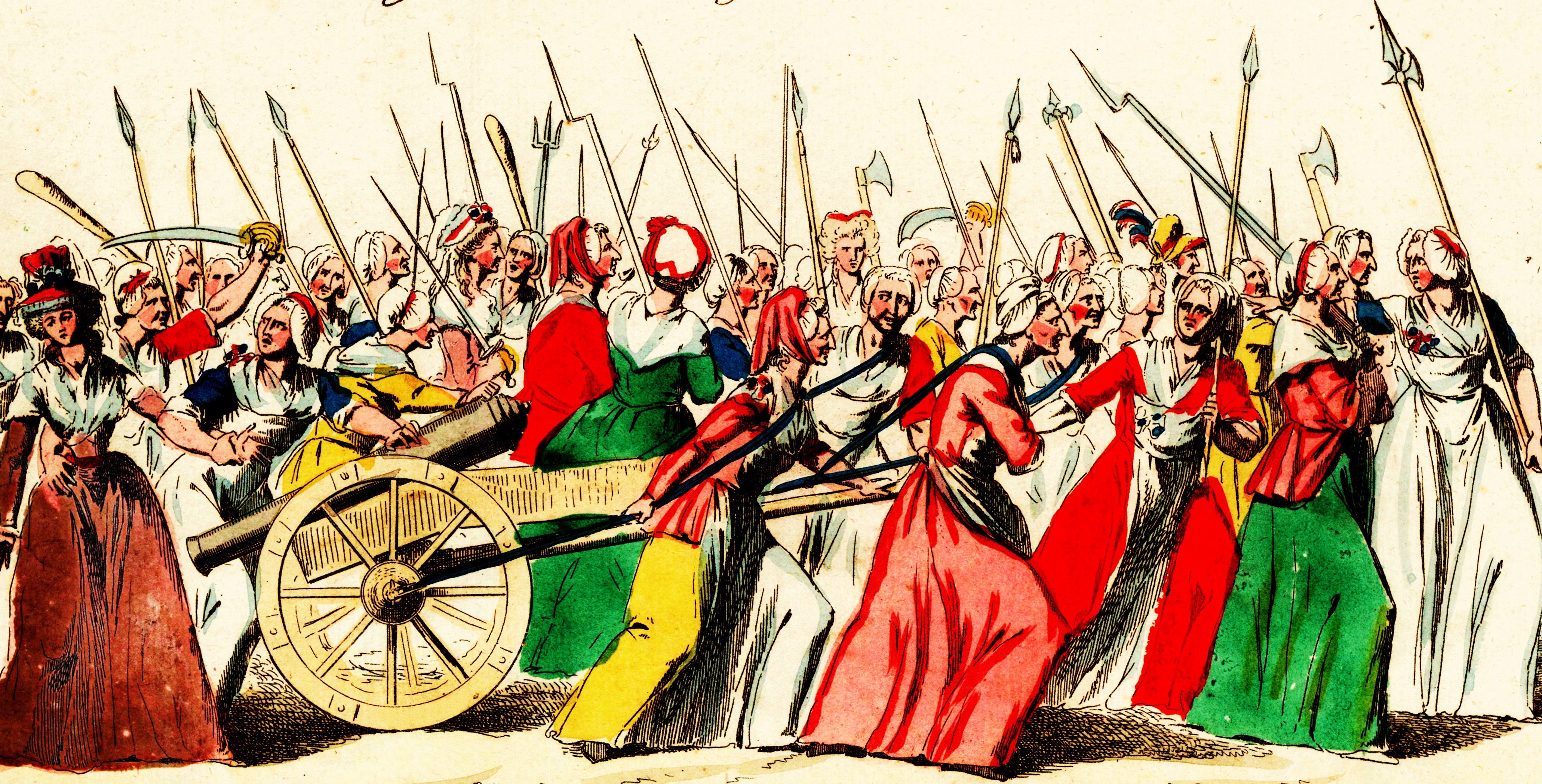
If something similar happened in the United States today, about all that would be left of the mad king would be wrecked tufts of his orange hairpiece. The anger in America is that much more intense.
The American regime has no sense of history, so it’s doubtful they’ll consider the consequences of the story of the women of the French Revolution.
They should.
Some Revolutionary Background
To understand the connections between the French Revolution and America’s current situation, we need to look at history. Don’t worry. History can be fun.
All they wanted was bread
In the late eighteenth century, Paris marketplace women, outraged at persistent bread shortages and the behavior of the king’s soldiers as he tried to crush dissent, were demanding reforms.
They had been on edge for years. They were making their political feelings known in ways reminiscent of what’s been happening during the last decade in the United States.
In 1775, Louis XVI’s gens d’armes and national police force blocked the distribution of bread by squirreling away grain in storage to make bread production impossible.1 Like the current American regime’s refusal to release SNAP funds2, no rational explanation was ever provided.
When bread disappeared from the tables of French citizens, bread riots erupted. The riots were contained, but the disenchanted populace remained primed for revolt until the king’s last days, fourteen years later.
Bread was everything to the general citizenry in those days. When it was scarce, people pulled their torches off the walls and marched, looking for heads to sear. By the time of the French Revolution, bread costs were eating up half of a worker’s wages. In some cases, bread consumed 90% of a worker’s earnings.
The French Revolution is most renowned for the Storming of the Bastille, which occurred on July 14, 1789. This date is imprinted onto French history as le 14 juillet, also known as French National Day, and more popularly known in the United States as Bastille Day (keen observers of my writing will note that every day is Bastille Day for some of us).
But it was the Women’s March on October 5 that sealed the king’s fate. With bread prices rising, city markets, heavily frequented by women, became hotbeds of dissent.
Before we get there, though, we need to understand the players involved in the French Revolution. Their historical significance applies in uncanny ways to our current predicament.
Estates, estates, and estates
The French Revolution was a confusing affair centered around the activities of “estates,” which were gossipy society circles consisting of a mix of nobility, clergy, and commoners. French commoners are usually referred to by historians as the Third Estate (the other two “estates” were nobility and the clergy). French historians also call them sans-culottes, but we’ll skip that name because I had to copy-paste it.
To compare: Unless you’re as wealthy as Jeff Bezos or his estranged philanthropic ex-wife MacKenzie Scott, you’re probably a commoner like me. Even the majority stockholders of Substack should probably be considered commoners, since their holdings could vaporize if the American regime’s likely stock market collapse comes to fruition.
The women in the Parisian marketplaces were also commoners.
Mixed in with the estates were policy wonks, scholars, and philosophers, all of whom enjoyed their roles as agitators poking the hot coals of dissent with a variety of ideas, both good and bad.
Before the Revolution, France was already seething with a mélange of complaints against the king.
Over the centuries, the French monarchy had developed a system of meetings to handle dissent called the Estates-General, which was created in 1302 by King Philip IV. The idea was to provide a forum through which feudal estate owners could bitch and moan without being thrown into unpleasant French dungeons.
Because France was a monarchy, the Estates-General was not a formal part of government, nor was it a sitting body. Although it had no legislative power, it was considered progressive for its time because, in the 14th century, most European ruling governments responded to dissent by lopping off heads.
Having a place to vent was a huge relief for the few who were allowed into the forum within the king’s hallowed halls. You can compare it to a visit to Mar-a-Lago, without the punishment of having to listen to the mad king’s obsequious minions prattle on about whatever focus of the king’s hate is driving them that day.
As time passed, the meetings between the Estates-General and French kings became less frequent. After one such meeting in 1614, the whole thing disappeared until 1789, the final year of Louis XVI’s reign.
By then, the concept of “estates” had evolved from a convention of the king and feudal estates run by grumpy lords who made a living demanding tribute from serfs to include just about everybody, as represented by the three estates I mentioned earlier: nobility and royalty, a powerful clergy, and commoners like me.
The last part of that metamorphosis, the one that included commoners, took place at the beginning of the French Revolution.
Come thee forth, oh ye estates!
Louis XVI, his back to the wall from all the dissent over bread prices and scarcity, called the Estates-General forth to try to salvage things.
Compounding the king’s problems was, as today, a propensity for lavish spending — but no way to pay for it all. Governments couldn’t put as much spending on the credit card in those days as they can today. The French treasury was emptied by a combination of the king’s obsession with golden toilets, gilded and expensive ballrooms, and military adventures.
Disclaimer: I’m not sure about golden toilets and ballrooms — I may have the wrong king in mind.
Luckily for us, one of those military adventures was support for a fledgling nation called the United States.3
The king’s ploy, calling for the Estates-General in his version of Mar-a-Lago, Versailles, failed. The Third Estate (in other words, the people) used the opportunity to create a National Assembly, declare a formal end to feudalism, and establish a constitutional monarchy to make the king a figurehead with no real power.4
Even worse for the king, a slew of clergymen joined forces with the commoners of the Third Estate (which may have been why they all huddled to create a new name for the gathering: The National Assembly).
The National Assembly created the famous (at least in France and Europe) Declaration of the Rights of Man and of the Citizen.5
The revolutionaries begged Louis XVI to back the Rights of Man document and the changes established by the National Assembly, such as the end of feudalism.
Let them eat cake!
The king pondered that possibility for a few days while hiding in the palatial halls in Versailles. But then, much as our current mad king did on the eve of the SNAP shutdown,6 he opted instead for a garish dinner among friends. Seriously. I’m not making this up.
The dinner was technically a welcoming feast for the 1,500-strong Flanders Regiment, which the king invited to Mar-a-Lago, oops, sorry, Versailles, to bolster defenses.
French journalist Jean-Paul Marat, through his newspaper L’Ami du Peuple (Friend of the People), described the Mar-a-Lago, oops, sorry, Versailles dinner as a “gluttonous orgy.”
Paris was full of gossip hounds in those days, so word of the opulent dinner spread through Paris, as did rumors that the regime was once again planning to pull grain from the market.
Queen Marie Antoinette, mocking the potential starvation of her citizens, was rumored to have said, “Let them eat cake.” There doesn’t seem to be a formal record of her statement, but since it sounds like something Melania would say, I think it happened.

What we do know is that the queen, holding her four-year-old eldest son, performed what amounted to a clog dance upon the tricolor flag of the revolution while dinner guests bellowed, “Down with the cockade of colors!”
Unlike today, they had real journalists in the late eighteenth century, so word of the event spread in Paris faster than the goiter in the back of Trump’s brain.
The Storming of the Bastille
The opulent dinner helped lead to the Storming of the Bastille, which demonstrated the power of the people filling the streets to take matters into their own hands.
The Bastille was a fortified political prison established by Kristi Noem (just kidding — she wasn’t alive yet, I don’t think) that had become a symbol of the regime’s tyranny.
French revolutionaries, consisting mostly of commoners, gathered near the Bastille after Louis XVI kicked popular Finance Minister Jacques Necker out of his regime. They were already outraged over the Mar-a-Lago, oops, sorry, Versailles dinner celebrating the Great Gatsby — oh, dear. Sorry again. I meant to say “celebrating the Flanders Brigade.”
See, I’m not any better at history than you good folks reading this.
Anyhoo, Necker was the only high-level government officer with a commoner background. He had just promised to try to resolve the ongoing financial crisis without raising taxes.
Even more importantly, Necker had been a leader of a movement governing how the king’s Estates-General should be convened.
The king’s original plan had been to populate it with representatives of the nobility and feudal estates, giving them disproportionate votes, similar to how Wyoming and its tiny MAGA population have a greatly outsized voice in America’s Electoral College.
Necker helped devise an election system involving the Third Estate. It was imperfect (for example, only men could vote), but far ahead of its time. Commoners gained representation in the Estates-General for the first time in French history.
Necker was forced out, but it was already too late. The damage was done. The Estates-General, complete with common folk, was convened in May 1789; the king then had his dinner, and it all went to hell for him.
Louis XVI had seen the writing on the wall before, so he placed about 30,000 troops around Paris in anticipation of possible strife. Instead of saying that the troops were staged to protect ICE, he said they were staged to protect the newly created National Assembly.
Like the nonsense that comes out of the Trump regime, nobody believed him.
To compound the problem, these weren’t loyal troops. Many of them were mercenaries who had no skin in the game.
Remember when I mentioned the rabble-rouser philosopher types who were always eager to poke the hot coals? When Necker was kicked out and exiled, a man named Camille Desmoulins jumped onto a table in a popular café and urged an armed revolt.
His audience cheered and followed him into the busy city streets, almost like something you’d see in a South Park episode. There, a massive crowd quickly gathered. The crowd marched to the Champs-Élysées, was pushed back by royal troops, and then found itself in the Tuileries Palace.
There, the angry mob threw everything they could find at the royal cavalry, from chairs to rocks or anything with a hard edge. The cavalry’s heart was not really in the fight, so the crowd won the battle and marched on to the Bastille.
The Bastille was heavily fortified, but by this time, it was a symbol more than anything, so the crowd easily overwhelmed what little resistance there was.
The victory wasn’t strategic. There were about seven prisoners there, depending on which account you read. But like General Washington’s victory in Trenton after crossing the Delaware, when the Colonial army was in its death throes, the symbolism was enough to change history.
Although it was no longer an important prison or fort, one important asset remained at the Bastille during its sunset years: ammunition, and lots of it. Revolutionaries scooped up as much as they could carry, and the revolution was born.
Women marched on Washington and captured the mad king — dammit. I did it again. I mean, women marched into Versailles and captured Louis XVI, and the rest is history.
This eventually led to Napoleon Bonaparte, so there’s still hope for those of you hoping to conquer and annex Greenland.
The parallels
There are obvious parallels between the French Revolution and current conditions in America. In France, the scarcity of bread was caused by a government act of callous disregard. The same is true today. The American regime, held together by faith in a droopy man who looks ready to drop any day, a man about to become nothing more than a pool of coagulated orange poopalade on the newly desecrated grounds of the White House, is about to fall.
Like that of Louis XVI, it’s a regime that is desperate to find a way to cling to power. It’s hiding a brain condition serious enough that he’s in a neurological protocol involving MRIs and basic cognitive tests regarding the identification of animals.
It’s hiding the sexual crimes of a man who was best friends with a sexual predator who commanded a billion-dollar child sex trafficking empire.
This is a man who has been accused by more than 20 women of sexual assault, and was found in a New York City civil case to have committed sexual assault on a woman who stands to collect millions of dollars if she can ever pry any of it from his cold, bruised hands.
A man who can barely speak an intelligible sentence on his best day.
A man who lies with each breath he takes, like it’s a bizarre sport.
All this talk of fascism is self-defeating hooey. The fascism that minions like Stephen Miller are trying to establish is nothing more than cosplay and 4Chan boy fantasies. The American people aren’t having it.
Look at the videos in Chicago. Note the resistance. It’s powerful stuff. When ICE comes to your town, you’ll see the same thing there.
Yes, this form of cosplay causes serious damage. People in Chicago can attest to that. It’s not trivial when a fourteen-year-old U.S. citizen is kidnapped7 by masked goons in darkened SUVs who slam into his dad’s car and take them both into custody. It’s not trivial when hundreds of these kinds of incidents take place every month.
But they all signify the last breaths of a dying man and a dying regime, a regime that ends when he does. And he’s on life support. He’s barely here.
In a worst-case scenario, if the regime continues its current course in the face of its defeat, nobody will need to call people to the streets.
They’ll just show up.
This regime greatly underestimates and misunderstands history.
But even if many of the rest of us misunderstand it, too, history understands itself. History dictates what the future holds for this regime.
It’s not a fascist government that awaits us. It’s a new one. Hopefully, one inspired by the serious lessons we must all glean from these last ten years.
Thanks for reading!
Special thanks to Richard Lowenthal for some editing help.
Notes
Despite the last name on the byline, I do not consider myself a French history expert, or even an expert on Bastille Day.
The New Tiers of Joy Ruminato Subscription Pricing
The economy is tough right now. Since my writing is free, but I work hard to produce it, I’ve created a new pricing tier to fit everyone’s budget:
Full price: $8 per month
$7 per month
$6 per month
$5 per month
$4 per month
$3 per month
$2 per month
Whether you’re feeling frugal or fancy, you decide how much your subscription to Ruminato should cost. I do have long-term plans to add more writers, but I’m not sure of the timeline yet.
If you hate subscriptions as much as I do, you can always do a one-time thing:
And if you can’t afford anything, join the club! Either can I! I appreciate all my readers, no matter what.
Sources
Estates-General
Estates-General of 1789 — World History— The Estates-General of 1789 was a meeting of the three estates of pre-revolutionary France
Storming of the Bastille
Camille Desmoulins — World History
Camille Desmoulins (1760-1794) was one of the most prominent journalists during the French Revolution (1789-1799). A…www.worldhistory.org
Storming of the Bastille — World History
The Storming of the Bastille was a decisive moment in the early months of the French Revolution (1789-1799). On 14 July
Jacques Necker — World History
Jacques Necker (l. 1732-1804) was a Swiss banker and statesman who served as finance minister to King Louis XVI
Bastille Day — Wikipedia
Bastille Day is the common name given in English-speaking countries to the national day of France
March on Versailles
Women’s March on Versailles — Wikipedia
Women’s March on Versailles — World History
The Women’s March on Versailles, also known as the October March or the October Days, was a defining moment in the French Revolution.
Lefebvre, Georges & Palmer, R. R. & Palmer, R. R. & Tackett, Timothy. The Coming of the French Revolution. Princeton University Press, 2015.
Schama, Simon. Citizens. Vintage, 1990
Footnotes
Much of the general understanding of this relies on 18th-century conspiracy theory. The police in France during that era had wide-ranging powers far beyond law enforcement. Beginning in 1773 until 1975, they tried to control the price of bread by managing grain supply, so it wasn’t as nefarious as it seems. Nowhere near as nefarious as our current situation, where the regime is actively trying to starve people. In 1775, French police tried to stabilize falling grain prices by withholding grain from the market. This brief episode created a general feeling of ill will and a persistent paranoia that the government was withholding supplies whenever the price of bread went up. Conspiracy theories were rampant, and helped lead to the Flour Wars (basically, a series of 300+ riots). It didn’t help that French citizens were so unwilling to eat, for example, potatoes, which alone would have solved a lot of their problems.
Mancini, Ryan. 2025. “New SNAP Restrictions Go into Place amid Shutdown Drama.” The Hill. November 2025. https://thehill.com/homenews/administration/5584863-new-snap-restrictions-november-shutdown/.
It’s worth noting that the King of France supported the U.S. revolution because it was part of a larger world war against his mortal enemy, England, not because he thought Benjamin Franklin was dope.
I’m simplifying this a little because I know y’all got videos to get back to.
“Avalon Project - Declaration of the Rights of Man - 1789.” 2025. Yale.edu. 2025. https://avalon.law.yale.edu/18th_century/rightsof.asp
Lubin, Rhian. 2025. “Trump Slammed for Lavish Gatsby-Themed Halloween Party as Vital Food Funding Lapses for Millions of Americans.” The Independent. November 2, 2025. https://www.independent.co.uk/news/world/americas/us-politics/trump-halloween-party-gatsby-snap-funding-b2856896.html.
https://chicago.suntimes.com/authors/michael-puente-wbez. 2025. “Siblings Shaken after Feds Raid Gary Home, Arrest Family — ‘They Punched Me in the Eye.’” Chicago Sun-Times. October 29, 2025. https://chicago.suntimes.com/immigration/2025/10/29/gary-family-arrested-ice-indiana-immigration.


Charles, Yes, and.
YES, I see the parallel you draw — the bread, the anger, the desperation that spills once the dam of endurance cracks. AND yet, something in me resists the comparison. Because the French system, beneath all its cruelty, rested on an old code of care — communitarian, relational, class-bound yet still carrying a sense of mutual duty. Even within hierarchy, there was the faint idea of stewardship, of dignity attached to belonging.
The American system was built on an entirely different rootstock. From the beginning it replaced people with property. It declared that freedom meant ownership — not of self, yet of land, of bodies, of labor. That shift from care to conquest is the original fracture.
So yes, the people may rise again — as they did in France — yet it will rise from a different soil. The French rage was relational: they marched because the king had broken an unspoken contract of responsibility. The American rage is transactional: it grows from betrayal inside a system that was never relational to begin with.
People sense this now. They sense how deeply out of control the current regime is — not in the predictable decadence of Versailles, but in the erratic chaos of an empire that believes it can purchase eternity. And they fear both the collapse and what might follow it. They fear their own power as much as the regime’s retaliation.
There is a dam — yes. A trembling wall of fear, anger, exhaustion. And behind it, the same hunger: for bread, for dignity, for a life that still feels human.
Yet when that dam breaks, it won’t echo 1789. It will sound like something new entirely — the noise of a people remembering what care once meant before property became the god
link to the army chorus performance of Do You Hear the People Sing. the irony was lost on most of the attendees but not on the choir members. 🫶https://youtu.be/pIQh_5dZUwI?si=lozqv1XcUUmkskH4