

When Substack announced $100 million in Series C funding that involved Marc Andreessen, a known right-wing stooge and lunatic, it’s fair to say my inner alarm bells grew bigger than the orange puffaroon’s chronically venous insufficient ankles.
This is our new possibility: The platform many of us rely on to counter the right-wing’s massive media and propaganda advantage has now been snatched into the far right’s clutches.

The good news is that Andreessen’s firm, Andreessen Horowitz, does not appear to be the primary investor. The bad news is that Andreessen Horowitz was already a major investor, and it’s adding to its share of what it already owns.
According to the Substack announcement:
Today, we’re announcing $100 million in Series C funding, led by investors at BOND and The Chernin Group (TCG), with participation from Andreessen Horowitz, Rich Paul, CEO and founder of Klutch Sports Group, and Jens Grede, CEO and co-founder of SKIMS. BOND’s Mood Rowghani will join our board.
No matter how you look at it, Substack is now firmly in techbro territory, starting with Mood Rowghani, the new board member.
Who, you must be wondering, is Mood Rowghani, aside from being a dude with a cool name?
Although he doesn’t have enough money yet to buy God, Rowghani and his wife, Tara Dhingra, did have enough money to lay out $45 million for Ellen DeGeneres and Portia de Rossi’s 10,376-square-foot mansion in Beverly Hills in October 2021.1
He is the quintessential tech bro, living in absurd luxury while the people around him struggle to afford the most fundamental necessities, like home insurance, electricity for their air conditioning, or clothing outside of the Temu fabricsphere.
Before Mood and Tara bought their palace, DeGeneres and de Rossi renovated it with rich people goodies like “an all-white foyer with dark brown, chevron-patterned hardwood floors.”2 The home, an English Tudor built in 19333, has a massive living room where you could hide the six thousand or so immigrants the couple surely needs to maintain the place.
Mood booted up his fortune at Kleiner Perkins, one of the earliest and most successful Silicon Valley venture capital firms, by leading something called the $1 billion Digital Growth Fund. He then played major roles in Kleiner Perkins’ investments in Uber and Waze (robot cars). His brother, Ali Rowghani, co-founded one of Substack’s new investing companies, BOND, which is another Silicon Valley VC firm with billions in investments and assets.
But hey, let’s not hate on these characters just because they’re rich, right? After all, Illinois Governor JB Pritzker is rich, and he ended bail bonds in Illinois. Not all rich people are evil.
They’re not to be trusted, but they’re not, by definition, evil.
I doubt Marc Andreessen is evil, either. His origin story includes helping to create the original Netscape browser, after all. How bad can that be? Back then, we all thought the internet was going to be the best thing to hit Planet Earth since the Chicxulub asteroid.

But somewhere between then and now, Andreessen discovered the Dark Side.
He started his public political life as a vocal supporter of Bill Clinton and Al Gore. He put his money where his mouth was, too, by pouring money into Clinton’s presidential campaign. He was a vocal defender of Gore’s mythical quote, “I invented the Internet,” by correctly pointing out that Gore never said it.
What Gore really said was, “I took the lead in the Senate in creating the internet.” Gore did, in fact, do so, by leading the effort to direct federal funds to build four supercomputing centers leveraging internet research efforts by the Defense Advanced Research Projects Agency (DARPA). One of them was on the University of Illinois campus. At that time, Andreessen was studying ways to build the predecessor to the Netscape browser, Mosaic.
He sold Netscape for billions of dollars, then used a bunch of his new cash to start a tech investment firm. Ultimately, that company grew to $42 billion in managed assets.4 No wonder he loved Clinton/Gore.
As Andreessen morphed into a morbidly rich tech bro, he began to have doubts about the tech bro alliance with the Democratic Party fostered by Clinton and Gore. It’s hard to know how that started. We can review some of what Andreessen has said about his metamorphosis from a reasonably secure human being into a paranoid right-wing activist, but it is impossible to believe right-wing propaganda, especially when someone so blatantly flies off the rails into a nest of right-wing talking points that are much more easily mocked than understood.
Unsurprisingly, Andreessen, in an interview with failed William Buckley wannabe Ross Douthat, blames Obama for his lurch to the right:5
The breakdown was during the second Obama term. It took me by surprise. I think maybe the one person it didn’t take by surprise is our mutual friend Peter Thiel. As with a lot of things, I think he saw it coming earlier than I did. But it definitely took me by surprise.
Andreessen makes vague references about how Obama was a great guy who loves tech, but complains about “changes,” which he can’t or won’t define, then vomits this:
The unifying thread here is, I believe it’s the children of the elites. The most privileged people in society, the most successful, send their kids to the most politically radical institutions, which teach them how to be America-hating communists.
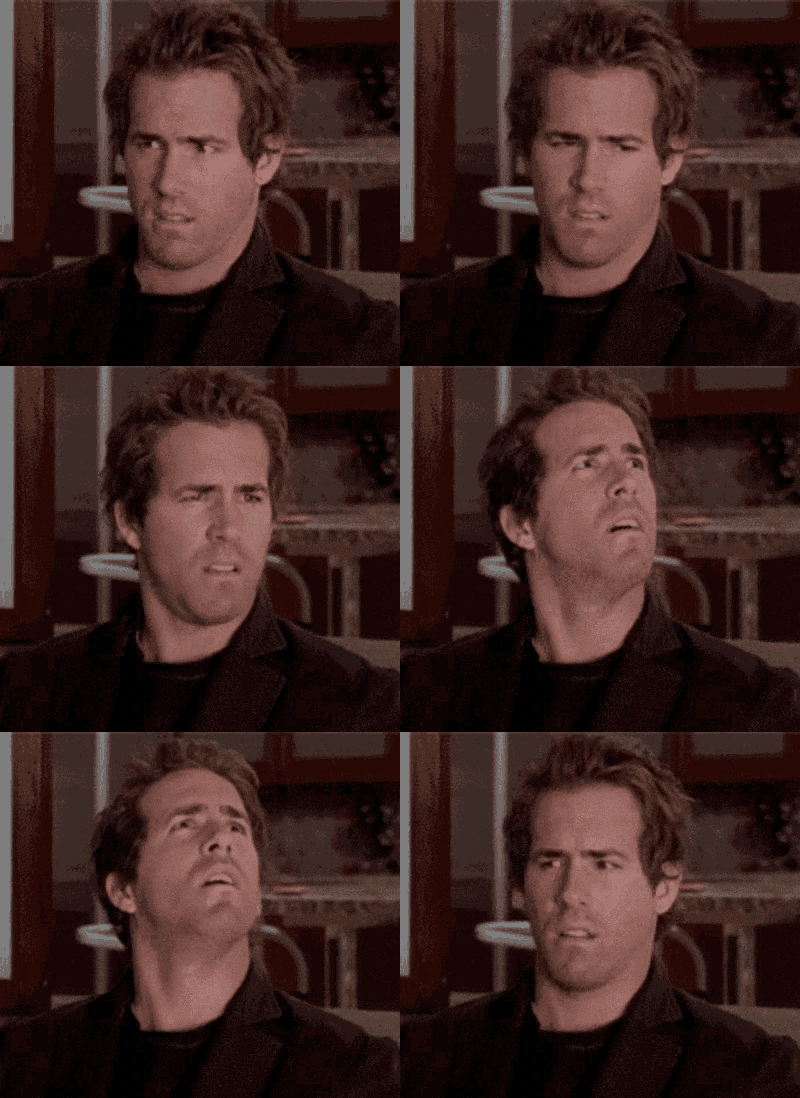
Andreessen then outs himself with the reality behind his newly found paranoia, which he had already hinted at when he mentioned his association with fellow tech bro Peter Thiel.
His business partner, he points out, is a fella named Ben Horowitz, who is the son of David Horowitz, a former left-wing gadfly turned right-wing nutter. Andreessen tells the rapt Douthat:
I’ve spent a lot of time talking to David Horowitz about this because he lived through it 40 years earlier.
Ruh-roh.
Frequent conversations with David Horowitz6 cannot be good.
Andreessen tells Douthat:
So I had this moment with a senior executive, who I won’t name, but he said to me with a sense of dawning horror, “I think some of these kids are joining the company not with the intent of doing things for us but destroying us.”
I spent many years in the tech business as a software engineer, and I don’t remember seeing any of these wild-eyed Trotskyites banging at their keyboards, mostly, I suppose, because people like Andreessen were laying down impossible deadlines so they could get ever richer. Otherwise, yeah, I’m sure these computer nerds would have been running around with torches and copies of the Communist Manifesto.
In their conversation, Douthat wants to know what the result of this transformation of “the kids” has led to. By now, Andreessen seems to have drifted from his “I blame Obama” message.
His answer: “Revolution.”
Cue the Ryan Reynolds gif again.
Andreesseen continues:
It turned out to be a coalition of economic radicals, and this was the rise of Bernie Sanders, but the kids turned on capitalism in a very fundamental way. They came out as some version of radical Marxist, and the fundamental valence went from “Capitalism is good and an enabler of the good society” to “Capitalism is evil and should be torn down.”
And then the other part was social revolution and the social revolution, of course, was the Great Awokening, and then those conjoined. And there was a point where the median, newly arrived Harvard kid in 2006 was a career obsessed striver and their conversation with you was: “When do I get promoted, and how much do I get paid, and when do I end up running the company?” And that was the thing.
This kind of statement will come as a surprise to the folks I worked with, who spent most of their long days sitting in a cube banging out software code to meet arbitrary deadlines created by program and project managers wanting to implement a new user interface widget or create an emergency database query, and do it now.
Andreessen’s most recent rant was directed at university DEI programs, describing Stanford and MIT as “mainly political lobbying operations fighting American innovation,” and, in a nod to the bizarre white replacement theory, immigration and DEI as “two forms of discrimination.”7
In 2024, he openly supported Trump’s re-election, for reasons that should now be obvious. He’s a frequent visitor to Mar-a-Lago and is good friends with the founder of Palantir, Peter Thiel. Palantir, if you haven’t heard of it, is a data science company that maintains gigabytes of data on everything you do, from bathroom habits to whether you’ve ever been to a dentist, a gun show, or, God forbid, a meeting of Democratic Socialists.
Palantir has signed giga contracts with the U.S. government since the November 2024 election. It is actively helping the regime build a surveillance state that seems destined to rival China’s.
This would be scary on its own, but Thiel’s philosophy about the troubles facing America is just like Andreessen’s. At the risk of profiling, I’ll sum up their thinking this way: lighter doses of melanin are the surest route to perfection.
We are all entitled to our opinions, of course, but when someone who thinks like this is a major investor in Substack, I worry. Andreessen's initial rounds were concerning enough. But the Substack folks are telling us that Andreessen is in even deeper than ever.
The far right already controls most of corporate media, is at the helm of a 300 million user base at Apartheid Twitter, and runs what history will describe as pure propaganda arms at Fox News and Sinclair, the latter of which owns a huge number of local television and radio outlets.
Media companies that once demonstrated a modicum of independence, like Paramount (formerly CBS), have become subservient to the MAGA cause, as most recently demonstrated by the recent firing of the best satirist in the business, Stephen Colbert.
Keep in mind, too, that some independent journalists, like Casey Newton at Platformer8 and Marisa Kabas9 at the Handbasket,10 left Substack because Substack’s owners weren’t willing to crack down on a fairly substantial Nazi presence on the platform.11
It’s impossible to make a judgment on someone’s political purity under the best circumstances. It seems likely to me that Chris Best, Hamish McKenzie, and Jairaj Sethi, the founders of this platform, believe themselves when they insist that Substack is designed to be free of any type of censorship. I don’t see evidence for things like shadow bans.
I’m not big on conspiracy theories (although I’ll admit they can be fun). I don’t think Hamish will read this and order a software developer to blacklist my Substack. (Partly because I doubt he’ll even see it, of course).
But when this much money is tossed around, especially by someone like Andreessen, it’s fair to sound the alarm.
So what’s the solution?
Maybe nothing, yet. Substack hasn’t been flipped. It may never be. For all I know, Hamish and company are taking Andreessen’s money and laughing all the way to the bank. It’s dangerous to make assumptions about people you don’t know. That’s partly what led to where we are today.
But if you’re a writer here, you should take precautions by regularly exporting all your stories and subscribers. Don’t lose your readers if the walls cave in.
If you’re a reader, be prepared to see your favorite writers move to a different platform. If they do it right, you won’t notice.
If the worst happens and Substack flips, we are not as helpless as it seems.
Is it time to create a People’s News Service?
This is a good time for folks here to unite under some kind of banner to prepare for the possibility of losing this platform.
The Ghost platform is an open-source writing and newsletter platform that has many of the same features as Substack.
Ghost can be “forked” (see explainer in the footnotes)12 into a separate code base on a platform such as GitHub (buyer beware — GitHub is owned by Microsoft). This would prevent an even worse scenario than losing Substack, where Ghost also gets gobbled up by tech bros, because whoever forks the code can do what they please with no constraints from corporate overlords.
Because it is open source, the code can be modified to create new features, such as a “Notes” type of functionality, which, along with other helpful growth tools, is currently missing from the Ghost platform.
The Ghost platform is robust. The subscription model is the same as Substack, except you get to keep all your subscription money. Ghost doesn’t take a cut. It’s a non-profit based in Singapore.13 They make their money with a subscription to their code base.
As I mentioned, though, the code base is open source. If a group of intrepid independent journalists were so inclined, they could fork the project into their own and find a different way to fund it.
I can envision a news service owned by only content creators using the Ghost platform. Accomplishing this would require the services of a couple of good, dedicated programmers. I qualify here, but I frankly don’t have the energy for that type of undertaking. If other people take the initiative, however, I’d contribute to the cause, and to the codebase. I think others would, too.
The important takeaway for now is this: If you’re a writer, regularly export all your Substack data, just in case. Be prepared to port everything to Ghost or something similar. It’s easy to do. Ghost even has a transition page for doing so:
https://ghost.org/docs/migration/substack/
If you’re a writer, you can make your own mind up by checking it out here:
In the meantime, we should all keep an eye on Substack. Maybe it won’t veer into right-wing deathland. But it might still do unpleasant things, like take on advertising (this has already been hinted at) or devote too many resources to becoming a video app, leaving those of us who don’t want to put our mugs in front of the camera on the regular in the lurch.
We should also consider forming a group of folks who commit to forming an alternative model if things go south. I’ll leave that all up to you good folks in the comments section or wherever else you can think of.
Notes
Ghost isn’t the only alternative available. Maria Kabas, for example, uses Beehiv for her newsletter. I refer to Ghost because I’ve tried it. I haven’t tried any others.
Why, you might ask, haven’t I simply transitioned to Ghost? I like this platform, is why. It has tools for building a subscriber base that Ghost doesn’t have (a fork of the code can change this, but I can’t do that alone).
Thanks for reading. See “Footnotes” below for references/resources/additional contextual comments.

Footnotes
Staff, TRD. 2021. “Silicon Valley Power Couple Named as Buyers of Ellen DeGeneres’ Beverly Hills Home.” The Real Deal. October 28, 2021. https://therealdeal.com/san-francisco/2021/10/28/silicon-valley-power-couple-named-as-buyers-of-ellen-degeneres-beverly-hills-home/.
The Real Deal, ibid
Pennell, Julie. 2018. “Ellen DeGeneres and Portia de Rossi’s Beverly Hills House Is Gorgeous.” TODAY.com. TODAY. October 2, 2018. https://www.today.com/home/ellen-degeneres-portia-de-rossi-s-new-house-gorgeous-t138535.
This essentially means that the firm is managing an investment portfolio worth $42 billion, depending on the vagaries of the stock market. The firm doesn’t have $42 billion in cash.
Douthat, Ross. 2025. “Opinion | How Democrats Drove Silicon Valley into Trump’s Arms.” Nytimes.com. The New York Times. January 17, 2025. https://www.nytimes.com/2025/01/17/opinion/marc-andreessen-trump-silicon-valley.html.
You can learn more about Horowitz from the write up by the Southern Poverty Law Center:
“David Horowitz.” 2025. Southern Poverty Law Center. June 3, 2025. https://www.splcenter.org/resources/extremist-files/david-horowitz/.
Ha, Anthony. 2025. “Marc Andreessen Reportedly Told Group Chat That Universities Will ‘Pay the Price’ for DEI | TechCrunch.” TechCrunch. July 12, 2025. https://techcrunch.com/2025/07/12/marc-andreessen-reportedly-told-group-chat-that-universities-will-pay-the-price-for-dei/.
Newton, Casey. 2025. “Let’s All Try to Help Substack Live up to Its New Valuation.” Platformer. July 18, 2025. https://www.platformer.news/substack-series-c-enshittification/.
Kabas, Marisa. 2022. “LEFT SUBSTACK—FIND ME at WWW.THEHANDBASKET.CO | Marisa Kabas | Substack.” Substack.com. 2022. https://thehandbasket.substack.com/.
Lawler, Richard. 2023. “Substack Says It Will Not Remove or Demonetize Nazi Content.” The Verge. December 21, 2023. https://www.theverge.com/2023/12/21/24011232/substack-nazi-moderation-demonetization-hamish-mckenzie.
To “fork” a project means to access the source code of a project, in this case Ghost at https://github.com/TryGhost/Ghost, and create a separate branch of code that is unaffected by further changes in the original source code. This is more common than you might think. For example, the Microsoft Edge browser is based on an open-source version of Chrome called Chromium (but I don’t know if that is a forked project that Microsoft manages or if they update their software based on updates to the main Chromium open-source project).
“About Ghost - the Open Source Publishing Platform.” 2015. Ghost - the Professional Publishing Platform. 2015. https://ghost.org/about/.
Thanks to the many readers and commenters. In fairness, here is a recent post from one of the founders, Hamish. It is full of all the kinds of principles we want to hear about re: Substack. H/T to Susan Niemann for sending me this. It seems only fair to pin a link to it. My apologies to those I don't reply to!
https://hamish.substack.com/p/civilization-on-the-electronic-frontier
Well, shit. This is wildly valuable, Charles. I've built a lovely group of friends and readers here. Why cant these right-wing nut jobs leave us alone! WAIT. I know. Money. 😭😭