

If you’re a writer using AI, welcome to the biggest bait-and-switch in history.
AI companies have lured millions of users into their lairs by offering their AI models for use at no charge. That’s about to end. Maybe not next week, or even next month, but very soon.
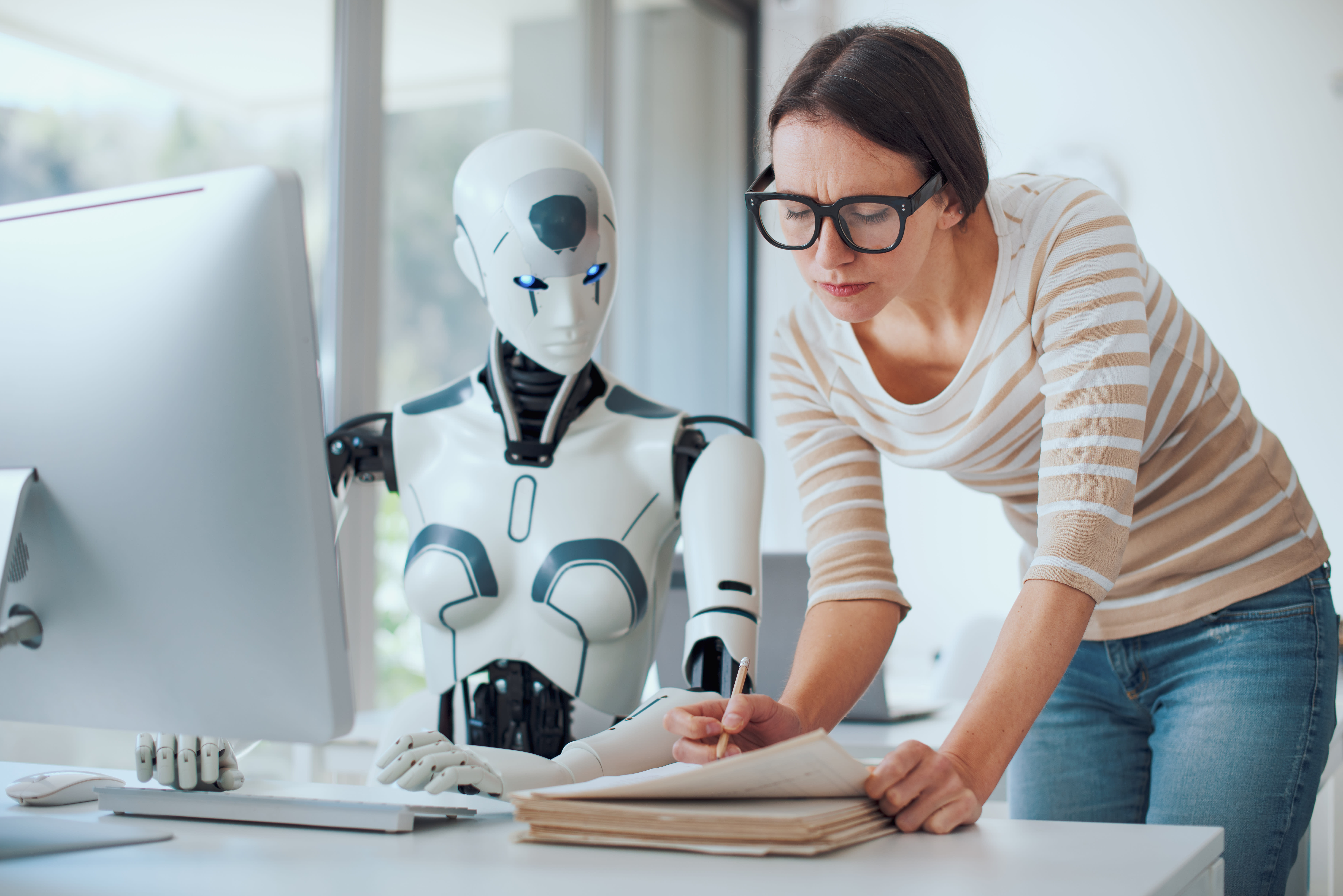
The end of the free ride means that it won't be shame, mangled reputation, or a reconsideration of ethics that stops people from using AI to write. It will be money. The cost of entry will become prohibitive, even if it only costs $10 per month to earn the average $2 monthly writer’s wage.
AI companies are not leeching money or burning through it like the tech bubble companies of old. Comparing the AI bubble to previous tech bubbles is like comparing the mendacity of Trump’s crime syndicate to Richard Nixon’s corrupt little thieves, whose comparative metaphor would have been tilting a vending machine to snag a free bag of chips.
The debt leveraged to continually expand the AI bubble is on the verge of burying all but the most resilient AI companies out of business.
We’ll take a closer look at that in a minute, but to give you a glimpse of the collapsing bait-and-switch scam, a collapse that (hopefully) will put an end to AI writing slop, we need to take a look at the software development world, which is typically a harbinger of the rest of AI.
Changes to software AI pricing models
Software coding has undergone tremendous change since the advent of AI. These days, you can bootstrap entire applications using artificial intelligence. This isn’t a surprise to software engineers, who are used to bootstrapping the skeletons of software applications anyway.
In the user interface world, there’s even a user interface (UI) style library known as “Bootstrap” that has been used for years to apply design styles to fonts and other design elements on web pages.
Bootstrap was released by Twitter long before Elon Musk turned the place into an apartheid watering hole. The UI library became so popular that web developers were able to easily recognize when a website was built on top of it the moment they hit a site’s home page.

Similarly, on the server side of things, libraries like Node.js, a server-side JavaScript library, can be used to bootstrap website server applications, in other words, the server code that handles requests and transactions from users.
Most software development tools, called IDEs, have featured built-in coding libraries that let users pour a bunch of code into a file with the click of a button for years.
All of this tech was around long before AI was much more than a Stephen Spielberg movie about a lonely AI kid and his gigolo cyborg friend (masterfully played by Jude Law, by the way).
What has changed is that AI now has more “intelligent” coding capabilities, so software developers can now “bootstrap” an entire application, not just the initial outline of one. This fits with the essence of AI, which is simply a big probability matrix. In simplest terms, AI knows coding patterns. The predictive model is perfect for a tool that relies on prior art, so it cranks out code like a pro.
Microsoft has been a purveyor of various tech tools through its GitHub service for several years. GitHub is a software repository where software engineers check out code, make changes, and check a copy back in, giving the changed code a new version number so that mistakes can be tracked and fixed, and, when necessary, blame assigned for bugs.
GitHub began life as a simple software storage facility. Microsoft bought the company that runs it and added a bunch of enhancements. When AI took the world by storm, Microsoft leveraged GitHub through its “CoPilot” brand, enabling software engineers to build apps with AI and check them into a source repository under one roof.
GitHub has always offered a free tier, but the free tier has severe limitations that make it difficult to create full applications. For a long time, Microsoft also provided a free trial of CoPilot’s full capabilities. These free trials ended on April 10, 2026.
Microsoft explains why:1
As GitHub Copilot continues to grow, we’ve seen a significant rise in abuse of our free trial system. To protect the experience and integrity of the platform for legitimate developers, we are pausing new GitHub Copilot Pro trials while we investigate and strengthen our protection mechanisms.
Microsoft, for now, is saying the pause is temporary. And by itself, this is not evidence that AI pricing models are about to change.
However, this is:
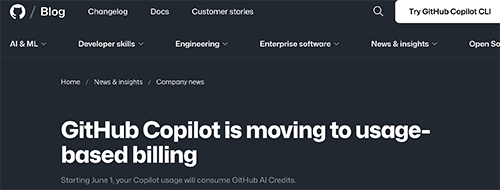
Again, Microsoft describes the change:2
Instead of counting premium requests, every Copilot plan will include a monthly allotment of GitHub AI Credits, with the option for paid plans to purchase additional usage. Usage will be calculated based on token consumption, including input, output, and cached tokens, using the listed API rates for each model.
This change aligns Copilot pricing with actual usage and is an important step toward a sustainable, reliable Copilot business and experience for all users.
This, my friends, is called an omen.
The metering system is such a change to what some GitHub customers are used to that Microsoft tries to soften the blow with a warning shot:
To help customers prepare, we are also launching a preview bill experience in early May, giving users and admins visibility into projected costs before the June 1 transition. This will be available to users via their Billing Overview page when they log in to github.com.
Yikes. I haven’t seen that before in a price hike communication, have you?
Metered billing (AKA “Pay as you go”) applications are nothing new to the software industry. Amazon Web Services (AWS), which powers about 30% of the world’s websites, has been doing it for years.3
What’s different is that AI has sucked the average non-tech user into its world without that user being aware of such things as tiered tech pricing (gouging).
Microsoft goes on to defend its decision by explaining that the legacy costs for simple queries, like what you find on ChatGPT, were the same as for developers who spun full applications:
Copilot is not the same product it was a year ago.
It has evolved from an in-editor assistant into an agentic platform capable of running long, multi-step coding sessions, using the latest models, and iterating across entire repositories. Agentic usage is becoming the default, and it brings significantly higher compute and inference demands.
Terminology sidebar: “Agentic usage” means doing things like coding and testing an entire software application or providing scaled customer relations bots that can do everything from answer a question to approving you for a bank loan.
Microsoft needed to change that dynamic to stop money leeching out of its coffers.
The bold in the next paragraph is mine:
Today, a quick chat question and a multi-hour autonomous coding session can cost the user the same amount. GitHub has absorbed much of the escalating inference cost behind that usage, but the current premium request model is no longer sustainable.
Usage-based billing fixes that. It better aligns pricing with actual usage, helps us maintain long-term service reliability, and reduces the need to gate heavy users.
I wouldn’t make an effective corporate communications writer, because I would have written:
“We knew going in that we’d be luring you in with freebies only to hit you hard over the head with a big-time usage bill later. So sue us for bait and switch? Good luck with that, sucker. Hey, maybe Trumplevania will take action against us. Ha ha ha ha ha ha ha!!!!!!”
The change means that users pay fees for every use of GitHub’s AI tool, such that a user who pays $100 for a monthly plan receives $100 worth of AI credits, and no more. If you use them up, your software project stalls until you purchase more.
Still, this is only anecdotal evidence that massive pricing changes are afoot across the industry. But wait, there’s more.
Axios discovers that AI workers cost more than human workers
Axios recently reported that efforts to replace human workers with AI are not going as smoothly as advertised:4
"For my team, the cost of compute is far beyond the costs of the employees," Bryan Catanzaro, vice president of applied deep learning at Nvidia, told Axios.
And…
Uber's chief technology officer already blew through his full 2026 AI budget due to token costs.
It’s still early May.
Definition: Token costs refer to the pay-as-you-go system of paying usage fees for each blob of AI data you pull in.
According to Michael Burry, who made news by betting against the housing market before it bankrupted millions in 2008, tech bro company values are overstated by around 42%.5
This is because companies that consume AI are expected to spend $1 trillion on AI in their zeal to fire workers, even though they don’t know for sure that the money they think they’re saving will actually be saved with the AI that replaces said workers.
Max Linder, a software engineer in Stockholm, told the New York Times: “I probably spend more than my salary on Claude.”6
According to the New York Times article:
Generous “token budgets” are becoming a job perk for coders, like dental insurance or free lunch, and some are spending thousands of dollars a month trying to automate as much of their own work as possible.
Consulting firm Gartner expects higher spending on AI worldwide: $6.31 trillion in 2026.
Data Centers are eating the world
Meanwhile, Moody’s, which is paid a lot of money to worry about balance sheets and rate the financial viability of companies accordingly, recently raised another AI expenditure alarm. The company found that the massive investment in data centers by five AI companies carries a $662 billion risk that isn’t even on their books.7
This accounting trick is perfectly legal. Out of $969 billion in future lease commitments to data center buildouts by Amazon, Meta, Alphabet, Microsoft, and Oracle, $662 billion has been committed to lease contracts that have not yet been initiated, so they don’t need to be accounted for when the companies submit their earnings reports to the SEC (not that the Trump version of the SEC gives a shit if earnings reports are legal or not).
The total build-out from just these five companies is nearly a trillion dollars. This is such a staggering sum of money that it isn’t really possible for humans to relate to it.
What can a trillion dollars buy? Investor News’ Tracy Hughes was so aghast that Tesla was going to give Elon “Apartheid” Musk a one trillion dollar compensation package that she asked ChatGPT what she could buy with it.
A lot of interesting answers, including:8
You could buy every team in the NFL, NBA, MLB, and NHL — twice — and still have pocket change big enough to sponsor the Super Bowl halftime show for the next decade.
According to AI gadfly Will Lockett, none of these data center outlays can be justified from a fiduciary standpoint:9
According to Harris Kupperman, founder of the hedge fund Praetorian, these data centres make zero sense. He found that AI datacentres built in 2025 will incur $40 billion in annual depreciation while generating only $15 billion to $20 billion in annual revenue. In other words, they are losing money hand over fist in real-world terms.
This is because the microchip technology used to produce the data centers is outdated almost as soon as the first Roomba hits the data center’s concrete floors on its first day in business.
Lockett continues:
Meta found that their AI data centre chips failed at a rate of 9% per year, meaning that after three years of operation, the data centre would lose a whopping 27% of its capacity if these insanely expensive chips weren’t replaced. That is enough to make their operation unviable.
Moreover, computer technology is still advancing rapidly and becoming more efficient. As a result, after just a few years of operation, it will be cheaper and more efficient to replace all the chips in an AI data centre. Therefore, the more realistic lifespan of an AI data centre is three years.
You should read the whole thing. It’s on Medium, but I’ve provided the article as a Ruminato gift link, because I’m nicer than Elon Musk, who only shares social hate.
All these poorly conceived cash outlays are propping up the economy and stock market and creating a few heavy-breathing millionaires, but it’s all funny money unless AI companies can turn it into profit somewhere.
That’s where you come in.
The free ride you’ve been experiencing in both the writing and generative art world is about to end. Besides, you’ll probably not own any of the works you create using AI.
The Supreme Court declared in March 2026, by refusing to consider overruling a lower court decision, that generative art is in the public domain. You can’t license it, you can’t claim copyright on it, and if you try to make money with it, anybody can use it and even claim it as their own (but they can’t copyright it, either).10
The writing is on the wall, so to speak.
This, my friends, is also called an omen.
Lawsuits, lawsuits, and more lawsuits. Everywhere!
You might think that AI companies will continue to use their AI writer tools as loss leaders, but that doesn’t take into account the 90+ lawsuits against them, many of them for copyright infringement.11
The first big case to be resolved, against Anthropic for pirating works, cost Anthropic a billion dollars to settle out of court.
You’ll be helping them pay for that soon, as the class action administrator for the settlement has locked down claims (Full disclosure: I am a member of the class who will be receiving compensation) and will begin depositing money in claimant bank accounts sometime between May 14 and August 2026.12
Joining those 90 lawsuits is another big class action lawsuit filed last week by author Scott Turow (who happens to be a lawyer) and five publishers: Hachette, Macmillan, McGraw-Hill, Elsevier, and Cengage, against Meta and CEO Mark Zuckerberg.13 This group is making the same kinds of claims as the plaintiffs in the Anthropic case, which focused on copyrighted works downloaded from pirate sites like LibGen to train its LLMs (Large Language Models).
Zuckerberg being Zuckerberg, he’ll probably fight this as long as he can, especially because he’s specifically named in the lawsuit, which claims he personally approved Meta’s pirate downloads. You can’t try to get in the way of an oligarch’s ability to buy half the world without some pushback.
NPR (cited in the footnotes) tells us:14
According to the complaint, Meta “briefly considered licensing deals with major publishers” but changed its strategy in April 2023. The question of whether to license or pirate moving forward was “escalated” to Zuckerberg, after which, the complaint alleges, Meta’s business development team received verbal instructions to stop licensing efforts. “If we license once [sic] single book, we won’t be able to lean into the fair use strategy,” a Meta employee is quoted as saying in the complaint.
“It’s the most flagrant copyright breach in history,” said Authors Guild CEO Mary Rasenberger in a statement to NPR. “And these voracious tech companies need to be held accountable.”
If Meta loses this case, it will trigger a cascade of additional lawsuits. Somebody has to pay for all this. It’s never the oligarchs who do. In this case, it will be the writer making below minimum wage who (for unknown reasons) thinks AI will give their income a boost.
Copyright infringement suits are becoming more common in Silicon Valley than stuck Waymo convoys.
But there are more serious AI lawsuits springing up, including damaging lawsuits from parents suing AI companies for hurting their children, who have been known to be coaxed into suicide by chatbots like ChatGPT. In other instances, AI chatbots have allegedly coaxed people into murder.15
If you’re a lawyer, you’re lining up your legal staff and sorting out who to sue first, and are so confident of winning that you’re house shopping on your favorite tropical island.
Other lawsuits will emerge from incidents like a recent security incident at Meta caused by a hallucinating AI agent that revealed personal information via an internal Meta AI service during an employee-only chat session.16
The Meta incident was mostly a scare and was quickly contained, unlike a similar incident at Amazon when a crazed AI module deleted an entire AWS code base.17
The code base was deleted, ironically, by Amazon’s in-house AI coding tool, Kiro, which, according to Amazon, made the mistakes because of “user error.” No wonder Bezos doesn’t like the idea of employee unions. It’s much more difficult to fire people who make user errors that cause AI to hallucinate when there’s a pesky union nearby.
The U.S. military’s bombing of an Iranian schoolhouse full of kids was attributed to an outdated Anthropic AI model. There won’t be any consequences under the Trump regime for this kind of malfeasance, but the piper might come calling after this regime finally sinks into its toxic graveyard of simpletons, drunks, and criminals.
These examples are only the kind that have caught mainstream media’s attention. How many smaller companies are getting hammered by faulty AI bots that we don’t know about because they simply cover it up?
Somebody’s going to pay, and it isn’t Sam Altman
Sam Altman, who took over OpenAI and converted it from a non-profit into a profit-hungry but debt-laden monster, is now involved in a highly publicized lawsuit with another tech huckster, Elon Musk.
Only the angelic bean counters at the First Bank of Heaven know how much money is ultimately on the table for this one. Despite reams of stories about the lawsuit in mainstream media, Substack, and elsewhere, nobody really knows what the lawsuit is about beyond two Jovian-sized egos trying to lay claim as the world’s biggest planet-buster.
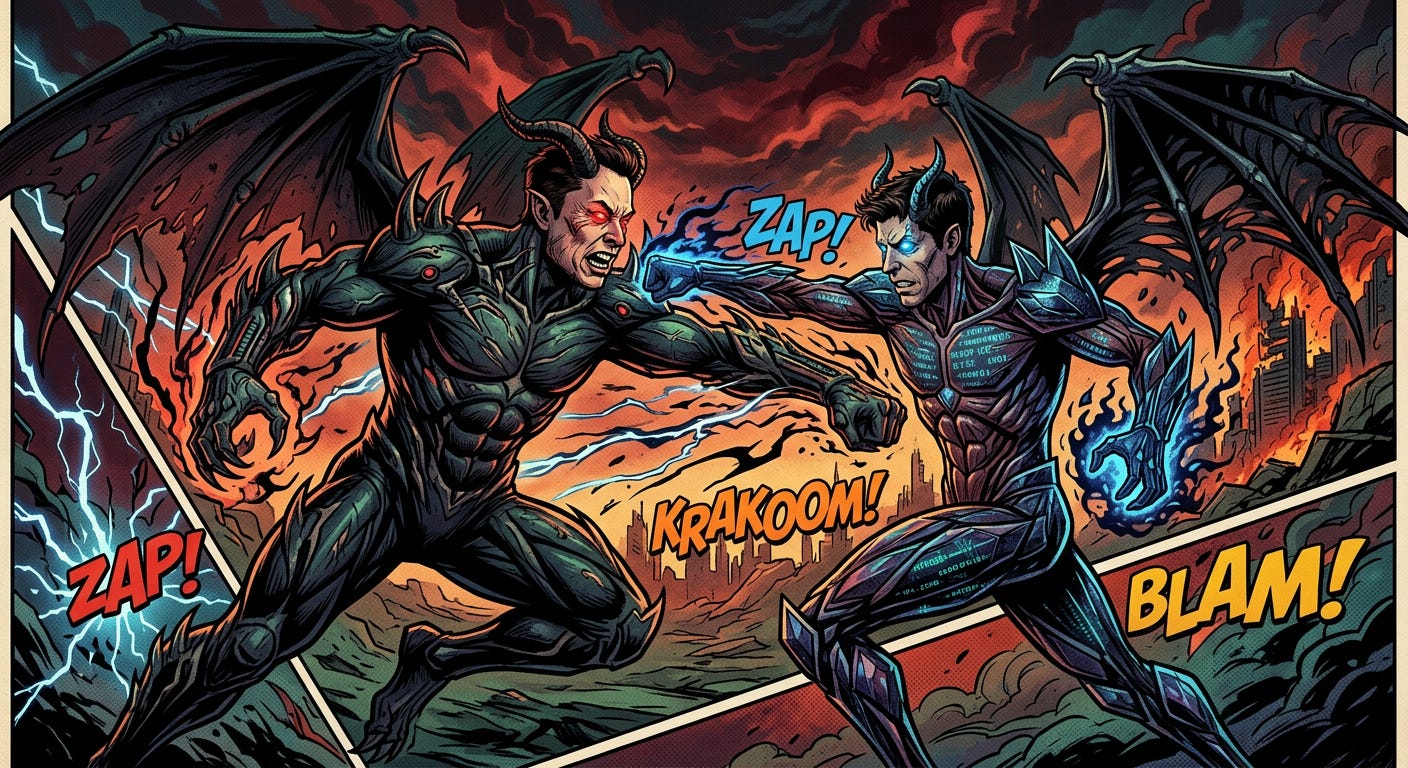
In theory, it’s about Musk's complaint that OpenAI has redirected itself from its original mission as a non-profit, but Musk long ago abandoned any legitimacy he might have claimed toward the public good, so we know something else is afoot.
One of the clues can be found in some of the injunctive relief Musk is seeking:18 Removal of Sam Altman as OpenAI’s CEO. This is probably for the public good, but the public good isn’t what Musk has in mind. Most likely, he is simply trying to destroy the company.
If he succeeds, OpenAI will have a lot of assets available for cheap. Musk will try to use his new trillion-dollar salary (via Tesla) to snatch some of it, since it has become apparent Musk can’t build a reliable AI system on his own.
What will ultimately come out of all this? The old, crusty software developer in me thinks the usual will happen: A few huge firms will collect the collapsing fragments of the AI economy, and continue to do what they do best: create a world of haves and have nots.
If you’re a writer using AI, you are almost assured of having not, and like the rest of the world, will be outside looking in.
Luckily, there’s a solution: Learn how to write.
Notes
The Taboola ad-style headline was done on purpose, mostly just for fun:

Be sure to check out the Footnotes 👇. There’s mucho sidebar information and detail there, especially about the Musk v OpenAI case.
Thanks for reading!

Footnotes
Allison. “Pausing New GitHub Copilot Pro Trials.” The GitHub Blog, April 10, 2026. https://github.blog/changelog/2026-04-10-pausing-new-github-copilot-pro-trials/.
Rodriguez, Mario. “GitHub Copilot Is Moving to Usage-Based Billing.” The GitHub Blog, April 27, 2026. https://github.blog/news-insights/company-news/github-copilot-is-moving-to-usage-based-billing/.
AWS Fun facts:
AWS holds about a 6% market share in all web hosting, but a much higher percentage among high-traffic platforms. It is is the market leader compared to competitors like Microsoft Azure (20%–25%) and Google Cloud Platform (10%–12%).
Contributors. “Subsidiary of Amazon That Provides On-Demand Cloud Computing Platforms on a Metered Pay-as-You-Go Basis.” Wikipedia.org. Wikimedia Foundation, Inc., April 4, 2005. https://en.wikipedia.org/wiki/Amazon_Web_Services.
AWS dominates the Infrastructure-as-a-Service (IaaS) sector with approximately 47.8% market share in the IaaS sector. The top ten AWS spenders:
Netflix: $19 million
Twitch (owned by Amazon): $15 million
LinkedIn: $13 million
Facebook: $11 million
Turner Broadcasting: $10 million
BBC: $9 million
Baidu: $9 million
ESPN: $8 million
Adobe: $8 million
Twitter: $7 million
Contino | Global Transformation Consultancy . “Breadcrumbs,” January 28, 2020. https://www.contino.io/insights/whos-using-aws.
Mills, Madison. “AI Can Cost More than Human Workers Now.” Axios, April 26, 2026. https://www.axios.com/2026/04/26/ai-cost-human-workers.
Mohamed, Theron. “‘Big Short’ Michael Burry: Tech Stocks Even Pricier than They Seem.” Business Insider, April 11, 2026. https://www.businessinsider.com/big-short-michael-burry-tech-ai-stocks-valuation-earnings-sbc-2026-4.
Roose, Kevin. “More! More! More! Tech Workers Max Out Their A.I. Use..” Nytimes.com. The New York Times, March 20, 2026. Ruminato Gift Link 🎁 https://www.nytimes.com/2026/03/20/technology/tokenmaxxing-ai-agents.html 🎁
Lichtenberg, Nick. “Moody’s Flags $662 Billion Risk at the Heart of the Data Center Build-Out by Just 5 Companies.” Yahoo Finance, February 25, 2026. https://finance.yahoo.com/news/moody-flags-662-billion-risk-081000616.html
Hughes, Tracy. “If I Had $1,000,000,000,000 — My Trillion Dollar Thought Experiment - InvestorNews.” InvestorNews, November 9, 2025. https://investornews.com/market-opinion/if-i-had-1000000000000-my-trillion-dollar-thought-experiment/.
Ruminato Gift Link 🎁 https://wlockett.medium.com/ai-debt-is-spiralling-out-of-control-bf0957767422. 🎁
Quotiing the National Constitution Center:
On March 2, 2026, the Court, without comment denied an appeal in Thaler v. Perlmutter. Nearly a year earlier, the U.S. Court of Appeals for the District of Columbia determined the Copyright Office correctly denied Dr. Stephen Thaler’s copyright claim for an AI-created picture titled “A Recent Entrance to Paradise.”
Thaler, a computer scientist, created a generative artificial intelligence named the “Creativity Machine,” which then created the picture on its own. On a copyright registration application, Thaler listed the Creativity Machine as the work’s sole author, and himself as the work’s owner.
In his appeal to the Supreme Court, Thaler wanted the justices to consider whether “works outputted by an AI system without a direct, traditional authorial contribution by a natural person could be copyrighted.”
It feels safe to assume that future cases regarding the written word will hit the same roadblock.
National Constitution Center – constitutioncenter.org. “Supreme Court Denies Artificial Intelligence Authorship Claim for Artwork Copyright | Constitution Center,” 2026. https://constitutioncenter.org/blog/supreme-court-denies-artificial-intelligence-authorship-claim-for-artwork-copyright.
This map contains 67 of them, but hasn’t been updated since December 2025
Chat GPT Is Eating the World. “Updated U.S. Map of Copyright Suits v. AI (Dec. 5, 2025) = 65 Suits,” December 5, 2025. https://chatgptiseatingtheworld.com/2025/12/05/updated-u-s-map-of-copyright-suits-v-ai-dec-5-2025-64-suits/.
Anthropiccopyrightsettlement.com. “Frequently Asked Questions,” 2026. https://www.anthropiccopyrightsettlement.com/faq.
NPR. “Scott Turow’s Latest Real-Life Legal Thriller: Suing Meta for Copyright Infringement,” May 5, 2026. https://www.npr.org/2026/05/05/nx-s1-5812623/scott-turow-meta-lawsuit.
NPR, ibid
Contributors. “Deaths Involving Use of Large Language Models.” Wikipedia.org. Wikimedia Foundation, Inc., September 14, 2025. https://en.wikipedia.org/wiki/Deaths_linked_to_chatbots.
Bonifield, Stevie. “A Rogue AI Led to a Serious Security Incident at Meta.” The Verge, March 19, 2026. https://www.theverge.com/ai-artificial-intelligence/897528/meta-rogue-ai-agent-security-incident.
Rafe Rosner-Uddin. “Amazon Service Was Taken down by AI Coding Bot.” @FinancialTimes. Financial Times, February 20, 2026. https://www.ft.com/content/00c282de-ed14-4acd-a948-bc8d6bdb339d.
(paywall)
Additional injunctive relief in the Musk OpenAI lawsuit:
Musk was a co-founder of OpenAI, which began life as a non-profit until Altman turned it into a for-profit corporation. Yesterday, Microsoft CEO Satya Nadella testified that Musk didn’t try to stop OpenAI from trying to turn a profit even though, “he had my phone number.” These guys. Anyway, here’s a list of things America’s biggest Apartheid cheerleader is looking for in his lawsuit:
Removal of CEO Sam Altman and President Greg Brockman
Wbur.org. “What Does Elon Musk Want out Legal Battle with OpenAI?,” May 11, 2026. https://www.wbur.org/hereandnow/2026/05/11/open-ai-elon-musk-lawsuit.
At least $134 billion in damages from OpenAI Microsoft (an OpenAI investor and key collaborator)
For allegedly defrauding him by shifting OpenAI’s corporate structure from a non-profit to a for-profit.
Yildirim, Ece. “Musk Asks Court to Give Potential Winnings in OpenAI Suit to OpenAI’s Nonprofit.” Gizmodo, April 7, 2026. https://gizmodo.com/musk-changes-openai-lawsuit-so-that-if-he-wins-the-134-billion-openais-nonprofit-gets-it-2000743663.
Restoration of OpenAI Nonprofit Status and disbursement of all profits to OpenAI’s non-profit entity
Ece Yildirim of Gizmodo writes:
But, according to the findings of a New Yorker investigation published on Monday, Musk was involved in discussions about reconstituting OpenAI as a for-profit company as early as September 2017, and he had demanded majority control of any for-profit structure.
Yildirim, Ece. “Musk Asks Court to Give Potential Winnings in OpenAI Suit to OpenAI’s Nonprofit.” Gizmodo, April 7, 2026. https://gizmodo.com/musk-changes-openai-lawsuit-so-that-if-he-wins-the-134-billion-openais-nonprofit-gets-it-2000743663.
Rob Nicholls, Senior Research Associate in Media and Communications, University of Sydney, tells us via The Conversation that…
Musk himself proposed merging OpenAI with Tesla in 2017 and walked away when denied majority control.
Nicholls, Rob. “Elon Musk vs Sam Altman: How the Legal Battle of the Tech Billionaires Could Shape the Future of AI.” The Conversation, April 29, 2026. https://theconversation.com/elon-musk-vs-sam-altman-how-the-legal-battle-of-the-tech-billionaires-could-shape-the-future-of-ai-281732
End all restrictions on OpenAI investors seeking money for other AI projects
This, despite the fact that Musk’s primary AI company, xAI, has managed to yank $11 billion out of the hands of gullible, apartheid-loving VC firms such as Andreessen Horowitz (a Substack investor).
Wiggers, Kyle. “Elon Musk Files for Injunction to Halt OpenAI’s Transition to a For-Profit | TechCrunch.” TechCrunch, November 30, 2024. https://techcrunch.com/2024/11/30/elon-musk-files-for-injunction-to-halt-openais-transition-to-a-for-profit/.
End sharing of proprietary information
Wiggers, Kyle. “Elon Musk Files for Injunction to Halt OpenAI’s Transition to a For-Profit | TechCrunch.” TechCrunch, November 30, 2024. https://techcrunch.com/2024/11/30/elon-musk-files-for-injunction-to-halt-openais-transition-to-a-for-profit/.
Two villains, and enough money to feed the world several times over
Lest you think Musk is a villain in this case, trying to upend a white night in shining armor, the Guardian reports that, well, Altman appears to be a scummy individual in his own right:
Altman’s former allies call him untrustworthy
In court last week, jurors heard video testimony from Mira Murati, OpenAI’s former chief technical officer, once a very close associate of Altman, in which she accused him of “creating chaos” at the company. Murati, who left OpenAI in 2024, testified that Altman had a pattern of “saying one thing to one person and completely the opposite to another person”.
Robins-Early, Nick. “‘A Consistent Pattern of Lying’: Musk v OpenAI Trial Exposes What Insiders Think of Sam Altman.” the Guardian. The Guardian, May 11, 2026. https://www.theguardian.com/us-news/2026/may/11/musk-v-openai-altman-trial.
Yeesh. These guys. Bring back the robber barons.
When it comes to people using AI for writing, I believe AI is dumbing down and dulling the senses of people who use it for that purpose. It makes people lazy.
AI cannot write about my personal feelings about a situation or my memories and moments.
I have used AI for proofreading...and even then I don’t use it all of the time. (Just ask Cliff about my typos and grammatical errors, lol.)
I have used AI for alt text to save time with weather posts, but the wording gets silly at times.
AI is priceless if you want to whip up a picture of a gorilla smoking a cigar while wearing a top hat and playing poker. 😂
To be honest, I’m 86, and I have no idea how AI works, and have no reason to use it. This article was Greek to me. I’m sure others find it illuminating, but there are still things on my phone that I need my daughter’s help with.